
Key Highlights:
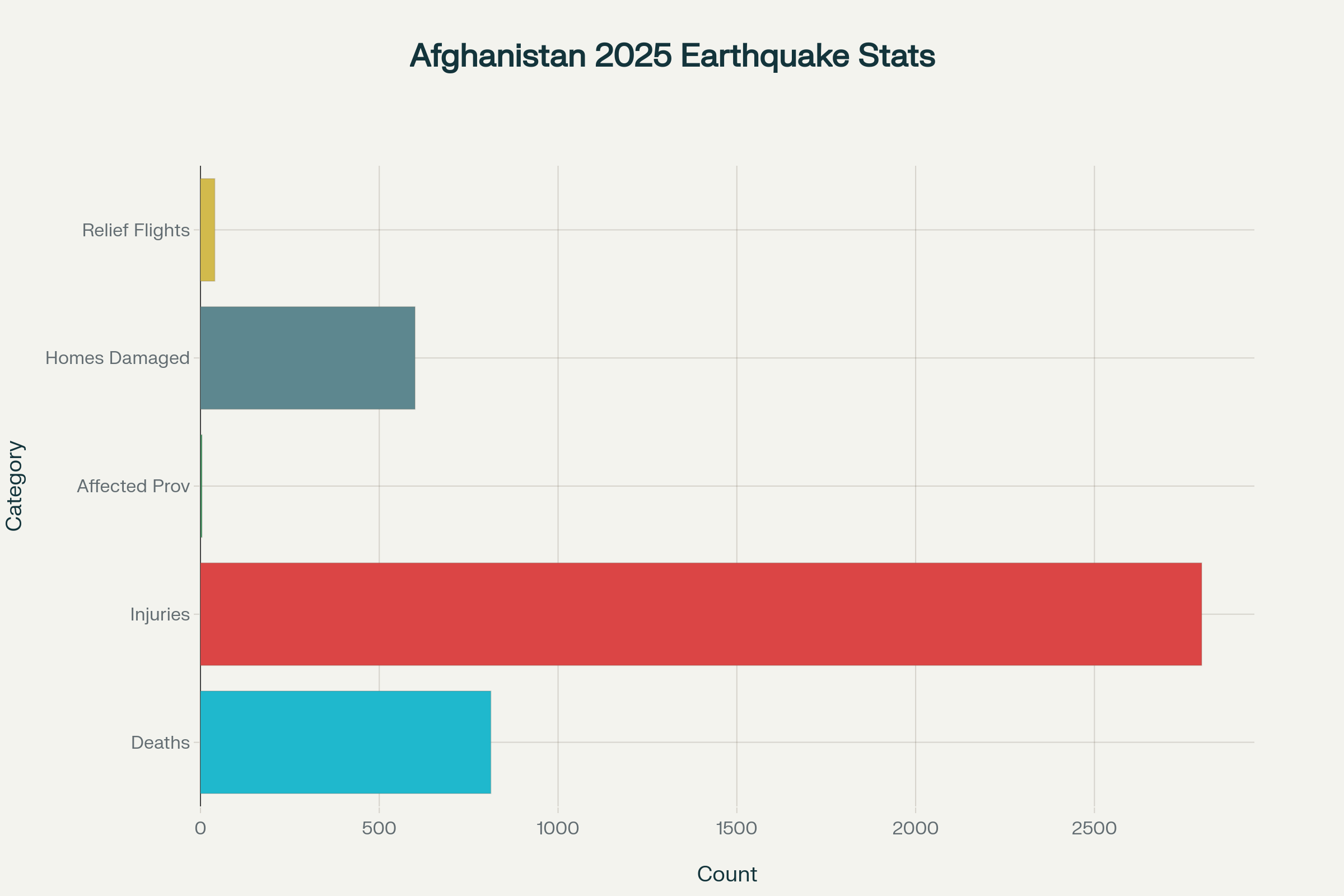
- Over 800 people confirmed dead and 2,800+ injured in one of Afghanistan’s deadliest seismic events
- Remote villages in Kunar Province wiped out by the 6.0 magnitude quake near Pakistan border
- Taliban authorities appeal for international aid as rescue teams struggle to reach isolated areas
Opening Overview
A catastrophic Afghanistan earthquake has claimed over 800 lives and left thousands injured in what authorities describe as one of the nation’s worst seismic disasters in recent years. The 6.0 magnitude tremor struck just before midnight on August 31, 2025, devastating remote mountainous areas in eastern Afghanistan near the Pakistan border. The Afghanistan earthquake epicenter was located approximately 27 kilometers northeast of Jalalabad city, with the tremor felt as far as Kabul and Pakistan’s capital, Islamabad.
Rescue operations face mounting challenges as teams struggle to reach isolated villages where entire communities have been obliterated by the Afghanistan earthquake. The disaster has prompted urgent appeals for international assistance from Taliban authorities, who warn that the death toll could rise significantly as more remote areas become accessible.
This Afghanistan earthquake adds to the nation’s existing humanitarian crises, striking a population already grappling with economic hardship, reduced international aid, and the recent deportation of hundreds of thousands of Afghan refugees from neighboring countries.
Unprecedented Destruction in Remote Eastern Provinces
- The Afghanistan earthquake destroyed at least four complete villages in Kunar Province
- Mountainous terrain and damaged infrastructure severely hampered rescue access
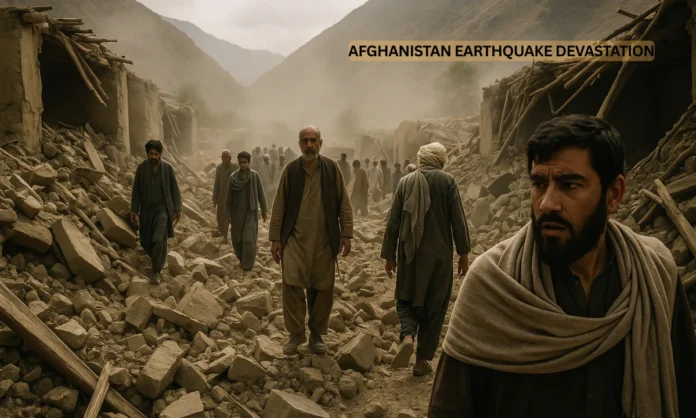
The Afghanistan earthquake devastated the remote eastern provinces of Kunar and Nangarhar, where traditional mud-brick homes offered little protection against the powerful tremor. According to Taliban government spokesperson Zabihullah Mujahid, at least 800 people were killed and over 2,500 injured in Kunar Province alone, while an additional 12 deaths and 255 injuries occurred in neighboring Nangarhar Province.
The seismic event completely destroyed villages including Sholt, Arit, Mamagal, and Wadir in Kunar’s Nurgal district, with survivors describing scenes of total devastation. “The entire village has been destroyed,” one resident of Mazar Dara told reporters. “Children and elders are trapped under the rubble. We need urgent help”.
The Afghanistan earthquake struck at a shallow depth of eight kilometers, amplifying its destructive impact across the region. The United States Geological Survey recorded multiple aftershocks, including two measuring magnitude 5.2, further complicating rescue efforts and heightening fears among survivors. Landslides triggered by the Afghanistan earthquake and subsequent heavy rainfall blocked crucial access roads, preventing rescue teams from reaching some of the most severely affected areas for hours after the initial tremor.
Official Statistics on the 2025 Afghanistan Earthquake Impact and Response
Massive Humanitarian Response Mobilizes Across Region
- Taliban defense ministry conducted 40 emergency flights evacuating 420 casualties
- UN agencies deployed medical teams and emergency supplies to affected areas
The Afghanistan earthquake triggered an immediate large-scale humanitarian response, with Taliban authorities mobilizing military assets and international organizations coordinating emergency aid. The Ministry of Defense reported conducting 40 flights to evacuate 420 wounded and deceased individuals from the disaster zone, while dispatching 30 medical professionals and 800 kilograms of medical supplies to overwhelmed local hospitals.
United Nations Secretary-General António Guterres pledged to “spare no effort” in assisting those affected by the Afghanistan earthquake, with multiple UN agencies already deploying teams to the region. The World Health Organization announced that medical teams were operating in hospitals and health facilities, delivering essential medicines and assessing urgent health needs in the earthquake-affected areas.
The UN Office for the Coordination of Humanitarian Affairs began coordinating with international partners immediately after the Afghanistan earthquake, with UNICEF reporting significant casualties among children. “When an earthquake of this magnitude happens, the homes basically tumble on top of each other,” explained Salam Al-Jabani from UNICEF. “And because it was so late at night, families were at home sleeping and that’s why we see such big losses”.
UNHCR spokesperson Babar Baloch emphasized that the scale of the Afghanistan earthquake disaster “far exceeds the current capacity of local authorities and communities,” appealing to the global donor community for urgent relief support.
Challenges Compound Afghanistan’s Existing Crises
- The disaster strains resources of a nation already facing reduced international aid
- Recent deportations of Afghan refugees from neighboring countries intensified vulnerability
The Afghanistan earthquake has struck a nation already struggling with multiple interconnected crises that severely limit its capacity to respond effectively to natural disasters. Since the Taliban’s return to power in 2021, Afghanistan has experienced dramatic reductions in international aid, leaving government resources stretched thin even before this seismic catastrophe.
The timing of the Afghanistan earthquake proves particularly challenging, as hundreds of thousands of Afghan refugees and migrants have recently been deported or forced to return from neighboring Iran and Pakistan. Many of these returnees had settled in the earthquake-affected border regions, constructing new homes with limited resources and minimal disaster-resistant construction techniques.
Health Ministry spokesperson Abdul Mateen Qanee acknowledged the overwhelming nature of the crisis, stating that “all our teams have been mobilized to accelerate assistance, so that comprehensive and full support can be provided” across areas ranging from security to food distribution and healthcare services. The Afghanistan earthquake compounds existing challenges including widespread poverty, food insecurity, and limited healthcare infrastructure that was already struggling to meet basic population needs.
Afghanistan’s location along the Hindu Kush mountain range, near the junction of Eurasian and Indian tectonic plates, makes the country particularly vulnerable to seismic activity. Previous deadly earthquakes include a 6.3-magnitude tremor in Herat Province in October 2023 that killed over 1,500 people, and a 5.9-magnitude quake in Paktika Province in June 2022 that resulted in more than 1,000 fatalities.
International Community Rallies Support Amid Political Complexities
- Global humanitarian agencies coordinate aid despite diplomatic challenges with Taliban government
- Emergency response highlights ongoing tension between humanitarian needs and political recognition
The Afghanistan earthquake response has mobilized international humanitarian organizations despite the complex political dynamics surrounding Taliban governance. UN agencies, working through established humanitarian channels, have maintained their commitment to providing emergency assistance to earthquake victims while navigating diplomatic challenges.
The disaster underscores the delicate balance between addressing urgent humanitarian needs and the international community’s approach to Taliban authorities. While most countries have not formally recognized the Taliban government, the Afghanistan earthquake has prompted immediate offers of assistance from various nations and international organizations, demonstrating that humanitarian concerns often transcend political considerations.
The World Health Organization, working alongside other UN agencies, has emphasized that their response to the Afghanistan earthquake focuses entirely on saving lives and alleviating suffering, regardless of political circumstances. “We are actively delivering essential medicines and supplies and deploying health teams to affected areas to help save lives,” the organization stated.
UNHCR has specifically highlighted how the Afghanistan earthquake adds “death and destruction” to the nation’s existing challenges, including drought conditions and the massive displacement of Afghan nationals returning from neighboring countries. The agency stressed that immediate international support is crucial “before it’s too late for many others” who remain trapped or injured in remote areas affected by the seismic event.
The Taliban’s direct appeal for international assistance in responding to the Afghanistan earthquake represents a significant diplomatic moment, with authorities explicitly requesting global support to address the scale of devastation that exceeds local response capabilities.
Final Perspective
The devastating Afghanistan earthquake of August 31, 2025, has exposed the fragility of life in one of the world’s most vulnerable regions, where natural disasters intersect with ongoing humanitarian crises to create catastrophic human suffering. With over 800 confirmed deaths and thousands injured, this seismic event ranks among Afghanistan’s deadliest earthquakes in recent history. The disaster’s impact extends far beyond immediate casualties, threatening to overwhelm a nation already struggling with economic collapse, reduced international aid, and massive population displacement.
As rescue teams continue searching through rubble in remote villages, the full scope of the Afghanistan earthquake’s devastation may not be known for days or weeks. The international community’s response will serve as a crucial test of humanitarian principles, demonstrating whether emergency aid can transcend political complexities when lives hang in the balance. For Afghanistan’s long-suffering population, this earthquake represents yet another profound challenge in their ongoing struggle for survival and stability in an increasingly uncertain world.