
Key Highlights
- RJD leader announces one-time Rs 30,000 transfer to women under ‘Mai Bahin Maan Yojana’ on January 14, 2025
- Direct counter to NDA’s Mukhyamantri Mahila Rojgar Yojana which has distributed Rs 10,000 to over 1.1 crore women
- Bihar Assembly elections scheduled for November 6 and 11, 2025, with results on November 14 across 243 constituencies
Electoral Strategy Intensifies as Tejashwi Yadav Rs 30000 Promise Targets Women Voters
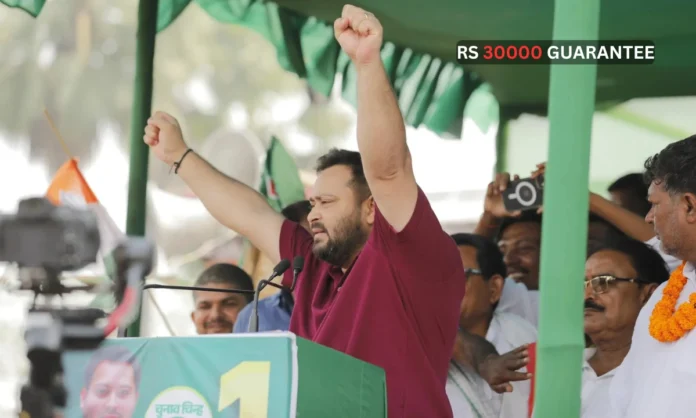
The Bihar Assembly elections have witnessed a dramatic escalation in women-centric welfare promises, with Tejashwi Yadav Rs 30000 promise emerging as the opposition’s boldest counter to the ruling NDA’s ongoing Mukhyamantri Mahila Rojgar Yojana. The RJD leader’s announcement on November 4, 2025, just two days before the first phase of polling, represents a strategic move to capture the women’s vote bank in a state where female labor force participation remains critically low despite recent improvements from 24.8% to 33.5% in rural areas.
आदरणीया माताओं बहनों के लिए शुभ मकर संक्रांति को लेकर @yadavtejashwi जी का शुभ प्रण!
— Rashtriya Janata Dal (@RJDforIndia) November 4, 2025
सभी माताओं बहनों को मकर संक्रांति पर उनके बैंक खातों में मिलेंगे एकमुश्त ₹30,000 रुपए!#माई_बहिन_मान_योजना के अंतर्गत साल भर की राशि एक साथ!#RJD #तेजस्वी_सरकार #तेजस्वी_प्रण #TejashwiYadav pic.twitter.com/u67EKj53Nu
Speaking at a press conference in Patna, Tejashwi Yadav, the Mahagathbandhan’s chief ministerial candidate, declared that his government would transfer the entire annual amount through Tejashwi Yadav Rs 30000 promise on Makar Sankranti (January 14) under the ‘Mai Bahin Maan Yojana’ if voted to power. This promise directly challenges the NDA’s systematic approach of distributing Rs 10,000 to women entrepreneurs, which has already reached over 1.1 crore beneficiaries across Bihar with Rs 12,100 crore disbursed through three phases. The timing of Tejashwi Yadav Rs 30000 promise coincides with the final phase of campaigning, reflecting the critical importance of women voters in determining electoral outcomes across Bihar’s 243 assembly constituencies.
NDA’s Mukhyamantri Mahila Rojgar Yojana Sets Implementation Benchmark Against Tejashwi Yadav Rs 30000 Promise
- Bihar’s scheme has transferred Rs 12,100 crore to 1.21 crore women across three phases
- Over 1.1 crore women selected as beneficiaries with systematic implementation through Self Help Groups
- Additional financial support of up to Rs 2 lakh available for successful enterprise developments3.amazonaws
The Nitish Kumar government’s Mukhyamantri Mahila Rojgar Yojana represents one of India’s largest women-focused Direct Benefit Transfer initiatives, directly competing with Tejashwi Yadav Rs 30000 promise through proven implementation rather than electoral promises. Prime Minister Narendra Modi launched the scheme on September 26, 2025, with the first phase transferring Rs 7,500 crore to 75 lakh women, followed by subsequent phases reaching 25 lakh and 21 lakh additional beneficiaries respectively. The scheme’s design focuses on sustainable economic empowerment, offering additional financial support of up to Rs 2 lakh for successful business ventures in sectors including agriculture, animal husbandry, handicrafts, and tailoring.
Bihar’s implementation of the Mukhyamantri Mahila Rojgar Yojana has reached unprecedented scale, contrasting sharply with Tejashwi Yadav Rs 30000 promise which remains an electoral commitment without implementation mechanisms. The scheme operates through community-driven mechanisms, utilizing Self Help Groups for training and developing Gramin Haat-Bazaars for market support. This comprehensive approach addresses Bihar’s challenge where women’s labor force participation increased from 24.8% to 33.5% in rural areas and 13.8% to 16% in urban areas between 2022-23 and 2023-24, though still significantly below national averages. The NDA’s systematic implementation provides tangible benefits to 1.1 crore women, establishing a concrete alternative to Tejashwi Yadav Rs 30000 promise across Bihar’s diverse electoral landscape.

Bihar Women’s Labor Force Participation Rate Progress 2022-24 vs National Averages
Opposition’s Strategic Positioning Through Tejashwi Yadav Rs 30000 Promise Against Established Welfare Framework
- Mahagathbandhan manifesto originally promised Rs 2,500 monthly, totaling Rs 30,000 annually for five years
- Modified to one-time transfer based on claimed feedback from Bihar’s women voters
- Additional promises include Rs 300 per quintal bonus for paddy and Rs 400 for wheat over MSPs3.amazonaws
Tejashwi Yadav Rs 30000 promise represents a significant modification from the original Mahagathbandhan manifesto, which had committed to providing Rs 2,500 monthly payments starting December 1, totaling Rs 30,000 annually for five years. The RJD leader justified this change by claiming it responded to demands from “mothers and sisters” of Bihar who preferred the lump-sum transfer on the auspicious occasion of Makar Sankranti. This strategic timing aligns with Hindu cultural traditions while potentially providing immediate financial relief to women across the state’s 38 districts covering 243 assembly constituencies.
The comprehensive welfare package extends beyond Tejashwi Yadav Rs 30000 promise, with additional announcements including farmer support measures of Rs 300 per quintal bonus for paddy and Rs 400 for wheat over the Minimum Support Price. Additional commitments include implementing the Old Pension Scheme for government employees and ensuring transfers within a 70-kilometer radius of home districts. These announcements reflect the Mahagathbandhan’s attempt to counter the NDA’s governance record while appealing to multiple voter segments across Bihar’s diverse demographic landscape. Tejashwi Yadav Rs 30000 promise positions the opposition as offering more substantial immediate financial support compared to the NDA’s gradual, business-oriented approach through the systematically implemented Mukhyamantri Mahila Rojgar Yojana.

Comparison between Tejashwi Yadav Rs 30000 promise and NDA’s Mukhyamantri Mahila Rojgar Yojana for Bihar women empowerment
Electoral Timeline and Implementation Challenges for Tejashwi Yadav Rs 30000 Promise
- First phase voting on November 6 covers 121 constituencies with 1,314 candidates across 18 districts
- Second phase on November 11 includes remaining 122 constituencies across 20 districts
- Total electorate of 7.43 crore includes 3.5 crore women voters who will evaluate both welfare approaches
The Bihar Assembly elections schedule, with voting on November 6 and 11 followed by results on November 14, creates a compressed timeline for both alliances to demonstrate their commitment to women’s welfare through either implemented programs or promises like Tejashwi Yadav Rs 30000 promise. The Election Commission of India has organized polling across 243 constituencies, including 38 reserved for Scheduled Castes and 2 for Scheduled Tribes, with 2,616 total candidates competing across both phases. This electoral structure provides multiple battlegrounds where Tejashwi Yadav Rs 30000 promise will compete against the NDA’s implemented Mukhyamantri Mahila Rojgar Yojana across diverse constituencies ranging from rural agricultural areas to urban centers.
The strategic timing of Tejashwi Yadav Rs 30000 promise reflects the critical importance of women voters in Bihar’s electoral mathematics, particularly given the state’s total electorate of 7.43 crore voters with women comprising approximately 47% of the voting population. Bihar’s historical patterns show the 2020 NDA alliance secured 125 seats against the opposition’s 110 seats, indicating that women’s economic concerns may determine electoral outcomes in closely contested constituencies.
Prashant Kishor’s Jan Suraaj Party adds another dimension to the contest, potentially influencing outcomes in constituencies where traditional alliances face fragmented vote shares due to competing welfare promises. The immediate financial commitments from both sides indicate recognition that women’s economic empowerment strategies, whether through proven implementation or Tejashwi Yadav Rs 30000 promise, may determine electoral outcomes across Bihar’s politically significant landscape.
Closing Assessment: Implementation Reality Versus Electoral Promise in Bihar’s Women Welfare Competition
The electoral battle between Tejashwi Yadav Rs 30000 promise and the NDA’s Mukhyamantri Mahila Rojgar Yojana represents fundamentally different approaches to women’s economic empowerment in Bihar. While the ruling alliance emphasizes sustainable entrepreneurship through graduated support, training mechanisms, and proven implementation reaching 1.1 crore women, Tejashwi Yadav Rs 30000 promise offers immediate substantial financial assistance without demonstrated delivery mechanisms or business development components. This contrast reflects broader ideological differences about welfare delivery and economic development strategies across India’s politically significant states.
Bihar’s women voters face a choice between the NDA’s implemented welfare framework that has already disbursed Rs 12,100 crore through systematic phases and Tejashwi Yadav Rs 30000 promise which remains an electoral commitment without implementation details. The ultimate effectiveness of either approach will depend on voter preferences for proven welfare delivery versus higher promised amounts, particularly given Bihar’s improving but still low women’s labor force participation rates. The November 14 results will provide crucial insights into whether voters prefer systematic entrepreneurship support with demonstrated results or Tejashwi Yadav Rs 30000 promise representing higher immediate financial assistance, potentially influencing policy frameworks in other states facing similar electoral dynamics around women’s economic empowerment strategies.
| Welfare Scheme Comparison | Tejashwi Yadav Rs 30000 Promise | NDA Mukhyamantri Mahila Rojgar Yojana |
|---|---|---|
| Initial Amount | Rs 30,000 (one-time) | Rs 10,000 (implemented) |
| Additional Support | None specified | Up to Rs 2 lakh for enterprises |
| Current Beneficiaries | 0 (electoral promise) | 1.1 crore women |
| Implementation Status | Promised for January 14, 2025 | Three phases completed |
| Total Disbursement | Estimated Rs 35,000+ crore | Rs 12,100 crore already transferred |