
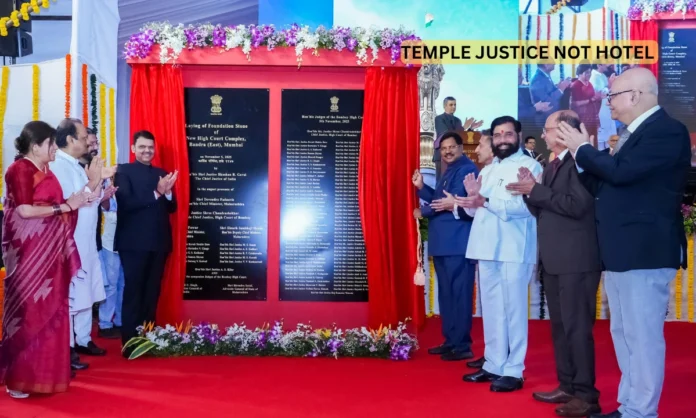
Key Highlights:
- Chief Justice of India BR Gavai emphasized that the new Bombay High Court building in Bandra should embody justice without extravagance, stating “it is a temple of justice and not a seven-star hotel”
- The ambitious project cost has escalated to Rs 4,217 crore from the initial Rs 3,750 crore sanction, with a five-year completion timeline on 30 acres of land
- The complex will feature 75 advanced courtrooms, 50 lakh square feet of construction space, and parking for 3,750 vehicles, designed by architect Hafeez Contractor
Opening Overview
Chief Justice of India BR Gavai delivered a powerful statement on judicial priorities during the foundation stone laying ceremony of the new Bombay High Court building at Bandra East on Tuesday, emphasizing that courts must serve citizens rather than showcase luxury. Speaking at the landmark event attended by Maharashtra Chief Minister Devendra Fadnavis and Deputy Chief Ministers Eknath Shinde and Ajit Pawar, the Chief Justice of India BR Gavai asserted that while the new Bombay High Court building should maintain grandeur, it must avoid extravagance.
चीफ जस्टिस ऑफ़ इंडिया जस्टिस श्री भूषण गवाई ने महाराष्ट्र सरकार और मुख्यमंत्री @Dev_Fadnavis की तारीफ की
— Abhishek Pandey – अभिषेक पाण्डेय (@abhishekpandey2) November 5, 2025
चीफ जस्टिस ने कहा कि पुरे भारत भर में वो घूमे लेकिन जितना ज्यादा न्याय व्यवस्था के लिए इंफ्रास्ट्रक्चर महाराष्ट्र सरकार ने किया वैसा किसी ने नहीं किया,
रिकॉर्ड समय में बाबा… pic.twitter.com/X4jlzM1MN2
The Chief Justice of India BR Gavai’s remarks came amid media reports suggesting opulent design features, including lifts shared by only two judges, prompting him to remind stakeholders that “judges are no more feudal lords”. The Chief Justice of India BR Gavai urged renowned architect Hafeez Contractor to ensure the structure remains iconic without being lavish, declaring that the new Bombay High Court building is “ultimately a temple of justice and not a seven-star hotel”.
CJI’s Vision for Democratic Court Architecture
Key Points:
- The Chief Justice emphasized that judiciary exists to serve citizens, not to display power or luxury
- Design modifications requested to ensure adequate space for public prosecutors and litigants
- Historical precedent cited from 160-year-old heritage building constructed under budget
The Chief Justice of India BR Gavai’s address reflected a fundamental shift in judicial infrastructure philosophy, moving away from imperial grandeur toward democratic accessibility. Referring to media coverage about the new Bombay High Court building design, the Chief Justice of India BR Gavai stated, “I read that one lift will be shared by only two judges. I would like to say that judges are no more feudal lords”. The Chief Justice of India BR Gavai emphasized that whether judges serve in trial courts, High Courts, or the Supreme Court, they exist solely to serve citizens.
Chief Minister Devendra Fadnavis echoed this sentiment, revealing that the 160-year-old heritage building currently housing the new Bombay High Court building was constructed for Rs 16,44,528, which was Rs 2,668 less than the sanctioned amount. The Chief Justice of India BR Gavai cited examples of new high court buildings at Lucknow and Aurangabad, where several chambers and courtrooms remain unused, urging planners to focus on litigant needs rather than judicial convenience.
The Chief Justice of India BR Gavai also revealed his initial reluctance to attend the foundation laying ceremony, but was persuaded by arguments that the event should occur during his tenure, noting uncertainty about when another person from the new Bombay High Court building would again hold the CJI post.
Project Specifications and Cost Escalation
Key Points:
- Project cost increased from Rs 3,750 crore to Rs 4,217 crore during planning stage
- Construction timeline set at five years with land transfer in phases
- Complex will span 30 acres with 50 lakh square feet of built-up area
The new Bombay High Court building project represents one of India’s most ambitious judicial infrastructure initiatives, with costs escalating significantly even before construction commenced. Deputy Chief Minister Eknath Shinde noted that the construction cost for the new Bombay High Court building has already escalated at the planning stage, while Deputy Chief Minister and Finance Minister Ajit Pawar assured full budgetary support for the landmark project.
The Maharashtra government initially sanctioned Rs 3,750 crore in September, but the Public Works Department’s tender notice issued on October 31 revealed the revised estimate of Rs 4,217 crore for the new Bombay High Court building. Deputy CM Pawar confirmed that 15 acres of the total 30-acre land allotted for the new Bombay High Court building has already been handed over, with the remaining 15 acres to be transferred by March 2026.
The new Bombay High Court building will include parking facilities for 3,750 cars and space for 1,000 two-wheelers, addressing the severe congestion at the current Fort location. The project stipulates a 60-month completion timeline for engineering, procurement, and construction of the new Bombay High Court building complex.
| Project Component | Specification | Source |
|---|---|---|
| Total Land Area | 30.16 acres | |
| Built-up Area | 50 lakh square feet | |
| Number of Courtrooms | 75 advanced courtrooms | |
| Car Parking Capacity | 3,750 vehicles | |
| Two-wheeler Parking | 1,000 vehicles | |
| Project Cost (Initial) | Rs 3,750 crore | |
| Project Cost (Revised) | Rs 4,217 crore | |
| Completion Timeline | 5 years (60 months) | |
Architectural Design and Modern Facilities
Key Points:
- Semi-circular facade spanning 450 meters with 70-meter central dome
- 50-meter high Ashoka Pillar as sculptural centerpiece
- Advanced digital infrastructure including WiFi, scanning centers, and fire safety protocols
The new Bombay High Court building design by architect Hafeez Contractor draws inspiration from classical architecture while incorporating state-of-the-art judicial facilities. The complex features a semi-circular facade spread over a length of 450 meters, positioned between Kalanagar and Kherwadi flyovers on the Western Express Highway. At the heart of the new Bombay High Court building will be a vast central atrium filled with natural light, featuring a grand circular staircase rising through the space beneath a 70-meter high central dome.
The main building will rise four storeys with a 50-meter high Ashoka Pillar serving as a sculptural centerpiece, constructed in white cement concrete. Each of the 75 courtrooms in the new Bombay High Court building will have four-and-a-half meter-wide corridors and dedicated waiting areas to avoid the congestion plaguing the existing Fort premises. The new Bombay High Court building will also house judges’ chambers, residences, a mediation and arbitration center, public auditorium, conference hall, libraries for judges and lawyers, and dedicated chambers for law officers.
Chief Minister Fadnavis specifically requested that adequate space be allotted for public prosecutors in the new Bombay High Court building, noting that many currently face a lack of workspace. Modern facilities in the new Bombay High Court building will include WiFi connectivity, scanning and digitization centers, and advanced fire safety protocols.
Context: India’s Judicial Infrastructure Investment
Key Points:
- Central government released Rs 11,758 crore for judicial infrastructure since 1993-94
- Bombay High Court has sanctioned strength of 94 judges, currently functioning with 82
- National scheme constructed 21,977 court halls and 19,697 residential units
The new Bombay High Court building project exists within the broader context of India’s substantial investment in judicial infrastructure development across the country. According to official data from the Ministry of Law and Justice, the Central government has released Rs 11,758 crore under the Centrally Sponsored Scheme for Development of Judicial Infrastructure since its inception in 1993-94.
Under this national scheme, 21,977 court halls and 19,697 residential units have been constructed in district and subordinate courts, with another 3,165 court halls and 2,618 residential units currently under construction. The scheme operates on a fund-sharing pattern between the Centre and States at 60:40, with 90:10 for North-Eastern and Himalayan states, and 100% central funding for Union Territories. During the financial year 2024-25, the government allocated Rs 1,500 crore in the Budget Estimate, of which Rs 1,232.19 crore has already been released to various High Courts.
The Bombay High Court has a sanctioned strength of 94 judges, the second highest in the country, and currently operates with 82 judges, the highest in recent years. Maharashtra received Rs 95.16 crore for judicial infrastructure in 2024-25 under the centrally sponsored scheme, distinct from the state-funded new Bombay High Court building project. The rise in the number of judges and litigation has created urgent need for the modern complex to address space constraints at the 146-year-old heritage building in Fort.
| India’s Judicial Infrastructure (Central Scheme) | Data | Source |
|---|---|---|
| Total Released Since 1993-94 | Rs 11,758 crore | |
| Court Halls Constructed | 21,977 | |
| Residential Units Constructed | 19,697 | |
| Court Halls Under Construction | 3,165 | |
| Budget Allocation 2024-25 | Rs 1,500 crore | |
| Released to High Courts 2024-25 | Rs 1,232.19 crore | |
| Bombay HC Sanctioned Strength | 94 judges | |
| Bombay HC Current Strength | 82 judges | |
Closing Assessment
The Chief Justice of India BR Gavai’s emphatic stance on avoiding extravagance in the new Bombay High Court building reflects a critical reassessment of judicial infrastructure priorities in democratic India. His call to architect Hafeez Contractor to “revisit” the design and ensure the new Bombay High Court building serves litigants rather than displays luxury signals a philosophical shift in how the judiciary perceives its physical manifestation. The Chief Justice of India BR Gavai’s remarks about the new Bombay High Court building being “a temple of justice and not a seven-star hotel” resonate with broader concerns about public spending and judicial accountability.
While the Rs 4,217 crore price tag for the new Bombay High Court building represents significant public investment, the emphasis on functionality over opulence may address criticisms about judicial extravagance. As the Chief Justice of India BR Gavai retires on November 23, his foundation-laying of the new Bombay High Court building and his principled stand on democratic architecture will likely influence judicial infrastructure planning nationwide. The success of the new Bombay High Court building project will ultimately be measured not by its architectural grandeur but by its effectiveness in serving the citizens who seek justice within its walls.