
Key Highlights:
- HAL signed agreement with General Electric for 113 F404-GE-IN20 engines to power 97 Tejas Mark 1A aircraft between 2027 and 2032
- The engine deal valued at approximately $1 billion follows September 2025 contract for 97 jets worth Rs 62,370 crore
- HAL expanded production capacity to 24 aircraft annually with third production line inaugurated in October 2025
Opening Overview
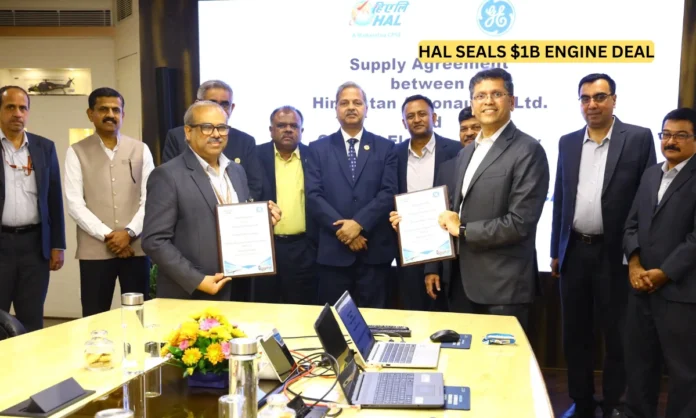
Hindustan Aeronautics Limited reinforced India’s indigenous fighter aircraft ambitions on November 7, 2025, by finalizing a landmark agreement with US-based General Electric Company for the supply of 113 F404-GE-IN20 engines. The HAL Tejas Mark 1A programme received a critical boost through this approximately $1 billion deal, which includes comprehensive support packages to ensure operational readiness throughout the delivery timeline extending from 2027 to 2032.
This engine procurement directly supports the execution of India’s second major HAL Tejas Mark 1A order placed in September 2025, when the Ministry of Defence sealed a Rs 62,370 crore contract with HAL to acquire 97 Light Combat Aircraft comprising 68 single-seater fighters and 29 twin-seater trainers. The agreement addresses longstanding supply chain challenges that delayed earlier HAL Tejas Mark 1A deliveries and positions the state-run aerospace manufacturer to accelerate production at its expanded facilities across Bengaluru and Nashik.
Hindustan Aeronautics Limited (HAL) has entered into an agreement with M/s. General Electric Company, USA, on 7th November 2025 for the supply of 113 Nos of F404-GE-IN20 engines and support package for execution of 97 LCA Mk1A programme. pic.twitter.com/zB4BVGP0LK
— HAL (@HALHQBLR) November 7, 2025
Strategic Significance for Indigenous Defence Manufacturing
Key Points:
- IAF currently operates 29 combat squadrons against sanctioned strength of 42 squadrons
- Defence production reached Rs 1.27 lakh crore in FY2023-24 under Aatmanirbhar Bharat initiative
The HAL Tejas Mark 1A engine procurement represents more than a routine equipment acquisition—it reflects India’s determination to bridge critical capability gaps within the Indian Air Force while advancing self-reliance in defence manufacturing. The Indian Air Force faces an acute squadron shortage, operating just 29 combat squadrons as of October 2025 when the last MiG-21 units were phased out, significantly below the authorized 42-squadron benchmark required for effective two-front deterrence. Defence analysts project that even with successful HAL Tejas Mark 1A inductions and other procurement programmes, the IAF can realistically achieve only 35-36 squadron strength by 2035 unless production timelines accelerate substantially.
Against this backdrop, the HAL Tejas Mark 1A programme serves as a cornerstone for fleet modernization, with both the initial 83-aircraft order and the follow-on 97-aircraft contract forming the backbone of India’s light fighter segment replacement strategy. The engine deal aligns with broader Aatmanirbhar Bharat objectives that drove India’s domestic defence production to Rs 1.27 lakh crore in FY2023-24, marking a 60% increase since 2019-20 and positioning the sector for the government’s ambitious target of Rs 3 lakh crore in defence manufacturing by 2029.
Technical Specifications and Production Timeline
Key Points:
- F404-GE-IN20 delivers maximum thrust of 85 kN (19,000 lbf) with afterburner capability
- Engine deliveries scheduled between 2027-2032 to match HAL’s expanded 24-aircraft annual production capacity
The F404-GE-IN20 engine selected for the HAL Tejas Mark 1A represents the highest thrust variant within General Electric’s F404 engine family, incorporating advanced hot section materials, Full Authority Digital Engine Control technology, and enhanced durability features. Technical specifications reveal the powerplant generates maximum thrust of 85 kilonewtons or 19,000 pounds-force when afterburner engages, significantly surpassing the 71.2 kN output of standard F404-GE-400 variants.
The engine measures 154 inches in length with a maximum diameter of 35 inches, processes airflow at 70 kilograms per second, achieves a pressure ratio of 28:1, and maintains operational weight of 1,072 kilograms. HAL and General Electric established collaboration on the HAL Tejas Mark 1A engine variant dating back to the 1980s when Aeronautical Development Agency initiated the Light Combat Aircraft programme, with formal engine selection occurring in 2004. The delivery schedule for the 113 engines spans five years from 2027 through 2032, carefully synchronized with HAL’s aircraft assembly timelines at expanded production facilities.
Defence Minister Rajnath Singh inaugurated HAL’s third HAL Tejas Mark 1A production line at the Nashik facility on October 17, 2025, which achieved full operationalization in just two years with capacity to manufacture eight aircraft annually. The new production line features more than 30 structure assembly jigs covering all major modules including centre fuselage, front fuselage, rear fuselage, wings, and air intake components, bringing HAL’s total production capacity to 24 HAL Tejas Mark 1A aircraft per year across three facilities.
Overcoming Supply Chain Disruptions
Key Points:
- GE restarted F404 production line after COVID-19 pandemic supply chain disruptions caused 18-month delays
- First F404-GE-IN20 engine delivered to HAL in March 2025 after vendor network reconstruction
The HAL Tejas Mark 1A programme confronted substantial challenges stemming from engine supply disruptions that threatened to derail delivery schedules and undermine India’s fighter modernization plans. General Electric had ceased F404 production when India placed orders, with no active customer base justifying continued manufacturing operations. Restarting the production line proved exceptionally complex as many original GE vendors had shifted to alternative supply chains during the COVID-19 pandemic, creating cascading delays that extended timelines by more than 18 months beyond initially projected dates.
HAL’s first 83-aircraft HAL Tejas Mark 1A order—valued at Rs 48,000 crore and cleared in 2021—anticipated initial deliveries beginning in February 2024, but engine availability constraints forced repeated postponements. The situation reached a critical juncture when HAL had constructed and tested 10 complete HAL Tejas Mark 1A airframes by September 2025 but lacked sufficient engines to commence handovers to the Indian Air Force. GE finally delivered the first F404-GE-IN20 engine to HAL on March 26, 2025, followed by the second unit in July 2025, establishing a stabilized production rhythm of two engines per month.
This supply restoration enabled HAL to deliver the first two HAL Tejas Mark 1A aircraft to the Indian Air Force on October 17, 2025, during a ceremony attended by Defence Minister Rajnath Singh at the Nashik facility. The November 2025 contract for 113 additional engines demonstrates that GE has successfully reconstructed its vendor network and can now support sustained HAL Tejas Mark 1A production through 2032.
Diversification into Civil Aviation Sector
Key Points:
- HAL signed October 2025 MoU with Russia’s UAC to manufacture SJ-100 regional aircraft domestically
- India requires over 200 regional jets for UDAN scheme connectivity over next decade
While the HAL Tejas Mark 1A engine agreement dominates defence headlines, Hindustan Aeronautics Limited simultaneously expanded its manufacturing portfolio into civil aviation through a strategic partnership with Russia’s United Aircraft Corporation. HAL signed a Memorandum of Understanding with PJSC-UAC on October 27, 2025, to jointly produce the SJ-100 twin-engine narrow-body regional aircraft within India, marking the country’s return to complete passenger aircraft manufacturing after decades of absence from the commercial aviation sector. The SJ-100 accommodates 103 passengers with a flight range of 3,530 kilometers and operates across all climatic zones with temperature tolerance from -55 degrees to 45 degrees Celsius.
HAL characterized the SJ-100 collaboration as a “game changer” for short-haul connectivity under the government’s UDAN (Ude Desh ka Aam Nagrik) regional air connectivity scheme, which aims to link tier-II and tier-III cities with affordable air services. India’s aviation sector requires over 200 aircraft in this narrow-body category during the next decade to strengthen regional connectivity networks, with an additional 350 jets potentially needed for the Indian Ocean region to serve international tourist destinations.
The civil aviation diversification complements HAL’s core defence business and demonstrates the manufacturer’s capabilities extend beyond military platforms like the HAL Tejas Mark 1A to encompass commercial aerospace production. Under the arrangement, HAL secures manufacturing rights for the SJ-100 to supply domestic Indian customers, aligning with Aatmanirbhar Bharat objectives in the civil aviation domain.
Closing Assessment
The November 2025 engine procurement agreement positions the HAL Tejas Mark 1A programme on firmer operational footing after navigating supply chain turbulence that threatened India’s indigenous fighter ambitions. With 113 F404-GE-IN20 engines secured for the 97-aircraft follow-on order, deliveries scheduled through 2032, and production capacity expanded to 24 jets annually, HAL can now execute both HAL Tejas Mark 1A contracts totaling 180 aircraft with greater confidence. The Indian Air Force’s squadron strength predicament—operating just 29 units against a 42-squadron requirement while facing over 2,000 fighters from China and 450 from Pakistan—lends urgency to accelerated HAL Tejas Mark 1A inductions.
Beyond immediate defence needs, the programme exemplifies India’s broader trajectory toward self-reliance in critical technologies, reducing strategic vulnerabilities associated with import dependence while building domestic aerospace capabilities that generate high-skilled employment and technology transfers. The HAL Tejas Mark 1A engine deal, combined with expanded production infrastructure and parallel civil aviation initiatives, signals that India’s defence-industrial ecosystem has matured sufficiently to support sustained indigenous fighter manufacturing at scale—a transformation that strengthens both military readiness and economic self-sufficiency in an increasingly uncertain geopolitical landscape.