
Key Highlights:
- Prime Minister Narendra Modi urged Opposition to avoid disruptions during Parliament Winter Session and focus on legislative delivery rather than theatrical displays
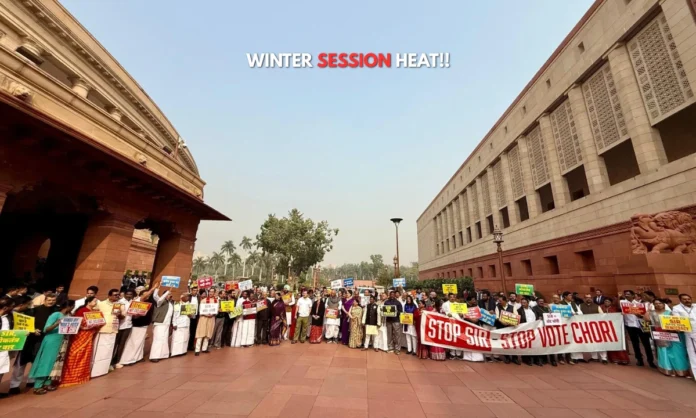
- Congress MP Priyanka Gandhi Vadra strongly countered PM’s remarks, emphasizing voter list revision and air pollution are critical democratic issues requiring Parliamentary debate
- Winter Session runs until December 19 with 15 sittings, 13 Bills on government agenda, and Opposition demanding discussions on Special Intensive Revision affecting 51 crore voters
Opening Overview
Parliament Winter Session commenced with sharp political exchanges as Prime Minister Narendra Modi launched a scathing critique of Opposition parties ahead of legislative proceedings on December 1, 2025. The Prime Minister’s pointed remarks about “delivery, not drama” triggered an immediate rebuttal from Congress leaders, setting a confrontational tone for the session that extends until December 19. PM Modi specifically referenced the Bihar election outcome, where the BJP-led National Democratic Alliance secured a landslide victory with 202 of 243 seats, suggesting some parties struggle to accept electoral defeats.
This political clash emerged against the backdrop of a condensed 15-sitting session during which the government plans to table 13 major Bills while Opposition forces demand comprehensive debates on Special Intensive Revision of electoral rolls affecting approximately 51 crore voters across 12 states and Union Territories. The Parliament Winter Session confrontation between PM Modi and Congress leadership reflects deeper tensions over democratic processes, legislative priorities, and electoral accountability as both sides stake competing claims about parliamentary responsibility and public interest representation.
हम प्रदूषण, SIR और कई अन्य जरूरी मुद्दों पर सदन में चर्चा की मांग कर रहे हैं, लेकिन सरकार किसी भी मुद्दे पर चर्चा के लिए राजी नहीं है।
— Shashi Kant Sharma (@ShashiK_Sharma) December 2, 2025
हम पिछले सत्र से चर्चा की मांग कर रहे हैं, लेकिन सरकार बात करने को तैयार ही नहीं है। सदन ऐसे नहीं चलता है।
लोगों के वोट काटे जा रहे हैं, 'वोट… pic.twitter.com/uyIZbwjzoN
Bihar Victory Fuels Modi’s Parliamentary Strategy
PM Modi’s criticism of Opposition behavior directly invoked the recent Bihar Assembly election results, where voters delivered a decisive mandate to the National Democratic Alliance. The Election Commission of India’s official data confirms the NDA coalition captured 202 seats in Bihar’s 243-member Assembly, reducing the Rashtriya Janata Dal-led Mahagathbandhan to merely 35 seats. The Prime Minister emphasized that Bihar’s electoral participation, particularly among women voters, demonstrates democracy’s capacity to deliver tangible outcomes rather than theatrical performances. PM Modi suggested certain political parties channel frustration over electoral defeats into Parliamentary disruptions rather than constructive legislative engagement during the Parliament Winter Session.
- The BJP-led coalition achieved its strongest performance in Bihar, with the ruling alliance winning 83% of contested constituencies across the state
- Chief Minister Nitish Kumar secured his tenth term following the November 2025 electoral verdict, reinforcing the NDA’s regional dominance
The Prime Minister specifically called out what he termed a “meltdown” over poll defeats, arguing Parliament should not become a battlefield for venting disappointment about electoral outcomes. PM Modi offered to provide “tips” on Opposition performance while urging lawmakers across party lines to prioritize substantive issues over grandstanding. His remarks during the Parliament Winter Session opening underscored government confidence following Bihar results while preemptively challenging Opposition disruption tactics. The electoral context shaped PM Modi’s framing of Parliamentary responsibility, positioning the government as focused on nation-building while casting Opposition parties as obstructionist forces unable to accept democratic verdicts from voters in Bihar and other states.
Priyanka Gandhi’s Sharp Democratic Defense
Congress MP Priyanka Gandhi Vadra immediately challenged PM Modi’s characterization of Opposition concerns as “drama,” asserting that raising critical public issues constitutes core Parliamentary responsibility rather than theatrical display. Gandhi specifically cited two major issues—Special Intensive Revision of voter lists and severe air pollution levels—as legitimate matters demanding thorough Parliamentary debate during the Winter Session. She questioned the Prime Minister’s framing by emphasizing that democratic institutions exist precisely to facilitate discussions about matters affecting millions of citizens across India.
- Priyanka Gandhi argued that preventing democratic discussions on public interest issues represents the actual “drama” rather than Opposition attempts to raise these concerns
- The Congress leader’s response highlighted tensions between government legislative priorities and Opposition demands for accountability debates
The Parliament Winter Session confrontation escalated as Gandhi insisted the forum’s fundamental purpose involves addressing voter concerns and scrutinizing government actions. Her rebuttal specifically defended the Special Intensive Revision debate, which the Election Commission ordered under Article 324 of the Constitution covering 9 states and 3 Union Territories in Phase-II. Gandhi’s intervention during the Parliament Winter Session reflected broader Opposition strategy to force discussions on electoral roll revisions affecting approximately 51 crore registered voters across Chhattisgarh, Goa, Gujarat, Kerala, Madhya Pradesh, Rajasthan, Tamil Nadu, Uttar Pradesh, West Bengal and three Union Territories.
Leader of Opposition Rahul Gandhi notably declined to comment on PM Modi’s remarks when questioned by media, maintaining silence on the Parliament Winter Session controversy. The Congress response emphasized democratic participation norms while rejecting government attempts to characterize legitimate Parliamentary questions as disruptive behavior unrelated to public welfare concerns.
Legislative Agenda And Opposition Demands Collide
The Parliament Winter Session features an ambitious government agenda with 13 major Bills scheduled for introduction and debate over 15 sittings concluding December 19. Finance Minister Nirmala Sitharaman introduced the Central Excise (Amendment) Bill 2025 and Health Security and National Security Cess Bill 2025 on opening day, aiming to replace GST compensation cess structures with new excise frameworks. The legislative calendar includes transformative proposals such as the Atomic Energy Bill 2025 permitting private sector participation in nuclear power generation, Higher Education Commission of India Bill 2025, Securities Markets Code Bill 2025, Insurance Laws (Amendment) Bill 2025 raising FDI caps, and Arbitration and Conciliation (Amendment) Bill 2025.
| Major Bills | Key Focus Area | Sector Impact |
|---|---|---|
| Atomic Energy Bill 2025 | Private investment in nuclear power | Energy sector reform |
| Insurance Laws Amendment 2025 | FDI cap increase in insurance | Financial services expansion |
| Securities Markets Code 2025 | Market regulation overhaul | Capital markets modernization |
| Jan Vishwas Amendment 2025 | Decriminalization of minor offences | Regulatory compliance easing |
Opposition parties simultaneously prepared coordinated pressure campaigns demanding Parliamentary debates on Special Intensive Revision implementation, which the Election Commission extended by seven days following concerns about verification timelines. The Parliament Winter Session legislative priorities face Opposition resistance as INDIA bloc constituents including Trinamool Congress, DMK, and Samajwadi Party signal intentions to challenge SIR processes through house disruptions if debate demands remain unaddressed. The SIR exercise mobilized over 5.3 lakh Booth Level Officers, 7.64 lakh Booth Level Agents, and 10,448 Election Registration Officers across 321 districts and 1,843 Assembly Constituencies for voter verification activities.
Additional Opposition concerns during the Parliament Winter Session include Booth Level Officer suicides allegedly linked to SIR workload pressures, national security matters following the November 10 Delhi attack, and deteriorating air quality in major metropolitan areas. Parliamentary Affairs Minister Kiren Rijiju urged Opposition parties to maintain discipline and allow legislative business to proceed, while government sources ruled out dedicated debate on SIR characterizing it as routine electoral administration backed by Supreme Court precedents. The compressed 15-sitting format represents a reduction from typical 20-sitting winter sessions, drawing Opposition accusations that the government deliberately shortened the Parliament Winter Session to limit scrutiny opportunities and rush controversial legislation without adequate debate.
Electoral Roll Controversy Dominates Proceedings
The Special Intensive Revision of electoral rolls emerged as the dominant contentious issue threatening to disrupt the entire Parliament Winter Session as Opposition parties demanded comprehensive debates on implementation processes. The Election Commission of India ordered SIR Phase-II under constitutional authority through Article 324, covering nearly 51 crore registered electors across 12 states and Union Territories following Bihar’s completion. The enumeration period commenced November 4, 2025 and received a seven-day extension to ensure adequate voter verification time, with the draft electoral roll now scheduled for release on December 16, 2025 rather than the original December 9 timeline.
Opposition allegations centered on claims that the SIR process facilitates systematic voter deletions targeting specific demographic groups, while government representatives characterized the exercise as constitutionally mandated electoral roll maintenance necessary before upcoming state elections. The Parliament Winter Session confrontation over SIR reflects deeper anxieties about electoral integrity and administrative procedures affecting democratic participation rights for millions of citizens. Congress, along with regional allies, insisted that reported Booth Level Officer suicides and workload concerns warrant Parliamentary scrutiny during the Winter Session rather than dismissal as routine administrative matters.
- The SIR Phase-II deployment involved unprecedented mobilization of electoral personnel including 5.3 lakh BLOs conducting house-to-house verification at least three times during enumeration
- Election Commission provided digital tools including ECINet App’s “Book-a-call with BLO” feature and toll-free 1950 helpline for voter assistance with SIR verification procedures
The Parliament Winter Session proceedings faced immediate disruptions as Opposition MPs staged walkouts and protests demanding debate time allocation for SIR-related concerns. Lok Sabha witnessed adjournments amid Opposition uproar over government refusal to schedule dedicated discussions on electoral roll revision implementation across the affected states. Parliamentary Affairs Minister defended government position by citing ongoing administrative nature of SIR activities and existing Election Commission oversight mechanisms as sufficient accountability frameworks. The Parliament Winter Session controversy highlighted fundamental disagreements about Parliamentary oversight responsibilities regarding electoral administration, with Opposition characterizing debate demands as democratic accountability measures while government framed them as attempts to politicize routine constitutional processes affecting voter registration accuracy ahead of scheduled state elections in 2026.
Closing Assessment
The Parliament Winter Session commenced with unprecedented political acrimony as PM Modi’s “delivery not drama” critique collided with Opposition demands for democratic accountability debates on voter list revisions and public welfare concerns. The 15-sitting condensed session faces immediate challenges balancing ambitious legislative agendas including 13 major Bills against Opposition determination to force discussions on Special Intensive Revision affecting 51 crore voters across 12 states and Union Territories. Priyanka Gandhi’s sharp defense of Parliamentary debate rights crystallized Opposition resistance to government attempts at limiting scrutiny during the Parliament Winter Session.
The Bihar election results provided political ammunition for PM Modi’s attacks while simultaneously hardening Opposition resolve to challenge electoral processes through Parliamentary mechanisms rather than accepting perceived administrative irregularities without debate. As the Parliament Winter Session progresses through December 19, the fundamental tension between legislative productivity and democratic accountability will test both government management capabilities and Opposition strategic coordination across diverse ideological constituents demanding space for voter rights discussions alongside statutory business priorities.