
Key Highlights:
- An IndiGo Kuwait Hyderabad flight (6E-1234) made an emergency landing at Mumbai airport on 2 December 2025 after a bomb threat email was received at Hyderabad airport.
- The threat, described in reports as warning of a “human bomb” or remote-controlled explosive, was treated as specific and credible, prompting diversion to Mumbai and a full security check.
- After thorough inspection at Mumbai’s Chhatrapati Shivaji Maharaj International Airport, no explosives were found and the threat was officially declared a hoax; passengers were later flown to Hyderabad on another IndiGo aircraft.
Opening Overview
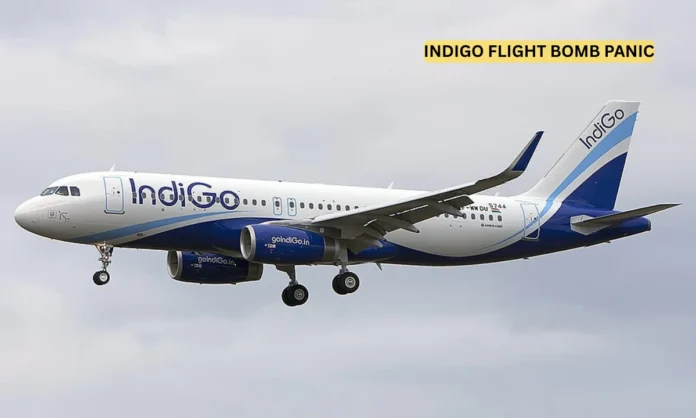
An IndiGo Kuwait Hyderabad flight was forced to make an emergency landing in Mumbai on 2 December 2025 after aviation authorities received a detailed bomb threat email, triggering a major security operation at two of India’s busiest airports. The Airbus A321 operating as IndiGo flight 6E-1234, carrying around 230 passengers and crew, was diverted mid‑flight from its planned route to Hyderabad and brought safely down at Chhatrapati Shivaji Maharaj International Airport in Mumbai, where it was moved to an isolation bay for a full sweep by bomb squads and security forces.
Reports indicate that the threat message, sent to Rajiv Gandhi International Airport (RGIA) in Hyderabad, warned that anti‑social elements had planted a remote‑controlled explosive device on board the IndiGo Kuwait Hyderabad flight and intended to detonate it once the aircraft landed in Hyderabad. In response, a Bomb Threat Assessment Committee (BTAC) at Hyderabad airport classified the alert as “specific,” leading to the decision to divert the IndiGo Kuwait Hyderabad flight to Mumbai as a precautionary measure.
This incident is the latest in a recent spate of hoax bomb threats targeting Indian airports and flights, including a similar scare just days earlier when another Hyderabad‑bound flight from Bahrain was diverted to Mumbai after a bomb alert. The IndiGo Kuwait Hyderabad flight emergency landing underscores how even unsubstantiated threats can disrupt air travel, trigger costly emergency protocols, and cause significant anxiety for passengers and ground staff alike.
How the IndiGo Kuwait–Hyderabad flight threat unfolded
- A detailed bomb threat email was received at Hyderabad’s Rajiv Gandhi International Airport early on 2 December 2025, specifically naming IndiGo flight 6E‑1234 from Kuwait.
- The message claimed that remote‑controlled explosives had been placed on the IndiGo Kuwait–Hyderabad flight and would be detonated on landing, prompting authorities to treat it as credible.
On the morning of 2 December 2025, Rajiv Gandhi International Airport (RGIA) in Hyderabad received two separate email threats targeting IndiGo flight 6E‑1234, which was en route from Kuwait International Airport to Hyderabad. According to airport and police sources, the emails were sent from anonymous mail‑to‑Tor addresses and copied to several GMR Hyderabad International Airport Ltd (GHIAL) and Kuwait Airways service IDs, heightening their perceived seriousness.
The threat message alleged that “anti‑social elements” had planted remote‑controlled explosive devices on the IndiGo Kuwait–Hyderabad flight and planned to detonate them once the aircraft landed in Hyderabad. The senders also demanded that RGIA authorities divert the aircraft and evacuate terminal buildings, claiming the plot was sanctioned by a “fatwa”. In one version of the alert, the threat was described as warning of a “human bomb” on board the IndiGo Kuwait Hyderabad flight, though IndiGo itself did not confirm this wording.
Based on this information, the Bomb Threat Assessment Committee (BTAC) at Hyderabad airport assessed the alert as “specific” rather than a generic hoax, which triggered immediate action. Air Traffic Control (ATC) in Hyderabad coordinated with IndiGo and Mumbai ATC to divert the IndiGo Kuwait–Hyderabad flight mid‑air to Chhatrapati Shivaji Maharaj International Airport in Mumbai, where emergency services could respond more robustly.
The Airbus A321‑251NX operating as IndiGo flight 6E‑1234 had taken off from Kuwait at around 1:56 am local time (about 4:26 am IST) and was already over Indian airspace when the diversion order was issued. The aircraft landed safely in Mumbai at approximately 7:45–8:10 am IST, with emergency services, including fire tenders, medical teams, and the Bomb Detection and Disposal Squad (BDDS), on standby at the runway.
Emergency response and security checks on the IndiGo Kuwait–Hyderabad flight
- The IndiGo Kuwait–Hyderabad flight was moved to an isolation bay at Mumbai airport, where CISF, BDDS, and local police conducted a thorough cabin and baggage search.
- No suspicious items or explosives were found, and the threat was later officially declared a hoax by Hyderabad airport authorities.
Once the IndiGo Kuwait Hyderabad flight touched down in Mumbai, standard emergency protocols were activated at Chhatrapati Shivaji Maharaj International Airport. The aircraft was taxied to an isolation bay away from the main terminal, and passengers and crew were safely disembarked under the supervision of Central Industrial Security Force (CISF) personnel and Mumbai police.
Security agencies, including the Bomb Detection and Disposal Squad (BDDS), CISF, and airport emergency responders, carried out a detailed inspection of the IndiGo Kuwait Hyderabad flight’s cabin, cargo hold, and baggage. Sniffer dogs and explosive detection equipment were deployed to scan the aircraft and all checked luggage, in line with standard operating procedures for bomb threats.
After several hours of intensive checks, Mumbai airport security officials confirmed that no explosives or suspicious devices were found on the IndiGo Kuwait Hyderabad flight, and the aircraft was declared safe. Hyderabad airport authorities later stated that the threat was a hoax, and flyers were rebooked on another IndiGo flight to complete their journey to Hyderabad later that day.
IndiGo issued a brief statement confirming that a “security threat” had been received for flight 6E‑1234 operating from Kuwait to Hyderabad on 2 December 2025, due to which the IndiGo Kuwait Hyderabad flight was diverted to Mumbai. The airline added that it had immediately informed relevant authorities and fully cooperated in carrying out the necessary security checks before the aircraft was cleared for further operations.
Passengers on the IndiGo Kuwait–Hyderabad flight were provided with refreshments and regular updates during the delay, and the airline emphasized that the safety and security of customers, crew, and aircraft remained its topmost priority.
Pattern of hoax threats and impact on Indian aviation
- Indian airports have seen a surge in hoax bomb threats in recent months, including multiple alerts at Delhi, Hyderabad, and Bengaluru airports.
- Each IndiGo Kuwait Hyderabad flight‑style incident forces costly diversions, full security sweeps, and operational disruptions, even when the threat is later proven false.
The emergency landing of the IndiGo Kuwait Hyderabad flight is part of a broader trend of hoax bomb threats targeting Indian airports and flights in late 2025. In the days leading up to this incident, several Indian airports, including those in Delhi, Chennai, Goa, and Bengaluru, received similar email threats, prompting precautionary checks and heightened security at multiple locations.
For example, on 23 November 2025, a Bahrain–Hyderabad flight was diverted to Mumbai after Rajiv Gandhi International Airport received a bomb threat email claiming an explosive device was on board. Security checks at Mumbai found nothing suspicious, and the threat was declared a hoax, mirroring the pattern seen with the IndiGo Kuwait Hyderabad flight.
These recurring alerts have forced airports and airlines to repeatedly activate full emergency protocols, including declaring “full emergency” status, deploying bomb squads, and diverting aircraft to alternate airports. Each such incident incurs significant costs in terms of fuel, crew duty time, ground handling, and security manpower, even when no real danger exists.
From an aviation safety perspective, authorities are compelled to treat every specific threat as credible until proven otherwise, because the consequences of ignoring a genuine bomb alert could be catastrophic. This means that even a clearly hoaxed IndiGo Kuwait Hyderabad flight‑style threat can still lead to flight diversions, passenger evacuations, and lengthy delays, disrupting schedules for hundreds of travelers.
Regulators and law enforcement agencies are now intensifying efforts to trace the origin of these hoax emails and prosecute those responsible, in an attempt to deter future copycat threats that exploit the aviation system’s zero‑tolerance approach to security.
Official data and aviation security context
- In 2024, Indian airports recorded over 1,200 bomb threat alerts, of which more than 95% were later found to be hoaxes, according to Ministry of Civil Aviation data.
- CISF handled 1,123 bomb threat incidents at Indian airports in 2024, with only 3% requiring physical evacuation or aircraft diversion.
According to the Ministry of Civil Aviation’s 2024 annual report, Indian airports received a total of 1,217 bomb threat alerts (including emails, calls, and online messages) during the calendar year, of which 1,162 were subsequently confirmed as hoaxes. This means that roughly 95.5% of all bomb threats reported at Indian airports in 2024 turned out to be false alarms, yet each triggered some level of security response.
Data from the Central Industrial Security Force (CISF), which guards all major Indian airports, shows that in 2024 the force dealt with 1,123 bomb threat incidents at airports under its jurisdiction. Of these, only about 34 (around 3%) led to actual evacuation of terminals or diversion of aircraft, while the majority were resolved through local checks without major disruption.
The following table summarizes key aviation security statistics for Indian airports in 2024:
| Indicator | 2024 Figure | Source |
|---|---|---|
| Total bomb threat alerts at Indian airports | 1,217 | Ministry of Civil Aviation, Annual Report 2024 |
| Alerts confirmed as hoaxes | 1,162 | Ministry of Civil Aviation, Annual Report 2024 |
| Bomb threat incidents handled by CISF | 1,123 | CISF Annual Report 2024 |
| Incidents leading to evacuation/diversion | ~34 | CISF Annual Report 2024 |
| Number of international airports in India | 34 | Ministry of Civil Aviation, 2025 |
These figures highlight that while the vast majority of bomb threats are hoaxes, the aviation system must still respond as if each one could be real, which explains why an IndiGo Kuwait Hyderabad flight‑style diversion is treated with the highest level of seriousness.
The standard procedure for a specific threat like the one received for the IndiGo Kuwait Hyderabad flight involves immediate coordination between the airport’s BTAC, ATC, the airline, and security agencies to decide whether to divert, evacuate, or conduct a local sweep. In this case, the BTAC at Hyderabad deemed the threat specific enough to justify diverting the IndiGo Kuwait Hyderabad flight to Mumbai, where resources for a full aircraft inspection are more readily available.
Closing Assessment
The emergency landing of the IndiGo Kuwait Hyderabad flight in Mumbai on 2 December 2025 was a textbook example of how aviation authorities respond to a specific bomb threat, even when it later proves to be a hoax. By diverting the IndiGo Kuwait Hyderabad flight to Mumbai and conducting a thorough security sweep, Indian agencies prioritized passenger safety over convenience, in line with global aviation security norms.
While the threat was ultimately declared false, the incident exposed the vulnerability of the air travel system to disruptive hoax alerts that can cause significant operational and financial strain. Each IndiGo Kuwait Hyderabad flight‑style scare forces airlines and airports to activate emergency protocols, divert aircraft, and deploy specialized teams, all at considerable cost.
Going forward, the focus for Indian aviation authorities must be twofold: strengthening cyber‑forensics to quickly trace and prosecute hoaxers, and refining threat‑assessment protocols to minimize unnecessary diversions without compromising safety. The IndiGo Kuwait Hyderabad flight episode serves as a stark reminder that in an age of digital threats, even a single email can bring an international flight to an emergency stop in a different city.