
Key Highlights
- Targhar railway station on Uran-Belapur line operationalized as key link to Navi Mumbai Airport, just 1.5 km away, enhancing access for passengers and staff.
- Maharashtra CM Devendra Fadnavis terms it a “special gift for Mumbaikars,” with new train services: 4 Nerul-Uran trips and 6 Belapur-Uran trips, plus stops at Targhar and Gavhan.
- Station built by CIDCO at Rs 112 crore over 2 lakh sq ft, featuring multi-modal links to Harbour Line, Coastal Metro, and airport skytrain.
Opening Overview
Navi Mumbai Airport Targhar railway station emerges as a game-changer just weeks before the airport’s commercial launch on December 25, 2025. This critical infrastructure bridges a vital connectivity gap for the Navi Mumbai International Airport, located only 1.5 km away, streamlining travel for millions in the Mumbai Metropolitan Region (MMR). Maharashtra Chief Minister Devendra Fadnavis hailed the development as a “special gift for Mumbaikars,” crediting Prime Minister Narendra Modi and Union Minister Ashwini Vaishnaw for approving additional local train services on the Uran-Belapur line.
A special gift for Mumbaikars!
— Devendra Fadnavis (@Dev_Fadnavis) December 5, 2025
Thank you, Hon. PM Narendra Modi Ji, and Hon. Union Minister Ashwini Vaishnaw ji, for initiating additional local train services: Nerul–Uran–Nerul (4 trips) and Belapur–Uran–Belapur (6 trips), in response to my request. Grateful for the approval of… pic.twitter.com/Ia5joBrAGI
The Navi Mumbai Airport Targhar railway station will serve not only flyers but also airport staff, reducing reliance on roads amid Mumbai’s notorious congestion. With the Belapur-Uran line already operational, trains previously skipped Targhar due to incomplete facilities; now, new stoppages and 10 extra services promise smoother commutes. This move aligns with broader efforts to position Navi Mumbai Airport as a future-ready hub, handling projected air traffic surges in MMR. Official projections from CIDCO indicate MMR air passenger demand will exceed 100 million per annum by 2034, necessitating such integrated transit solutions.
As Navi Mumbai Airport completes its Operational Readiness and Airport Transfer (ORAT) exercise, the Targhar station’s timing underscores government commitment to seamless multimodal connectivity. Volunteers simulated full passenger flows with airlines like IndiGo, Akasa Air, and Air India Express, confirming operational readiness. The Navi Mumbai Airport Targhar railway station thus forms the backbone of this ecosystem, easing daily travel and boosting economic activity in Navi Mumbai.
Targhar Station Infrastructure Details
- Rs 112 crore project by CIDCO spans 2 lakh sq ft with three island platforms and two end platforms, each 270m long and 12m wide.
- Includes subways, multi-corner parking, drop-off zones, and direct airport walkways/shuttles for seamless access.
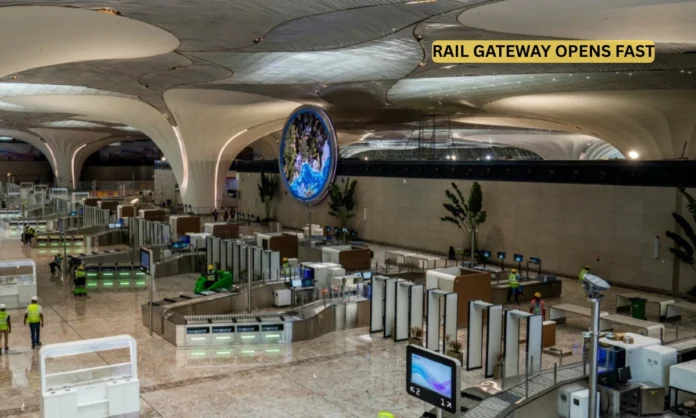
The Navi Mumbai Airport Targhar railway station stands as a modern transit hub, meticulously planned by City and Industrial Development Corporation (CIDCO). Spanning 2 lakh square feet, it features five platforms: three island-style and two end ones, each measuring 270 meters in length and 12 meters wide to accommodate peak suburban traffic. Subways enable cross-platform movement, while parking facilities at all four corners cater to cars, buses, and autorickshaws, alongside dedicated drop-off areas.
We look forward to welcoming you all soon!
— Navi Mumbai International Airport (@navimumairport) November 30, 2025
As we prepare for flights on December 25, our ORAT Team successfully completed our first ever full-scale integrated passenger trial with hundreds of simulated travellers. From check-in with IndiGo, Akasa, and Air India Express to… pic.twitter.com/yaOrdLfR4w
Direct connections to Navi Mumbai Airport include planned walkways and shuttle services, critical given the 1.5 km proximity. The station’s design anticipates future expansions, integrating with the Harbour Line, upcoming Coastal Metro (Line 2D), and proposed airport skytrain. CIDCO’s official documentation highlights Targhar as the primary rail access point on the Nerul-Uran line, enhancing the airport site’s reach via National Highway 4B and Aamra Marg. This setup positions Navi Mumbai Airport Targhar railway station as an interchange nexus, vital for offloading pressure from Chhatrapati Shivaji Maharaj International Airport (CSMIA).
Architectural elements, like undulating roof mullions inspired by local streams, add aesthetic value without compromising functionality. Retail spaces and parking for hundreds of vehicles further elevate its role. With MMR’s suburban network handling over 7.5 million daily commuters per Central Railway data, the Navi Mumbai Airport Targhar railway station will significantly cut travel times, fostering efficient passenger distribution.
| Feature | Specification | Source |
|---|---|---|
| Area | 2 lakh sq ft | CIDCO |
| Platforms | 3 island + 2 end (270m x 12m each) | CIDCO |
| Cost | Rs 112 crore | CIDCO |
| Connectivity | Walkways/shuttles to airport (1.5 km) | CIDCO |
New Train Services and CM’s Initiative
- 10 additional services approved: 4 Nerul-Uran-Nerul trips, 6 Belapur-Uran-Belapur trips, with stops at Targhar and Gavhan.
- Responds to Fadnavis’s request, marked “most urgent” by Railway Board for immediate rollout.
Maharashtra CM Devendra Fadnavis spearheaded the push for enhanced rail links to Navi Mumbai Airport Targhar railway station, securing approvals for 10 new suburban services. These include four Nerul-Uran-Nerul round trips and six Belapur-Uran-Belapur ones, directly addressing commuter demands in Navi Mumbai. The Railway Ministry’s swift response, labeling it “most urgent,” ensures rollout aligns with the airport’s December 25 opening.
Fadnavis expressed gratitude to PM Modi and Rail Minister Vaishnaw via an X post, emphasizing eased daily travel for Mumbaikars. Previously, the operational Belapur-Uran line bypassed Targhar; now, dedicated stoppages transform it into a vital node. Central Railway’s network, serving MMR’s dense population, benefits immensely, with projections of reduced congestion on key routes. The Uran-Belapur corridor, commissioned in phases since 2018 at Rs 2,973 crore (shared 67:33 by CIDCO and Railways), finally delivers full potential.
This initiative supports Navi Mumbai Airport’s role in handling MMR’s aviation boom. CIDCO notes the airport’s Phase 1 capacity at 10 million passengers per annum (MPPA) and 2.6 lakh tonnes cargo, expanding to 60 MPPA long-term. Integrating Navi Mumbai Airport Targhar railway station with these services positions Navi Mumbai as a logistics powerhouse.
Airport Operational Readiness
- ORAT trial completed successfully with simulated passengers, airlines IndiGo, Akasa Air, Air India Express.
- Confirms full-scale readiness from check-in to baggage reclaim ahead of December 25 launch.
Navi Mumbai Airport Targhar railway station complements the airport’s Operational Readiness and Airport Transfer (ORAT) milestone, signaling full preparedness for commercial flights. Hundreds of simulated travelers tested every process: check-ins with IndiGo, Akasa Air, and Air India Express; security via CISF; boarding; and baggage handling by L&T and NMIAL teams. The flawless execution validates Phase 1 infrastructure, spanning 1,160 hectares with dual parallel runways.
CIDCO’s framework positions Navi Mumbai Airport as India’s first multi-airport city system alongside CSMIA, easing 48.81 MPPA pre-COVID loads toward 100 MPPA by 2034. All clearances secured: environment, CRZ, forest from MoEF&CC; defence from MoD. Concessionaire NMIAL (MIAL SPV with 26% CIDCO equity) drives development via PPP, with L&T as EPC contractor.
The Navi Mumbai Airport Targhar railway station enhances this by providing rail feeders, crucial for staff and flyers. First arrival: IndiGo 6E460 from Bengaluru at 8 AM on launch day. Multimodal plans include Navi Mumbai Metro Lines 1, 2D, 3, 4, 8, and Mumbai Trans Harbour Link (MTHL).
| Phase | Capacity (MPPA) | Cargo (tonnes/annum) | Timeline |
|---|---|---|---|
| Phase 1 | 10 | 2,60,000 | Dec 2025 |
| Ultimate | 60+ | 1.5 million | Post-2034 |
| MMR Demand | 100 | N/A | By 2034 |
Multimodal Connectivity Vision
- Links Harbour Line, Coastal Metro, airport skytrain; future hovercraft and high-speed rail.
- Bolsters Navi Mumbai Airport as MMR’s second gateway with NH4B, MTHL access.
Navi Mumbai Airport Targhar railway station anchors a comprehensive multimodal network, evolving Navi Mumbai into a connectivity paragon. It interchanges with Harbour Line locals, Coastal Metro (DN Nagar-Mankhurd), Navi Mumbai Metro (Pendhar-Belapur-Taloja), and airport skytrain, facilitating transfers. Sion-Panvel Highway, Palm Beach Road, Aamra Marg (NH348A), and NH548 converge here, augmented by MTHL from South Mumbai and upcoming Ulwe Coastal Road.
CIDCO envisions Phase 2 cargo from Raigad and hovercraft from Colaba, plus Mumbai-Hyderabad high-speed rail terminus. At 18°59’40″N, 73°04’13″E near Panvel, 35 km from CSMIA, the site optimizes MMR flows. Land acquisition complete for 1,160 ha core area; R&R for 2,633 structures (98% done). Ulwe Recourse Channel finished in 2019.
This framework cements Navi Mumbai Airport Targhar railway station’s role in FDI attraction and Mumbai’s financial hub status. Daily commuters gain from reduced wait times; economically, it spurs trade via 1.5 million tonnes ultimate cargo capacity.
Closing Assessment in Navi Mumbai Airport Targhar railway station
The Navi Mumbai Airport Targhar railway station marks a pivotal stride in redefining MMR mobility, perfectly timed for the airport’s December 25 debut. By weaving rail, metro, and road seamlessly 1.5 km from terminals, it alleviates CSMIA pressures while unlocking Navi Mumbai’s potential as an aviation epicenter. CM Fadnavis’s advocacy for 10 new services exemplifies responsive governance, benefiting lakhs of daily users.
CIDCO’s Rs 112 crore investment yields a forward-thinking hub, integral to handling 100 MPPA by 2034. As ORAT success paves the way, multimodal synergy promises efficiency gains, from staff shuttles to passenger flows. This “special gift” not only eases commutes but catalyzes economic vitality in Maharashtra.
Ultimately, Navi Mumbai Airport Targhar railway station embodies India’s infrastructure ambition: integrated, scalable, commuter-centric. As flights commence, watch this node propel regional growth, proving strategic planning trumps congestion challenges.