
Key Highlights
- India-Russia partnership stands as one of the steadiest major relationships over 70-80 years, with Putin’s recent visit focusing on economic reimagining.
- Bilateral trade hit $68.7 billion in FY 2024-25, targeting $100 billion by 2030 through new pacts on mobility and fertilizers.
- Jaishankar rejects concerns over Putin visit impacting India-US trade talks, stressing strategic autonomy.
Opening Overview
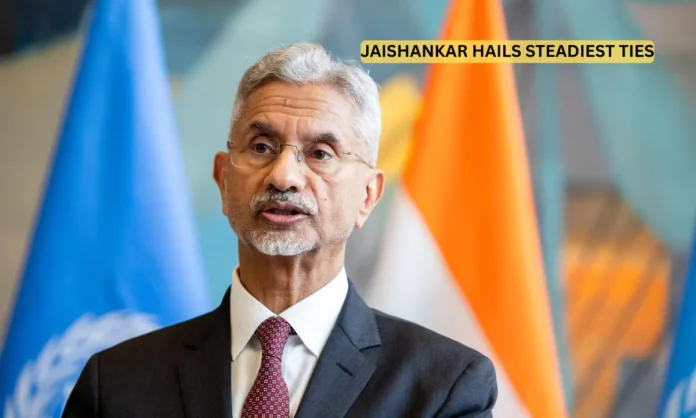
India Russia ties remain among the steadiest globally, as External Affairs Minister S Jaishankar asserted during a recent interactive session. These enduring India Russia ties, spanning over seven decades, have weathered geopolitical storms while others fluctuated, positioning them as a model of consistency. President Vladimir Putin’s two-day visit to New Delhi underscored this resilience, prioritizing economic dimensions to balance trade and unlock new sectors.
Jaishankar highlighted how India Russia ties evolved as Russia pivoted economic focus toward the West and China, leaving gaps that the summit addressed. Key outcomes include a mobility agreement easing Indian worker access to Russia and a joint venture on fertilizers, critical for India’s imports. This comes amid US tariffs of 50 percent on Indian goods, linked to Russian crude purchases, yet Jaishankar dismissed any veto on India’s multi-aligned diplomacy.
The visit aligns with the 25th anniversary of the strategic partnership declaration, reaffirming mutual trust. Both nations aim to elevate bilateral trade from $68.7 billion in FY 2024-25 to $100 billion by 2030, per official joint statements. India’s approach reflects national interests, navigating US trade negotiations without compromising core relationships like India Russia ties.
Putin Visit Boosts Economic Pillars of India Russia Ties
- Joint statement from 23rd India-Russia Annual Summit outlines Programme 2030 for strategic economic cooperation.
- Agreements on labour mobility and fertilizers address trade imbalance and workforce needs.
India Russia ties received fresh momentum from President Putin’s December 4-5, 2025, state visit, coinciding with the 25th anniversary of their strategic partnership. Prime Minister Narendra Modi hosted Putin, leading to a comprehensive joint statement that frames these India Russia ties as time-tested and progressive. Discussions emphasized expanding trade, with bilateral volume reaching $68.7 billion in FY 2024-25, driven by India’s $63.8 billion imports of Russian crude, fertilizers, and coal against $4.9 billion exports.
A standout outcome is the Programme for the Development of Strategic Areas of India-Russia Economic Cooperation till 2030, targeting balanced growth. Both leaders directed fast-tracking a Free Trade Agreement with the Eurasian Economic Union and bilateral investment treaty negotiations. Russian firms committed to boosting purchases of Indian pharmaceuticals, agriculture, and textiles to rectify imbalances.
Labour mobility pacts enable seamless temporary work for Indians in Russia, particularly in IT, construction, and engineering, meeting Moscow’s shortages. Fertilizer joint ventures secure supplies, vital as India imported 58.62 lakh metric tons of urea from April-October 2025 alone. Connectivity via INSTC and Chennai-Vladivostok corridors further strengthens these economic facets of India Russia ties.
| India-Russia Trade Breakdown FY 2024-25 (USD Billion) |
|---|
| Category |
| Total Trade |
| Key Exports (India) |
| Key Imports (India) |
Strategic Autonomy Shields India Russia Ties from US Pressures
- Jaishankar affirms no major power holds veto over India’s relationships, amid 50% US tariffs.
- India-US talks proceed on framework deal targeting $500 billion trade by 2030.
External Affairs Minister S Jaishankar firmly defended India Russia ties against suggestions that Putin’s visit complicates US trade negotiations. He stated that expecting vetoes on such partnerships is unreasonable, as India maintains freedom of choice across major powers. This stance underscores strategic autonomy as central to India Russia ties, resilient amid US-imposed 25% tariffs plus 25% penalties on Indian goods over Russian oil procurement.
India-US bilateral trade stands at approximately $191 billion currently, with six rounds of talks completed toward a framework addressing tariffs and a comprehensive pact aiming for $500 billion by 2030. Jaishankar noted Washington’s trade focus under President Trump exceeds prior administrations, but India prioritizes livelihoods of workers, farmers, and businesses. Negotiations seek reasonable terms without concessions harming domestic interests.
Putin’s visit reinforced energy security, with Russia pledging uninterrupted supplies despite sanctions on firms like Rosneft. India’s crude imports from Russia hit record highs, averaging 1.9 million barrels per day in November 2025, per official tracking. Jaishankar emphasized diplomacy as national interest defense, not appeasement, ensuring India Russia ties complement rather than conflict with US engagements.
Fertilizers and Mobility Transform India Russia Ties Dynamics
- Joint venture tackles India’s recurring fertilizer shortages; second-largest importer globally.
- Mobility pacts target 70,000 Indian workers in Russian sectors like manufacturing.
India Russia ties gained practical depth through fertilizer and mobility agreements during Putin’s summit. As the world’s second-largest fertilizer importer after Brazil, India faces supply volatility, prompting a substantial joint venture with Russia. This addresses unstable sources, with imports surging: urea alone reached 58.62 lakh metric tons April-October 2025, up from 24.76 lakh prior year.
The temporary labour activity agreement allows Indians legal work in Russia, combating irregular migration via data sharing. Estimates suggest 70,000 opportunities in skilled/semi-skilled roles like textiles and electronics, aiding Russia’s labour crunch from low births and emigration. These pacts balance trade, boosting Indian exports while securing resources.
Defence cooperation evolves toward co-production under Make in India, including spares for Russian equipment. Nuclear ties advance with Kudankulam Units 3-6 progress and second-site talks aiming for 100 GW capacity by 2047. Such integrations fortify Indiab Russia ties against external pressures.
| India Fertilizer Imports Snapshot (Lakh Metric Tons) |
|---|
| Period |
| Apr-Oct 2025 |
| Apr-Oct 2024 |
| Growth |
Defence, Nuclear, and Multilateral Anchors in India Russia Ties
- Robust military-technical ties shift to joint R&D; regular INDRA exercises continue.
- UNSC reform, BRICS, SCO cooperation aligns global visions.
India Russia ties extend robustly into defence, nuclear, and multilateral realms, as reaffirmed in the joint statement. Military cooperation, a partnership pillar, now emphasizes co-development of advanced systems and Make in India production of spares for legacy platforms. The 22nd IRIGC-M&MTC session in New Delhi advanced these, with exercises like INDRA maintaining momentum.
Civil nuclear collaboration progresses at Kudankulam, with Units 1-2 operational and 3-6 under construction. Discussions target a second site and VVER reactors, supporting India’s 100 GW nuclear goal by 2047. Space ties via ISRO-Roscosmos cover human flight and navigation.
Multilaterally, both push UNSC reform, with Russia backing India’s permanent seat. In BRICS, SCO, and G20, they align on Global South priorities, counter-terrorism, and climate. Joint counter-terror vows target UN-listed groups post-Pahalgam and Crocus attacks, cementing India-Russia ties as stability anchors.
Closing Assessment
India Russia ties emerge stronger from Putin’s visit and Jaishankar’s candid defence, embodying steadiness amid flux. Economic pacts on trade, fertilizers, and mobility propel toward $100 billion by 2030, balancing imports with exports. Strategic autonomy ensures these ties coexist with US negotiations, prioritizing national interests.
Challenges like tariffs test resilience, yet diversified partnerships prove maturity. As Jaishankar noted, diplomacy defends workers and farmers, not pleases others. Forward, India Russia ties offer a blueprint for multipolar cooperation, blending tradition with innovation for shared prosperity.