
Key Highlights:
- The Goa nightclub fire at Birch By Romeo Lane in Arpora killed 25 people, including 20 staff members and 5 tourists, during a Bollywood-themed event on December 7, 2025
- Investigation reveals the club operated without fire safety clearance (NOC) and violated multiple National Building Code norms, including flammable decor and inadequate emergency exits
- Authorities have registered culpable homicide charges against club owners who remain absconding, while four staff members face arrest and state-wide safety audits are now mandatory
Opening Overview
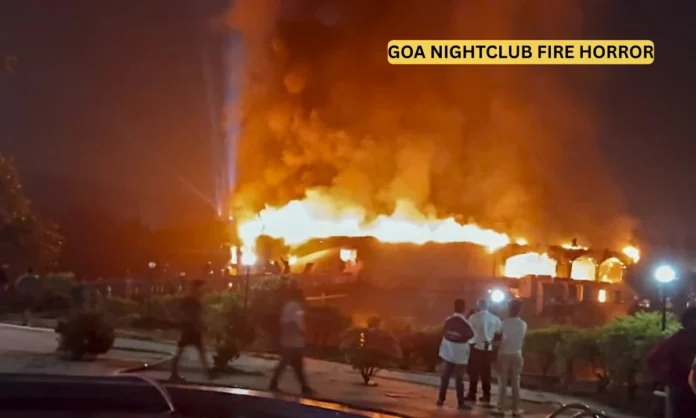
The Goa nightclub fire at Birch By Romeo Lane in Arpora has exposed catastrophic safety failures that transformed a Saturday night entertainment venue into a deadly inferno. On December 7, 2025, shortly after midnight, 25 people lost their lives when electronic fireworks ignited highly flammable decor materials during a “Bollywood Banger Night” event. The tragedy has sent shockwaves through India’s hospitality sector, raising urgent questions about enforcement of fire safety regulations just weeks before the peak holiday season.
Preliminary investigations by Goa’s Fire Department Director Nitin Raiker confirm the establishment lacked a valid No Objection Certificate (NOC) and violated mandatory fire safety protocols outlined in the National Building Code of India. The Goa nightclub fire victims include five tourists from Delhi and Karnataka, alongside 20 staff members from Uttarakhand, Nepal, Jharkhand, Assam, Maharashtra, Uttar Pradesh, and West Bengal who were working in the basement kitchen when toxic smoke filled the enclosed space. Most fatalities resulted from suffocation rather than burns, underscoring the lethal consequences of inadequate ventilation systems.
How it started to how it spread.
— Sapna Madan (@sapnamadan) December 8, 2025
The fire at Birch by Romeo Lane claimed at least 25 lives and left 6 people injured. My heart goes out to all who lost loved ones and those recovering..#GoaFire #nightclub #NightClubFire pic.twitter.com/L4WreKTlMz
Structural Violations That Enabled the Goa Nightclub Fire Catastrophe
- The club’s construction violated building permit requirements, with the Arpora-Nagoa sarpanch confirming it operated without a construction license despite receiving demolition notices
- Fire safety infrastructure was entirely absent, including no functional alarm systems, automatic sprinklers, smoke extraction mechanisms, or illuminated emergency exit signage
The architectural design of Birch By Romeo Lane created what fire safety experts describe as a “tinderbox” awaiting ignition. Investigators documented extensive use of bamboo, rattan, palm leaves, and straw throughout the ceiling and decorative elements. These highly combustible materials directly contravened Section 7.1 of the National Building Code, which mandates non-combustible construction for commercial establishments with public assembly occupancy. The Goa nightclub fire spread across the ceiling within minutes, visible in viral social media footage showing flames racing through the overhead bamboo structure as patrons initially continued dancing.
The venue’s single entry-exit point presented a critical bottleneck during evacuation. National Building Code Section 7.9 requires multiple exits with minimum widths based on occupancy load, particularly for entertainment venues accommodating over 100 people. Survivor accounts describe panicked crowds converging on the narrow passageway lined with flammable arch structures, while some disoriented guests mistakenly fled downward into the basement kitchen rather than toward the exit. The confined 400-meter access road prevented fire engines from approaching the structure directly, forcing firefighters to deploy hoses over extended distances while precious minutes elapsed.
The Goa nightclub fire investigation revealed zero compliance with basement safety protocols mandated under Section 7.11 of the National Building Code. The ground-floor kitchen lacked adequate ventilation systems despite serving as a workspace for over 20 staff members. Code requirements specify basement compartments must not exceed 500 square meters without fire-resistant partitions, and ventilation must provide cross-sectional airflow equivalent to 2.5 percent of floor area. The absence of smoke extraction systems transformed the basement into a death trap when toxic fumes accumulated, causing 20 staff members and multiple trapped tourists to suffocate.
How Electronic Fireworks Ignited the Goa Nightclub Fire Tragedy
- Eyewitnesses report electronic firecrackers were activated during a belly dance performance to the song “Mehbooba Mehbooba,” with flames appearing on the ceiling within seconds
- Fire Department Director Raiker confirmed that using fireworks near commercial establishments without proper isolation distances and permits presents “severe and unacceptable fire risk”
Video documentation shows the Goa nightclub fire’s progression from celebratory pyrotechnics to catastrophic blaze. At approximately 12:30 AM, as dancers performed and electronic fireworks discharged, initial flames appeared unnoticed by most patrons, with one voice heard saying “aag laga di aapne” (you started a fire) as a compliment to the performer’s energy. Club management failed to make emergency announcements or activate non-existent alarm systems as the fire rapidly consumed the bamboo ceiling. Staff members were observed removing electronic equipment rather than coordinating evacuation procedures, reflecting absence of fire safety training protocols.
The Goa nightclub fire’s intensity increased exponentially due to the combination of ignition source and flammable materials. Standard fire safety regulations prohibit pyrotechnic displays in enclosed spaces with combustible decor, particularly when automatic suppression systems are absent. Within three minutes, the entire upper deck structure was engulfed, blocking visibility and filling the venue with toxic smoke from burning synthetic materials mixed with natural fibers. Firefighters arrived within 30 minutes and extinguished the visible flames, but by then the basement had already filled with lethal carbon monoxide and other asphyxiating gases.
The narrow access conditions significantly hampered rescue operations during the Goa nightclub fire emergency response. Fire engines halted approximately 400 meters from the venue due to the constrained lane width leading to the “island club” location near Arpora backwaters. Responders deployed portable equipment and hose lines while navigating the single-file pathway, but the delay proved fatal for those trapped in the basement. National Building Code Section 7.8 mandates adequate access roads with minimum widths to accommodate emergency vehicles, a requirement clearly violated in this case.
Regulatory Framework and Enforcement Gaps Exposed by the Goa Nightclub Fire
- National Building Code Part IV mandates that commercial establishments exceeding 750 square meters must obtain Fire NOC with annual renewals for hotels, entertainment venues, and assembly occupancies
- Delhi fire safety protocols enacted after similar incidents require annual declarations confirming operational fire equipment, with expired NOCs triggering suspension of excise and municipal licenses
The Goa nightclub fire has illuminated systemic failures in fire safety enforcement despite comprehensive regulatory frameworks. Under Section 7.2 of the National Building Code, building plans for commercial establishments must receive clearance from the Chief Fire Officer before construction, with architectural drawings requiring signatures from licensed fire consultants. Birch By Romeo Lane circumvented this entire approval process, operating for months without submitting plans or installing mandated safety systems. The absence of functional fire extinguishers, hydrants, sprinklers, and detection alarms violated fundamental first-aid fire protection requirements outlined in Section 7.20.1.
Following the Goa nightclub fire, the State Disaster Management Authority (SDMA) issued sweeping directives under Sections 22(2)(h), 22(2)(i), and 24 of the Disaster Management Act 2005. All nightclubs, restaurants, bars, and event venues must now conduct internal safety audits within seven days and maintain documentation for inspection by district administration and fire services teams. Non-compliance will result in closure, license suspension or cancellation, and prosecution under Section 51(b) of the DM Act alongside other applicable laws. The advisory mandates strict adherence to authorized occupancy limits with prominent capacity displays, functional smoke and heat detectors, alarm systems, sprinkler networks, and hydrant installations.
The Goa nightclub fire has prompted nationwide review of entertainment venue safety protocols. Delhi Police and Fire Services have intensified inspections at high-footfall locations including clubs, bars, and restaurants ahead of the Christmas and New Year period. Officials are verifying NOCs, permits, emergency exit accessibility, fire extinguisher functionality, electrical appliance safety, and crowd density management systems. The National Restaurant Association of India has emphasized that crowd monitoring and fire safety norms must be “non-negotiable,” particularly for basement venues which require enhanced ventilation and multiple exit routes.
Legal Accountability and Preventive Measures Following the Goa Nightclub Fire
- Goa Police have registered an FIR for culpable homicide not amounting to murder and negligence against club owners Saurabh Luthra and Gaurav Luthra, who remain absconding with a lookout notice issued
- Four management personnel—Rajiv Modak, Vivek Singh, Rajveer Singhania, and Priyanshu Thakur—have been arrested, while the Arpora-Nagoa panchayat sarpanch faces detention for alleged regulatory failures
The criminal investigation into the Goa nightclub fire centers on whether owners knowingly operated a hazardous establishment. The FIR alleges that “accused persons, who are the owners, partners, manager, event organiser and other managing staff of Birch by Romeo Lane, without taking proper care and caution, without providing fire safety equipment and other safety gadgets, organised [a] fire show at their restaurant/club which resulted in serious fire”. Authorities are examining whether management ignored previous complaints and demolition notices issued due to illegal construction violations. Other Romeo Lane-affiliated clubs have been closed after fire safety inspections revealed similar violations.
The Goa nightclub fire has catalyzed immediate regulatory reform discussions. Fire safety policy experts note that the tragedy highlights gaps between written regulations and ground-level enforcement. The National Building Code provides comprehensive technical specifications for fire detection systems, sprinkler installations, emergency lighting, evacuation plans, and fire-resistant compartmentalization, yet municipal enforcement mechanisms remain inconsistent. Commercial establishments under 90 square meters often escape mandatory fire department inspections, relying instead on self-certification affidavits that lack verification.
Prime Minister Narendra Modi announced ex-gratia compensation for Goa nightclub fire victims’ families, while Chief Minister Pramod Sawant has ordered a comprehensive inquiry. The state government is coordinating with home states to repatriate bodies and provide support to families of the 20 staff members who perished. Medical teams are treating six injured survivors who suffered burns and smoke inhalation injuries. The tragedy has disrupted Goa’s peak tourism season, with visitor confidence shaken by revelations of widespread safety compliance failures across entertainment venues.
Final Perspective
The Goa nightclub fire at Birch By Romeo Lane represents more than a singular tragedy—it exposes endemic enforcement failures that allow commercial establishments to operate as unregulated death traps. Twenty-five lives were lost not due to unpredictable circumstances, but through deliberate violations of established fire safety protocols designed specifically to prevent such catastrophes. The combination of flammable construction materials, absent emergency infrastructure, inadequate exits, and reckless use of pyrotechnics created conditions that fire safety experts had warned against for decades.
As investigations continue and accountability mechanisms engage, the Goa nightclub fire must serve as a catalyst for systemic reform in how India enforces building safety codes. The comprehensive regulatory framework exists within the National Building Code and Disaster Management Act—what remains critically absent is consistent, rigorous enforcement backed by consequences severe enough to ensure compliance. Until municipal authorities, licensing bodies, and judicial systems prioritize proactive safety verification over reactive tragedy response, the conditions that enabled the Goa nightclub fire will continue threatening public safety across India’s hospitality and entertainment sectors.