
Key Highlights
- Union Home Minister Amit Shah defended the parliamentary discussion on Vande Mataram’s 150th anniversary, countering Priyanka Gandhi’s claims of political timing ahead of West Bengal elections
- Shah criticized Jawaharlal Nehru for splitting Vande Mataram to two stanzas in 1937, linking the decision to appeasement politics and Partition
- Congress President Mallikarjun Kharge defended Nehru’s legacy, citing the 1937 Congress Working Committee resolution that unanimously adopted the first two stanzas for national events
Opening Overview
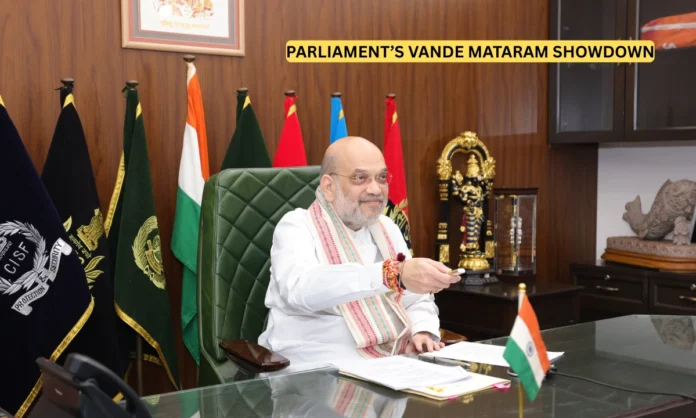
A fierce political confrontation erupted in Rajya Sabha on December 9, 2025, when Union Home Minister Amit Shah Vande Mataram remarks triggered sharp exchanges with opposition Congress leaders over the timing and purpose of a parliamentary debate commemorating 150 years of India’s national song. The Amit Shah Vande Mataram controversy centers on Congress MP Priyanka Gandhi Vadra’s allegation that the NDA government orchestrated the discussion with West Bengal assembly elections in mind, scheduled for 2026. Responding without naming her directly, Amit Shah Vande Mataram defense emphasized that the patriotic composition transcends regional boundaries and electoral calendars, asserting its universal significance among Indian freedom fighters and armed forces personnel.
The Amit Shah Vande Mataram debate gained intensity when the Home Minister directly criticized India’s first Prime Minister Jawaharlal Nehru for restricting the song to two stanzas on its 50th anniversary, characterizing this as the beginning of appeasement politics that ultimately led to Partition. Shah’s Amit Shah Vande Mataram speech also targeted former Prime Minister Indira Gandhi, recalling the Emergency period when those chanting the national song faced imprisonment. Congress President Mallikarjun Kharge immediately countered the Amit Shah Vande Mataram allegations by beginning his address with the national song itself, defending the 1937 Congress Working Committee decision as a unanimous resolution rather than individual action by Nehru.
Historical Context and 150-Year Legacy
The Amit Shah Vande Mataram parliamentary discussion marks a century and a half since Bengali writer Bankim Chandra Chattopadhyay first composed the song in 1875, later publishing it in his 1882 novel “Anandamath”. The Government of India officially recognized this milestone through a Press Information Bureau release on October 31, 2025, documenting that Vande Mataram was first sung publicly at the 1896 Indian National Congress session in Calcutta . During the Amit Shah Vande Mataram address, the Home Minister emphasized that the composition became the rallying cry for independence activists across continents, not merely within Bengal’s borders.
Key Historical Milestones of Vande Mataram:
- 1875: Bankim Chandra Chattopadhyay composes Vande Mataram in Bengali
- 1882: Published in novel “Anandamath” during British colonial rule
- 1896: First public singing at Indian National Congress session, Calcutta
- 1937: Congress Working Committee adopts first two stanzas for official occasions
- January 24, 1950: Constituent Assembly designates Vande Mataram as National Song of India
The Amit Shah Vande Mataram historical references highlighted that Rabindranath Tagore himself sang the composition at the 1896 Congress session, establishing its early connection with the independence movement . Shah’s Amit Shah Vande Mataram parliamentary remarks stressed that freedom fighters meeting in underground hideouts worldwide used these words as their greeting, demonstrating the song’s role beyond geographical constraints. The Home Minister’s Amit Shah Vande Mataram position countered suggestions that discussing the song’s significance stems from electoral calculations rather than genuine national commemoration.
| Year | Event | Significance |
|---|---|---|
| 1875 | Composition by Bankim Chandra | Original creation of patriotic poem |
| 1896 | First public performance | Sung by Tagore at INC session |
| 1937 | Congress resolution | Two stanzas adopted officially |
| 1950 | Constitutional status | Designated National Song |
| 2025 | 150th anniversary | Parliamentary debate held |
The official government documentation confirms that the Constituent Assembly’s decision on January 24, 1950, elevated Vande Mataram to its constitutional status as India’s National Song, distinct from the National Anthem. During the Amit Shah Vande Mataram debate, this historical trajectory formed the foundation for arguing why a comprehensive parliamentary discussion remained necessary even 75 years after independence.
Political Clash: Amit Shah Versus Congress Leadership
The Amit Shah Vande Mataram confrontation with Congress intensified when Wayanad MP Priyanka Gandhi Vadra questioned the timing of the parliamentary discussion during her December 8 address. She argued that Amit Shah Vande Mataram debate served as a diversionary tactic ahead of West Bengal assembly elections, where the national song holds particular regional significance due to its Bengali origins. The Congress general secretary’s Amit Shah Vande Mataram criticism included questioning why the government refused to debate electoral reforms unless Parliament first discussed the national song.
Priyanka Gandhi’s Main Arguments:
- Timing coincides suspiciously with approaching West Bengal polls in 2026
- Song has occupied hearts for 150 years without requiring debate
- Government using historical symbols to avoid discussing present challenges
- NDA objectives focus on past rather than addressing current issues
Responding to these charges, the Amit Shah Vande Mataram rebuttal emphasized that the Home Minister accused certain members of attempting to diminish the national song’s glory by connecting it to electoral politics. Shah’s Amit Shah Vande Mataram counter-argument stated that while Bankim Chandra Chattopadhyay was indeed born in Bengal, the composition’s impact spread far beyond one state or even the Indian subcontinent. The Amit Shah Vande Mataram defense noted that Indian troops at borders and internal security personnel sacrifice their lives with these words on their lips, making the discussion perpetually relevant.
The Amit Shah Vande Mataram attack on Nehru’s legacy proved particularly controversial when the Home Minister directly linked the first Prime Minister’s decision to restrict the song to two stanzas with the eventual Partition of India. This Amit Shah Vande Mataram claim about appeasement politics ignited immediate pushback from Congress President Mallikarjun Kharge, who began his response by chanting Vande Mataram before defending the 1937 Congress Working Committee resolution. Kharge’s Amit Shah Vande Mataram counter-response highlighted that Congress initiated the tradition of singing Vande Mataram at party conventions and made it central to freedom struggle mobilization.
The 1937 Resolution Controversy
Central to the Amit Shah Vande Mataram debate lies the contested interpretation of the October 1937 Congress Working Committee resolution that recommended singing only the first two stanzas at national events. The Amit Shah Vande Mataram criticism of this decision characterized it as the beginning of appeasement that Shah claims led to Partition. Historical documents reveal that this resolution emerged from consultations between party leaders, including correspondence between Nehru and Subhas Chandra Bose regarding concerns raised by Muslim League members.
The 1937 Congress Working Committee Resolution Details:
- Passed unanimously by entire committee, not unilateral decision
- Recommended first two stanzas for singing at national functions
- Addressed concerns from various community representatives
- Nehru’s letter to Bose discussed balancing unity with cultural sensitivity
During the Amit Shah Vande Mataram parliamentary exchange, Congress leaders defended that Nehru did not act alone when the resolution passed, making it unfair to single him out for criticism. The Amit Shah Vande Mataram allegations prompted Kharge to directly challenge the Prime Minister and Home Minister about their own party’s past alliances, specifically referencing BJP’s coalition with Muslim League in Bengal. This Amit Shah Vande Mataram back-and-forth revealed deeper disagreements about how to interpret decisions made during the independence movement within contemporary political contexts.
The Amit Shah Vande Mataram statements about Indira Gandhi added another dimension when the Home Minister recalled that the song’s 100th anniversary in 1975 occurred during the Emergency, when opposition members chanting Vande Mataram faced imprisonment. This Amit Shah Vande Mataram comparison between different eras of Congress leadership aimed to establish a pattern of what Shah termed insufficient respect for the national song. However, Kharge’s Amit Shah Vande Mataram rebuttal emphasized that Congress made Vande Mataram the primary slogan for Indian freedom and established its ceremonial importance decades before independence.
| Leader | Position on Vande Mataram | Key Argument |
|---|---|---|
| Amit Shah | Full song should have remained unchanged | Two-stanza decision led to appeasement, Partition |
| Priyanka Gandhi | Debate timing politically motivated | Discussion targets West Bengal elections |
| Mallikarjun Kharge | 1937 resolution was unanimous | Congress established Vande Mataram’s national role |
| Jawaharlal Nehru (1937) | Two stanzas for official functions | Balanced unity concerns with patriotic expression |
The Amit Shah Vande Mataram controversy also touched on broader questions of parliamentary functioning, with Shah asserting that the government welcomes all debates and never boycotts Parliament sessions. This Amit Shah Vande Mataram assertion positioned the NDA as transparent and unafraid of discussions, contrasting with what Shah characterized as opposition attempts to avoid addressing the national song’s significance.
Electoral Context and West Bengal Connection
The Amit Shah Vande Mataram timing debate cannot be separated from West Bengal’s upcoming assembly elections scheduled for 2026, where the state’s 294 constituencies will vote to determine the next government. The Amit Shah Vande Mataram discussion holds particular resonance in Bengal since Bankim Chandra Chattopadhyay, the song’s composer, hailed from the state and first published the work in Bengali. Opposition leaders like Priyanka Gandhi seized on this connection, arguing the Amit Shah Vande Mataram parliamentary debate represents calculated political messaging to Bengal voters ahead of elections.
West Bengal Electoral Significance:
- Assembly elections due in 2026 with 294 seats at stake
- Vande Mataram’s Bengali origins make it emotionally resonant in state
- BJP seeks to expand presence after making gains in 2021 elections
- Cultural and patriotic symbols play significant role in Bengal politics
The Amit Shah Vande Mataram defense explicitly rejected this electoral framing, with the Home Minister asserting that the song’s importance extends far beyond one state’s political calendar. Shah’s Amit Shah Vande Mataram argument emphasized that dedication to the national song was necessary when it was written in 1875, when India gained independence in 1947, today in 2025, and will remain essential even in 2047 when India marks its centenary of independence. This Amit Shah Vande Mataram perspective attempted to elevate the discussion above immediate electoral considerations.
However, political analysts note that the Amit Shah Vande Mataram controversy emerged as Parliament witnessed disruptions over various issues, with the government agreeing to this specific discussion while opposition sought debates on electoral reforms and other governance matters. The Amit Shah Vande Mataram parliamentary scheduling thus became emblematic of larger tensions between ruling and opposition parties over legislative priorities. Kharge’s Amit Shah Vande Mataram closing statement argued that true tribute to Bharat Mata would involve Parliament functioning effectively on issues directly affecting citizens’ daily lives.
Closing Assessment
The Amit Shah Vande Mataram parliamentary confrontation on December 9, 2025, exposed enduring tensions between India’s major political parties over how to interpret independence-era decisions and honor national symbols without politicizing them. The Amit Shah Vande Mataram debate succeeded in generating extensive public discourse about the song’s 150-year history, though questions remain whether this discussion advanced national unity or deepened partisan divisions. The Amit Shah Vande Mataram controversy ultimately reflects broader challenges democracies face when historical narratives become contested terrain in contemporary electoral battles.
As the Amit Shah Vande Mataram exchanges demonstrated, even universally respected patriotic symbols can become flashpoints when timing and context suggest political motivations. The Amit Shah Vande Mataram discussion revealed that Congress and BJP fundamentally disagree not just on policy but on historical interpretation itself, particularly regarding Nehru’s legacy and the 1937 Congress Working Committee resolution. Whether the Amit Shah Vande Mataram parliamentary debate genuinely honored the national song’s sesquicentennial or primarily served electoral positioning ahead of West Bengal polls will likely remain subject to partisan interpretation, mirroring the very divisions the discussion ostensibly sought to bridge.