
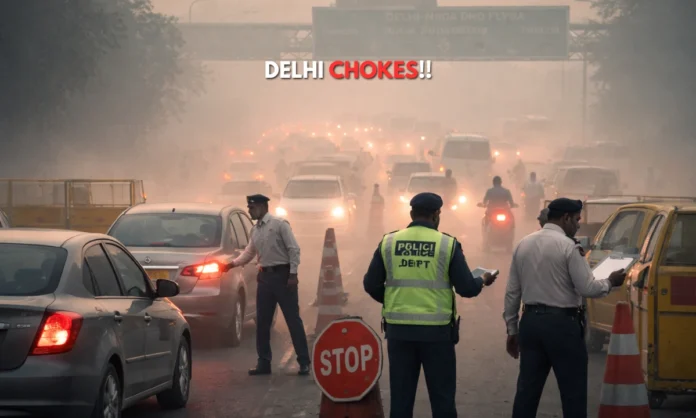
Key Highlights
- Delhi-NCR air quality hits hazardous levels with AQI around 490 at Chilla border, triggering GRAP Stage IV restrictions on non-BS VI vehicles from outside the capital.
- Enforcement teams impose Rs 20,000 fines or U-turns on old commercial/private vehicles without PUCC, amid reduced visibility from thick smog.
- Transport sector contributes 20-40% to winter PM2.5, with 37% of vehicles BS-III or older emitting high pollutants.
Opening Overview
Delhi air pollution has reached a critical stage this December 2025, as toxic smog blankets the Delhi-Noida border at the DND Flyway, slashing visibility and pushing AQI into the hazardous category near 490. On this hazy Thursday, Delhi Police and transport teams ramped up checks under GRAP Stage IV, barring non-BS6 vehicles registered outside Delhi. Officers like Deepak from the Delhi transport department emphasized strict enforcement: Rs 20,000 challans or forced U-turns for violators, plus fines for missing Pollution Under Control Certificates (PUC).
This escalation reflects a recurring winter nightmare for Delhi air pollution, where cold air traps emissions, stubble burning residues, and industrial outflows. With 93% of NCR’s 2.88 crore vehicles being light motor vehicles and two-wheelers, transport alone fuels over 20% of PM2.5 in winter. GRAP measures aim to curb this, but public frustration mounts, as seen with Faridabad resident Rakesh fined for his BS3 Hyundai Creta. He questioned unchecked government buses amid random stops.
Broader Delhi air pollution patterns show November 2025 averaged AQI 357, with three severe days, per Central Pollution Control Board data. As temperatures dip to 5°C, inversion layers lock pollutants, demanding coordinated action beyond borders.
Headline Management
— Saurabh Bharadwaj (@Saurabh_MLAgk) December 18, 2025
BJP Govt is just doing headline management to fool people and Supreme Court
There is no one at Delhi borders to check & restrict entry of Vehicles below BS VI
Newspapers have dedicatee full pages to this so called Govt Action.
But in reality, there is no… pic.twitter.com/8nwxdbqzWT
GRAP Enforcement at Entry Points
- Delhi-NCR borders see barricades and portable scanners verifying BS norms and PUC validity instantly.
- Focus on 10-year-old diesel, 15-year-old petrol vehicles under BS-III or lower, with UP Traffic Police targeting non-BS6 cars lacking blue stickers.
Delhi air pollution controls intensified at key entry points like DND Flyway and Chilla, where thick smog reduced visibility to meters. Teams deploy across checkpoints, ensuring no escape via alternate routes. Delhi transport officer Deepak noted media awareness campaigns urge compliance, yet hackers issue fake PUCs, complicating efforts.
| GRAP Stage IV Vehicle Restrictions | Details |
|---|---|
| Non-BS VI Commercial Vehicles | Banned entry; Rs 20,000 fine or U-turn |
| Private Non-BS VI Vehicles | Similar penalties; PUC checks mandatory |
| BS-III Diesel (10+ years) | Fined or turned back |
| BS-III Petrol (15+ years) | Targeted enforcement |
This table highlights targeted measures, drawing from Commission for Air Quality Management protocols. Enforcement spans Delhi Traffic Police and NCR states, though interstate coordination lags. Experts like former Transport Commissioner Anil Chhikara call for practical tailpipe checks and dedicated task forces to sustain Delhi air pollution fight.
Vehicle scrappage policies gain urgency, as 37% of NCR fleet emits 31 times more particulates. Public transport upgrades could offset bans, reducing reliance on polluting older models.
Vehicular Emissions’ Role in Smog
- Transport accounts for 20-40% of Delhi winter PM2.5; older vehicles emit 16x more NO2.
- 93% fleet is two-wheelers/light vehicles; BS-III/older dominate high emitters.
Delhi air pollution stems heavily from vehicular sources, with Central Pollution Control Board estimating 20% PM2.5 contribution in winter. Low-speed traffic in smog exacerbates this, as idling engines spew more toxins. GRAP Stage IV bans aim to filter dirty inflows, but NCR’s 2.88 crore vehicles challenge scalability.
Official data underscores the scale: India Meteorological Department links cold snaps below 10°C to AQI spikes above 400. Stubble burning tapers post-November, yet vehicular dominance persists.
| Pollutant Contribution in Delhi Winter PM2.5 | Percentage |
|---|---|
| Transport Emissions | 20-40% |
| Industrial/Other | 30-40% |
| Biomass Burning Residue | 20-30% |
| Secondary Aerosols | 10-20% |
This breakdown, aligned with CPCB forecasts, reveals transport’s outsized impact. PUC systems falter on particulates, pushing for advanced norms like BS-VI nationwide. Strengthening enforcement with real-time monitoring could cut emissions faster.
Health and Economic Toll of Toxic Air
- Hazardous AQI 490+ poses risks even to healthy; cancer links rise per oncologists.
- Flight delays, over 8 lakh PUC fines signal economic strain.
Delhi air pollution inflicts severe health costs, with AQI 400+ deemed severe by CPCB, harmful to all. Winter peaks trap PM2.5, linked to respiratory issues and rising lung cancer cases. Visibility drops trigger 250+ flight delays, disrupting commerce.
Economic fallout mounts: Delhi Traffic Police fined 8 lakh vehicles for PUC lapses. GRAP work-from-home orders hit productivity, while crop damage from inversions affects farmers.
| Delhi AQI Trends (Nov-Dec 2025) | Average AQI | Days Severe |
|---|---|---|
| November | 357 | 3 |
| Early December | 300-450 | Multiple |
| Chilla Border (Dec 18) | ~490 | 1+ |
CPCB data shows inverse temperature-AQI correlation, with 5°C lows fueling spikes. Broader measures like electric vehicle push and metro expansion offer long-term relief from Delhi air pollution cycles.
Expert Calls for Systemic Reforms
- Scrappage, public transport, tailpipe enforcement needed beyond bans.
- Interstate coordination vital despite aligned state governments.
Delhi air pollution demands holistic fixes, as experts decry knee-jerk GRAP reliance. Anil Chhikara urges pollution task forces and fake PUC crackdowns. WHO guidelines flag PM2.5 exceeding 5 µg/m³ annually as risky; Delhi far surpasses.
CAQM’s Early Warning System predicts transboundary flows, yet coordination falters. RBI reports pollution costs India 3% GDP yearly in health/economy hits, spotlighting urgency.
Renewable energy shifts and green corridors could transform NCR mobility. Political will, paired with awareness, holds promise against entrenched Delhi air pollution.
Closing Assessment
Delhi air pollution persists as a man-made crisis, with GRAP Stage IV vehicle curbs offering temporary respite amid AQI 490 hazards. Enforcement at borders curbs inflows, yet vehicular emissions’ 20-40% PM2.5 share demands scrappage acceleration and public transport overhaul. Official CPCB data reveals winter patterns locked by cold inversions, urging sustained interstate action.
This episode underscores unsustainable last-minute fixes; proactive tailpipe norms and EV incentives beckon. Citizens bear fines, but systemic change promises cleaner air. Will NCR leaders prioritize coordination over politics in battling Delhi air pollution?