
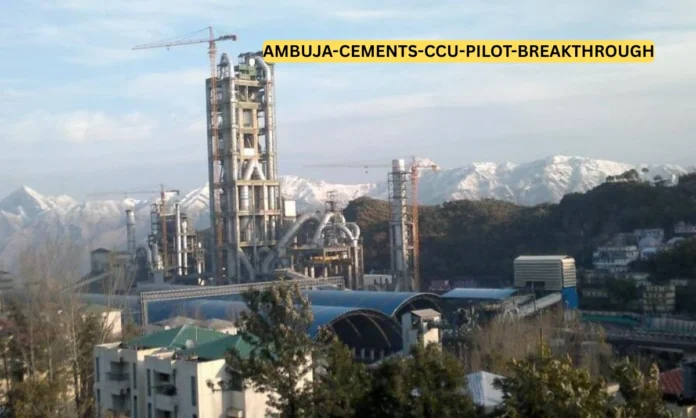
Key highlights:
- Ambuja Cements CCU pilot is the first Indo‑Swedish carbon capture and utilisation project sanctioned in the global cement sector, in partnership with IIT Bombay and Sweden’s Eco Tech.
- The pre‑pilot study will test the feasibility of capturing CO₂ from cement operations and converting it into materials like calcium carbonate and green methanol using green hydrogen pathways.
- The initiative builds on Ambuja’s SBTi‑validated net‑zero roadmap, backed by 1 GW captive renewables, 376 MW waste‑heat recovery and deployment of Coolbrook’s RotoDynamic Heater technology.
Opening overview
Ambuja Cements CCU pilot has placed the company at the centre of a landmark Indo‑Swedish effort to decarbonise one of the world’s hardest‑to‑abate industries, making it the first cement producer to secure such a bilateral grant for carbon capture and utilisation. The pre‑pilot technology feasibility study will capture CO₂ from cement operations and channel it into value‑added products like calcium carbonate and green methanol, pivoting from simple carbon storage to an industrial model where emissions become feedstock.
This Ambuja Cements CCU pilot is being developed with IIT Bombay’s National Centre of Excellence in Carbon Capture Utilisation and Storage and Sweden’s Eco Tech, aligning domestic research strength with Scandinavian expertise in low‑carbon process design. The project comes at a time when cement is estimated to account for roughly 7–8 per cent of global energy‑related CO₂ emissions and is routinely classified as a hard‑to‑abate sector by international climate and industry bodies, placing real pressure on producers to adopt breakthrough technologies rather than incremental fixes.
For India, which has committed to a net‑zero target year of 2070 and is steadily rolling out industrial decarbonisation initiatives across cement and steel, the Ambuja Cements CCU pilot serves as a test case for how advanced capture and utilisation solutions can be integrated into existing plants at scale. By positioning the pilot within a wider Indo‑Swedish green‑industry programme, policymakers and industry leaders are attempting to show that climate‑aligned growth and heavy‑industry expansion can move in tandem.
Inside the Indo‑Swedish CCU pilot design
- Ambuja Cements CCU pilot will evaluate both technical performance and economic viability of integrating carbon capture directly with cement production lines.
- The project’s core differentiator is its strong emphasis on utilisation pathways, particularly conversion of captured CO₂ into calcium carbonate and green methanol.
At the heart of the Ambuja Cements CCU pilot is an Indo‑Swedish grant that supports a detailed pre‑pilot study, co‑anchored by Indian and Swedish agencies working together on green‑industry collaborations. Ambuja Cements will provide the industrial platform and operational data, while IIT Bombay brings deep expertise in capture, mineralisation and process integration, and Eco Tech focuses on optimising energy demand, harnessing waste heat and aligning the system with renewable electricity and heat sources.
The feasibility work under the Ambuja Cements CCU pilot is expected to cover capture efficiency, CO₂ purity requirements, energy intensity and retrofit integration at cement kilns, as well as the costs and revenue potential associated with downstream products. Calcium carbonate derived from captured CO₂ can feed into construction materials and speciality applications, while green methanol produced via green hydrogen routes has potential as a low‑carbon fuel and chemical feedstock.
Crucially, the project is being framed as a step towards scalable, industry‑ready solutions rather than a small, isolated experiment, with the Ambuja Cements CCU pilot expected to generate design and economics data that can inform replication at other Indian cement plants. For policymakers and technology providers, such data is vital in de‑risking investment decisions and shaping supportive regulations and financing tools that can unlock larger deployment of CCU technologies across the cement value chain.
Why CCU is becoming central to India’s cement decarbonisation
- Cement’s share in India’s industrial emissions makes projects like the Ambuja Cements CCU pilot critical for any realistic net‑zero pathway.
- India and Sweden are using joint CCU projects to demonstrate that advanced climate technologies can be deployed in growing heavy‑industry economies.
Cement and related mineral industries are among the largest contributors to industrial CO₂ emissions in India, a reality that has prompted authorities to support at least five dedicated CCU testbeds focused on cement plant decarbonisation. These initiatives are designed to explore how carbon capture, utilisation and, where necessary, storage can address both process emissions from clinker production and combustion emissions from fuel use. In this context, the Ambuja Cements CCU pilot is not an isolated corporate project, but part of an emerging ecosystem of testbeds and collaborations that seek to industrialise CCU technologies in real‑world operating environments.
India’s collaboration with Sweden, supported by agencies such as the Department of Science and Technology and Swedish innovation and energy bodies, extends across cement and steel and targets a mix of fossil‑free processes, hydrogen‑based routes and CCU solutions. Under these arrangements, the Ambuja Cements CCU pilot sits within a portfolio of projects explicitly aimed at advancing India’s net‑zero plans while opening opportunities for Swedish technology providers in a rapidly growing market.
For a country where cement demand is expected to remain strong because of infrastructure, housing and industrial investment, utilisation‑focused CCU offers an appealing proposition, as seen in the design of the Ambuja Cements CCU pilot. Converting CO₂ into commercial products creates the possibility of new revenue streams and export‑oriented green materials, which can improve the business case for capturing emissions while supporting job creation and technological upgrading in domestic industry.
India’s emerging CCU and green‑industry initiatives
| Initiative / testbed focus | Sector focus | Key partners involved | Stated goal or outcome |
|---|---|---|---|
| CCU testbeds in cement clusters in multiple Indian states | Cement | Department of Science & Technology, Indian cement producers, academic institutions | Capture CO₂ from operating cement plants and convert it into fuels, chemicals and aggregates |
| Indo‑Swedish green‑industry programme for cement and steel | Cement and steel | India DST, Swedish Energy Agency and associated innovation bodies, industry partners | Demonstrate deep‑decarbonisation technologies including CCU, hydrogen routes and fossil‑free processes |
| Ambuja Cements CCU pilot pre‑feasibility study | Cement | Ambuja Cements, IIT Bombay, Eco Tech Sweden | Assess technical and economic viability of capturing CO₂ and converting it into green materials and fuels |
These initiatives show how the Ambuja Cements CCU pilot aligns with a broader policy push to create a pipeline of low‑carbon technologies across India’s most emission‑intensive sectors.
Ambuja’s broader net‑zero roadmap and how CCU fits in
- The Ambuja Cements CCU pilot builds on a decarbonisation strategy that has already been validated by the Science Based Targets initiative.
- Large‑scale renewable power, waste‑heat recovery and electrification technologies are being scaled in parallel with CCU.
Ambuja Cements, part of the diversified Adani portfolio, is described as the ninth‑largest building materials solutions company globally, with a significant footprint in India’s cement market. The company has publicly stated that its net‑zero roadmap has been validated by the Science Based Targets initiative, indicating that its decarbonisation plan is aligned with science‑based trajectories for limiting global temperature rise. The Ambuja Cements CCU pilot is being presented internally as a “final step” in this journey, complementing earlier measures rather than substituting for them.
A major element of the roadmap is the build‑out of around 1 GW of captive solar‑wind capacity dedicated to Ambuja’s operations, aimed at reducing dependence on emissions‑intensive grid electricity and supporting future electrified process technologies. In parallel, the company is expanding its waste‑heat recovery portfolio to about 376 MW, using heat from kilns and clinker coolers that would otherwise be lost, to generate power and cut fuel use. Ambuja has also announced what it calls the world’s first commercial deployment of Coolbrook’s RotoDynamic Heater technology in cement, an electrification solution designed to deliver high‑temperature process heat using renewable electricity.
The Ambuja Cements CCU pilot enters this landscape as an additional lever that directly tackles process emissions that cannot easily be avoided through efficiency or fuel switching alone. Alongside this, the company refers to its adoption of TNFD‑aligned disclosures, biodiversity initiatives and “Agentic AI” systems for operational optimisation, strengthening the signal that decarbonisation is part of a wider sustainability and risk‑management transformation across its cement business.
Ambuja’s key decarbonisation levers
| Decarbonisation measure | Description | Reported scale / status | Strategic role |
|---|---|---|---|
| Ambuja Cements CCU pilot | Pre‑pilot feasibility for carbon capture and utilisation with IIT Bombay and Eco Tech, Sweden | First Indo‑Swedish CCU pilot in the global cement sector | Convert CO₂ into green materials and fuels, enable a circular carbon model in cement |
| Renewable power build‑out | Captive solar‑wind projects supplying cement operations | Around 1 GW of planned capacity | Reduce scope‑2 emissions and support electrified technologies |
| Waste‑heat recovery systems | Utilisation of low‑grade heat from kilns and coolers | About 376 MW of WHR capacity | Lower fuel use and improve plant energy efficiency |
| RotoDynamic Heater technology | High‑temperature process electrification using Coolbrook’s system | World’s first commercial deployment in cement, according to Ambuja | Enable deeper process decarbonisation when powered by renewables |
By combining these measures with the Ambuja Cements CCU pilot, the company is seeking to cover both energy‑related and process‑related emissions while building resilience against tightening climate regulations and investor scrutiny.
Global implications and what to watch next
- Success of the Ambuja Cements CCU pilot could provide a replicable template for other cement plants in India and abroad.
- The project may influence green‑product markets, investment flows and regulatory approaches to CCU in heavy industry.
If the Ambuja Cements CCU pilot can demonstrate high capture rates, manageable energy penalties and commercially viable utilisation pathways, it is likely to be closely studied by other producers and industry platforms that track cement decarbonisation. India has already launched several CCU‑related testbeds, and a successful pre‑pilot at an established player such as Ambuja would strengthen the case for wider deployment across clusters where technical and financial barriers are still perceived as high.
The pilot also has potential implications for emerging markets in low‑carbon construction materials, synthetic fuels and green chemicals, since CO₂‑derived calcium carbonate and methanol sit within value chains that international agencies consider crucial for deep decarbonisation. As more lenders, investors and rating agencies look for SBTi‑aligned plans, TNFD‑style disclosures and credible transition strategies, initiatives like the Ambuja Cements CCU pilot can shape perceptions of the cement sector’s readiness to engage with advanced climate technologies rather than relying solely on incremental efficiency gains.
The Indo‑Swedish dimension adds another layer of relevance, mirroring a broader trend in which countries with strong technology and innovation ecosystems partner with large emerging economies where future emissions growth is concentrated. In this sense, the Ambuja Cements CCU pilot is part of a larger experiment in climate‑technology diplomacy, with lessons likely to inform not only corporate strategy but also bilateral and multilateral cooperation models in industry decarbonisation.
Closing assessment
The Ambuja Cements CCU pilot stands out as a defining test of whether carbon capture and utilisation can move from promising concept to commercially meaningful practice within India’s rapidly expanding cement industry. By linking a major domestic producer with IIT Bombay’s research capabilities and Eco Tech’s Swedish process‑optimisation expertise, the project combines industrial scale, scientific depth and international technology inputs in a single platform. For India’s policymakers, the pilot offers a real‑world proving ground that can inform standards, incentives and regulatory frameworks for CCU deployment across multiple plants and regions.
As Ambuja’s SBTi‑validated roadmap, large renewable pipeline, extensive waste‑heat recovery assets and early move into process electrification converge with this new CCU initiative, the company is positioning itself as a reference case for climate‑aligned cement manufacturing in a major emerging economy. Yet the ultimate impact of the Ambuja Cements CCU pilot will hinge on more than tonnes of CO₂ captured: success will also depend on whether it can unlock robust markets for CO₂‑derived products, crowd in follow‑on capital and reduce perceived technology risk for the broader sector.
With India aiming for net‑zero by 2070 and global attention increasingly focused on heavy‑industry transitions, pilots of this kind are likely to be tracked closely by investors, regulators and communities as indicators of how decisively cement producers are responding to the climate challenge. If the Ambuja Cements CCU pilot delivers on its promise, it could not only transform one company’s emissions profile, but also accelerate a shift towards a circular carbon economy across the cement industry in India and beyond.