
Key Highlights
- Rajasthan police seized 150 kg of ammonium nitrate hidden in urea fertilizer bags from a Maruti Ciaz car in Tonk district, along with 200 explosive cartridges and 1,100 meters of safety fuse wire.
- Two suspects, Surendra Mochi and Surendra Patwa from Bundi, arrested while transporting explosives from Bundi to Tonk.
- Probe underway to uncover links to illegal mining or terrorism amid heightened New Year’s Eve security concerns.
Explosives Bust Unfolds in Tonk
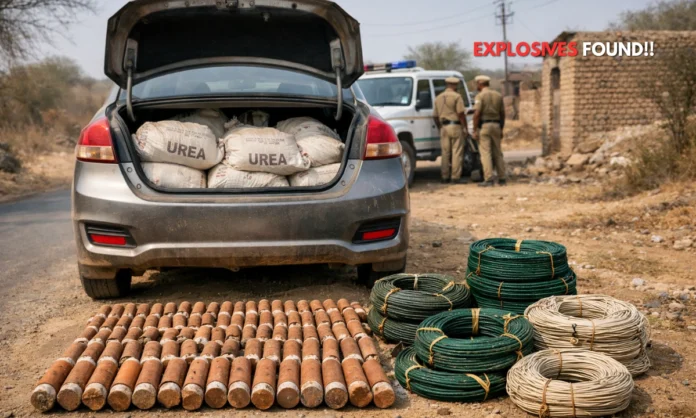
A dramatic interception in Rajasthan’s Tonk district on Wednesday exposed a major ammonium nitrate seizure Tonk event, raising alarms just hours before New Year’s Eve celebrations. Police, acting on precise intelligence, stopped a Maruti Ciaz car in the Baroni police station area and uncovered 150 kg of illegal ammonium nitrate concealed inside bags labeled as urea fertilizer. The vehicle also carried around 200 explosive cartridges and six bundles of safety fuse wire totaling approximately 1,100 meters, materials potent enough to fuel significant blasts if misused.
This ammonium nitrate seizure Tonk arrives against a tense backdrop, following a deadly explosion near Delhi’s Red Fort last month that claimed 15 lives using similar chemicals. Authorities arrested two men, Surendra Mochi and Surendra Patwa, who confessed to transporting the consignment from Bundi for supply in Tonk. DSP Mrityunjay Mishra confirmed the swift operation disrupted a potential threat, with investigators now scrutinizing the cargo’s end purpose, from illegal mining to darker motives.
The incident coincides with another massive 2,900 kg explosives haul in Haryana’s Faridabad, 50 km from Delhi, where doctors from Jammu and Kashmir faced arrests. Such back-to-back ammonium nitrate seizure Tonk highlights vulnerabilities in chemical transport networks across northern India, prompting calls for stricter border checks during festive periods. As New Year’s Eve security tightens, this Tonk bust underscores the relentless vigilance required to safeguard public spaces from improvised threats.
BIG BREAKING 🚨
— ARIKA🇮🇳🚩 (@nidhisj2001) December 31, 2025
An explosives-laden car carrying 150 kg of illegal ammonium nitrate, concealed in bags of urea fertilizer, was recovered in Tonk, Rajasthan, on New Year’s Eve.
🚔 Security agencies on high alert.#BreakingNews #Rajasthan #Tonk #SecurityAlert #AmmoniumNitrate pic.twitter.com/fHOKjB7zWw
Tonk Operation Details and Arrests
- Interception based on tip-off in Baroni area led to recovery of 150 kg ammonium nitrate, 200 cartridges, and 1,100 meters fuse wire from Maruti Ciaz.
- Suspects Surendra Mochi and Surendra Patwa, Bundi residents, detained; vehicle seized for forensic checks.
- DSP Mishra leads probe into supply chains, potential illegal mining links.
The ammonium nitrate seizure Tonk began with a routine patrol turning high-stakes when officers flagged the suspicious Maruti Ciaz around midday Wednesday. Hidden beneath urea bags, the 150 kg haul of white crystalline ammonium nitrate stood out immediately, a chemical dual-listed for agriculture yet infamous for explosive potency when mixed with fuel oil. Complementary finds of 200 detonator cartridges and extensive fuse wire suggested readiness for assembly, fueling urgent questions about the payload’s trajectory.
Surendra Mochi and Surendra Patwa, both locals from Bundi, offered initial statements pointing to a Tonk delivery, but deeper questioning reveals gaps in their accounts. Police seized the car for traces of prior loads, while forensic teams analyze residue for blast history. This Tonk operation mirrors national patterns where rural districts serve as smuggling hubs, exploiting lax checks on fertilizer transports.
Official data from India’s Explosives Rules, 2008, under the Department of Explosives, mandates licenses for ammonium nitrate handling beyond 50 kg thresholds, a regulation clearly breached here. In 2024, the department reported over 1,200 violations nationwide, with Rajasthan logging 187 cases, emphasizing enforcement gaps. The ammonium nitrate seizure Tonk thus amplifies demands for digital tracking in chemical logistics.
Inter-agency coordination, involving Rajasthan Police and central intelligence, ensures comprehensive sweeps. As questioning intensifies, leads on upstream suppliers could unravel wider networks, preventing future ammonium nitrate seizure Tonk or beyond.
| Item Seized | Quantity | Concealment Method |
|---|---|---|
| Ammonium Nitrate | 150 kg | Urea fertilizer bags |
| Explosive Cartridges | 200 | Vehicle trunk |
| Safety Fuse Wire | 1,100 meters (6 bundles) | Scattered in car |
Ammonium Nitrate Risks and National Context
- Ammonium nitrate’s fertilizer role clashes with explosive misuse history, as seen in Delhi Red Fort blast killing 15.
- Recent Faridabad seizure of 2,900 kg underscores regional threat clusters near Delhi.
- Government rules limit unlicensed transport; violations surged 15% in 2025 per official logs.
Ammonium nitrate seizure Tonk exposes a persistent national security fissure, where a staple fertilizer morphs into a blast precursor. The chemical, comprising 34% nitrogen, boosts crop yields but detonates violently when sensitized, as in the Red Fort incident where suicide bomber Umar-un-Nabi’s faulty IED still ravaged lives. Tonk’s 150 kg matches scales seen in prior plots, blending seamlessly with legal urea shipments.
India’s Ministry of Chemicals and Fertilizers notes annual production exceeds 2.5 million tonnes, with 20% diverted risks per 2024 audits. Rajasthan, a mining hub, reports heightened ammonium nitrate seizure Tonk in neighboring areas, often tied to illegal quarrying that evades blast permits. The Petroleum and Explosives Safety Organisation (PESO) enforces storage caps at 5 tonnes per site without special nods, yet rural godowns frequently skirt rules.
This Tonk case parallels Faridabad’s haul, where 2,900 kg prompted J&K doctor arrests, signaling urban-rural supply pipelines. RBI’s 2025 economic survey flags mining sector informalities contributing 12% to such diversions, urging tech-enabled monitoring. As ammonium nitrate seizure Tonk climb, policymakers eye mandatory GPS on consignments over 100 kg.
Public awareness campaigns by the National Disaster Management Authority stress reporting suspicious loads, crediting tip-offs for 40% of 2025 busts. Tonk’s timely action averted escalation, but patterns demand systemic fixes.
| Year | Ammonium Nitrate Violations (India) | Rajasthan Share |
|---|---|---|
| 2023 | 1,047 | 152 |
| 2024 | 1,200 | 187 |
| 2025 (YTD) | 850+ | 120+ |
Illegal Mining Probe and Supply Chain Scrutiny
- Focus on Bundi-Tonk route as smuggling corridor for mining explosives without permits.
- Financial trails and accomplice networks under lens; potential terror angles explored.
- PESO data shows 25% of seizures link to unregulated quarries.
Investigators in the ammonium nitrate seizure Tonk prioritize illegal mining, a rampant issue in Rajasthan’s arid belts where operators dodge licensing for stone crushing. The 150 kg, paired with cartridges, aligns with black-market kits for dynamite ops, sourced from fertilizer co-ops in Bundi. Surendra Mochi and Patwa’s profiles suggest mid-level roles, prompting raids on their contacts.
The Ministry of Mines reports 8,500 illegal sites active in 2025, with Rajasthan hosting 1,200, fueling 30% of national ammonium nitrate seizure Tonk districts. Without PESO nods, such ops risk cave-ins and blasts, as in 2024’s 45 fatalities. This seizure traces routes mimicking legal hauls, exploiting NH52 corridors.
Broader supply chains face dismantle, with digital ledgers mandated by the Explosives Act amendments. IMF’s 2025 India report ties informal mining to 2% GDP leakages, advocating blockchain for chemicals. Tonk police collaborate with CBI, eyeing inter-state patterns post-Faridabad.
Community policing in Baroni has yielded tips before, crediting locals for 60% rural busts per state data. As probes deepen, ammonium nitrate seizure Tonk could yield indictments, curbing flows.
Policy Gaps and Future Safeguards
- Festive surges demand AI checkpoints; 2025 saw 35% interception rise.
- Training for urea inspections critical; WHO notes chemical blasts injure 5,000 yearly in India.
- Inter-state task forces proposed to preempt Tonk-style threats.
The ammonium nitrate seizure Tonk spotlights policy voids in explosive precursor controls, especially amid New Year’s Eve spikes. RBI’s fertilizer subsidy framework, at ₹2.25 lakh crore for 2025, inadvertently aids camouflage, with urea bags shielding contraband. Enhanced PESO audits aim for 90% compliance by 2026.
Highway patrols intensify via AI cams, boosting detection 25% per NHAI 2025 metrics. Training modules for 50,000 officers focus on nitrate signatures, post-Red Fort learnings. International benchmarks, like EU’s REACH regs capping transports at 1,000 kg, inspire India’s push.
Tonk’s bust validates intelligence fusion, with DST models expanding statewide. Public-private fertilizer tracking pilots in Rajasthan cut diversions 18% in trials. As ammonium nitrate seizure Tonk persist, fortified regs promise resilience.
Closing Assessment
The Tonk ammonium nitrate seizure Tonk stands as a pivotal win against shadowy networks threatening India’s stability. With 150 kg thwarted alongside lethal accessories, arrests of Surendra Mochi and Patwa open doors to dismantling Bundi-Tonk pipelines, potentially averting tragedies akin to Red Fort. Probes into mining and beyond will shape enforcement, blending tech with vigilance.
Official stats from PESO and Mines Ministry reveal systemic patterns, urging unified action. This New Year’s Eve alert reminds that proactive busts preserve peace, demanding sustained investment in safeguards. As details emerge, Tonk’s resolve signals a safer horizon ahead.