

Key Highlights:
- Boston Brahmins were America’s hereditary elite, descended from Puritan settlers who dominated New England’s cultural and political landscape from the 18th to 20th centuries
- The term was coined by Oliver Wendell Holmes Sr. in 1861, referencing India’s highest caste to denote Boston’s wealthy, educated Protestant families
- These influential families founded Harvard University, Boston Latin School, and numerous cultural institutions while maintaining strict exclusivity through intermarriage and social barriers
The Origins and Historical Context of Boston Brahmins
The term “Boston Brahmins” emerged from a specific cultural and historical context that defined American aristocracy for over two centuries. Peter Navarro’s recent controversial comments about “Brahmins profiteering” in relation to India’s Russian oil trade has inadvertently thrust this distinctly American social class back into public discourse.
The Boston Brahmins represented America’s closest equivalent to a hereditary aristocracy, comprising wealthy, educated Protestant families who traced their lineage to the earliest English colonists and Puritan settlers of Massachusetts. These families consolidated power through generations of strategic marriages, institutional control, and cultural influence that extended far beyond Boston’s boundaries.
Physician and writer Oliver Wendell Holmes Sr. popularized the phrase in 1861 through his novel “Elsie Venner,” where he described Boston’s elite families as “the Brahmin Caste of New England”. Holmes deliberately borrowed the term from India’s highest caste, implying refinement, privilege, and inherent authority that these families believed destiny had bestowed upon them.
The Boston Brahmins maintained their influence through what scholars describe as a “peninsula city” advantage—Boston’s geography made it easier to control access and maintain exclusivity compared to other major American cities. This geographical isolation, combined with deliberate social barriers, allowed them to resist the waves of immigration that diluted elite influence in cities like New York and Chicago.
Wealth, Power, and Cultural Dominance in New England
- Boston Brahmin families built fortunes through shipping, manufacturing, and the China trade during the 18th and 19th centuries
- Their influence extended to politics, education, literature, and cultural institutions throughout New England
The economic foundation of Boston Brahmin power rested on maritime commerce, particularly the lucrative China trade, shipping, and later manufacturing ventures. Families like the Cabots engaged in carbon black manufacturing for tire production, while others dominated textiles, rum trading, and real estate development across the region.
The Cabot family exemplified this aristocratic wealth and exclusivity. Their prominence became so legendary that a local poem captured their social hierarchy: “And this is good old Boston, the home of the bean and the cod, where the Lowells talk only to Cabots, and the Cabots talk only to God”. This verse encapsulated the insularity and perceived superiority that defined Boston Brahmin society.
These families established a distinctive lifestyle characterized by Harvard education, Beacon Hill residences, specific dialect patterns, and carefully prescribed social rituals. They maintained power through intermarriage within their circle, creating what observers described as an “inbred quality” similar to strict caste marriages in traditional Indian society.
The Boston Brahmins’ cultural influence manifested through their patronage of arts and literature. They founded the Boston Symphony Orchestra, the Museum of Fine Arts, the Boston Athenaeum, and the Isabella Stewart Gardner Museum. Their literary contributions included prominent figures like poet T.S. Eliot, who ironically critiqued his own Brahmin heritage in works like “The Boston Evening Transcript.”
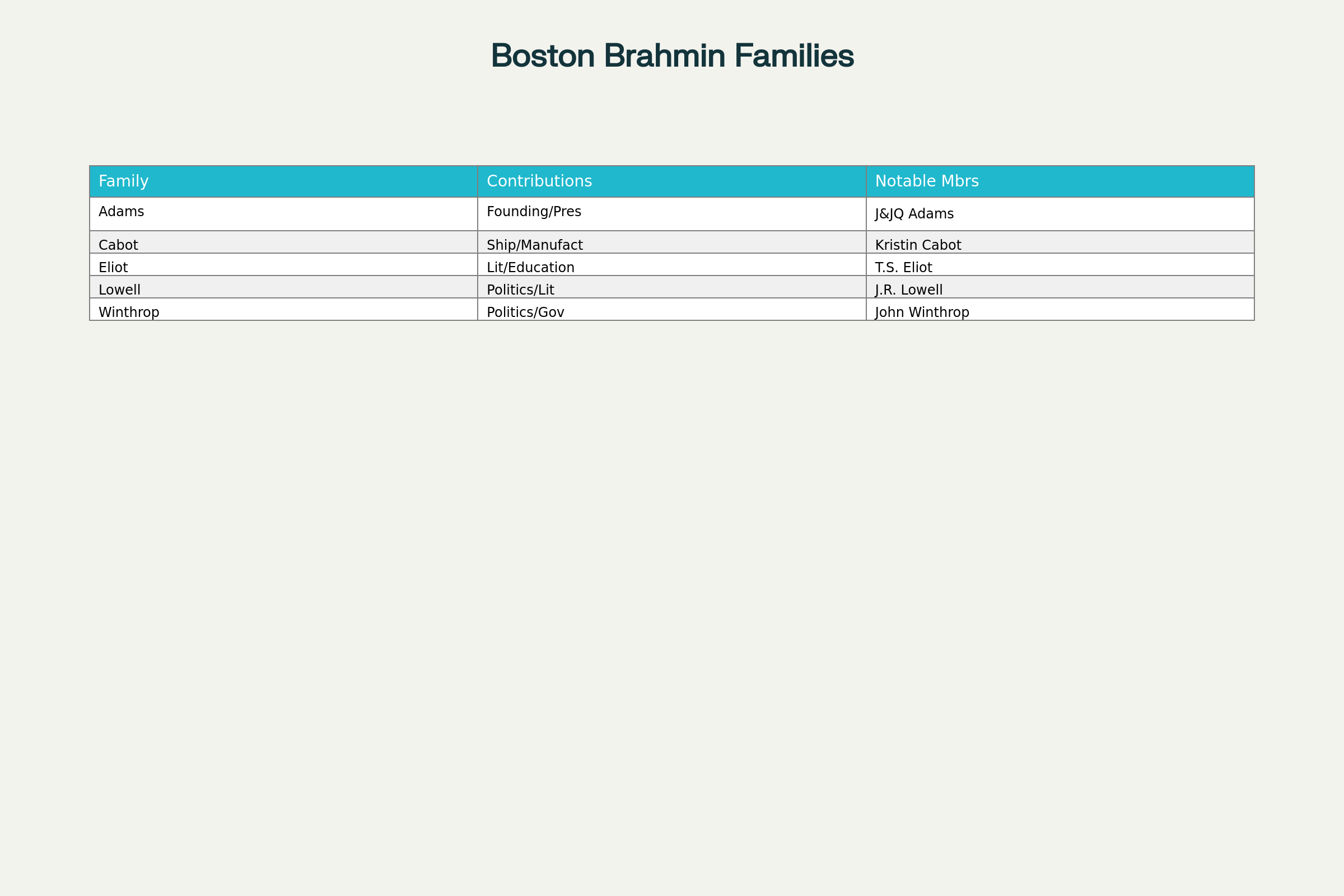
Prominent Boston Brahmin Families and Their Contributions
Educational Legacy and Institutional Control
- Harvard University became the crown jewel of Boston Brahmin educational influence, with elite families dominating its governance and student body
- Boston Brahmins established the first high school in America and numerous prestigious preparatory schools
Harvard University, founded in 1636, became the institutional cornerstone of Boston Brahmin influence. While not technically founded by Boston Brahmins themselves—the university predated the emergence of this specific social class—it became their primary vehicle for perpetuating cultural and educational values across generations.
The Great and General Court of the Massachusetts Bay Colony officially founded Harvard through a vote allocating £400 for “a schoale or colledge”. John Harvard, the university’s first major benefactor, donated half his estate and over 400 books to the institution, leading to its naming in 1639.
By the 1830s, Boston Brahmin families had gained control of Harvard’s governance through an elite corporation structure. They filled the university’s halls with their children and grandchildren, using the institution to transmit their educational and moral values to subsequent generations. This control extended beyond enrollment—Brahmin families influenced curriculum, faculty appointments, and institutional policies.
The Boston Brahmins’ educational influence extended far beyond Harvard. They founded Boston Latin School in 1635, which became the first high school in the United States. Their commitment to elite education led them to establish prestigious preparatory schools including Choate (now Choate Rosemary Hall), Groton, Andover, and Phillips Exeter.
This educational network created a pipeline that reinforced social exclusivity. Brahmin children attended these preparatory schools, proceeded to Harvard or other Ivy League institutions, and then returned to Boston to assume leadership positions in business, politics, and cultural institutions. This system perpetuated their influence well into the 20th century.
Political Influence and Social Exclusivity
- Notable Boston Brahmin political figures included Presidents John Adams, John Quincy Adams, and Franklin D. Roosevelt
- The families actively opposed immigration and founded organizations like the Immigration Restriction League in 1894
The political influence of Boston Brahmins extended to the highest levels of American government. The Adams family exemplified this political prominence, producing Founding Father Samuel Adams, President John Adams, and President John Quincy Adams. Franklin D. Roosevelt, though associated with New York, also traced his lineage to Boston Brahmin families.
These families viewed themselves as natural leaders of American democracy, believing their Puritan heritage and cultural refinement qualified them to guide the nation’s development. They championed causes like abolitionism while simultaneously maintaining strict social barriers against other groups seeking political or social advancement.
The Boston Brahmins’ approach to immigration revealed the contradictions in their democratic ideals. While they supported the abolition of slavery, they fiercely resisted the integration of Irish Catholic immigrants who arrived during the 1840s famine. Young Brahmin graduates founded the Immigration Restriction League in 1894, advocating for literacy tests and other barriers to limit immigration.
Henry Cabot Lodge Sr., a prominent Brahmin politician, sponsored congressional legislation requiring literacy tests for immigrants. This resistance to demographic change reflected their determination to preserve political and social control in an increasingly diverse America.
The families’ exclusivity extended to religious and cultural practices. They founded the New England Watch and Ward Society, a puritanical organization active from 1878 to the 1920s that advocated book bans and moral censorship. These efforts made Boston a target of national criticism but demonstrated their commitment to maintaining cultural hegemony.
Even as late as the mid-20th century, Boston Brahmins maintained social barriers against newer immigrant groups. The Kennedy family, despite their wealth and political success, faced continued ostracism from established Brahmin society due to their Irish Catholic heritage.
Contemporary Relevance and Decline of Brahmin Influence
The mid-20th century marked the beginning of the Boston Brahmins’ decline as America’s dominant social class. Immigration, social mobility, and changing political dynamics gradually eroded their exclusive control over New England’s institutions. The geographic and cultural barriers that once protected their influence became less effective in an increasingly mobile and diverse society.
Peter Navarro’s recent comments about “Brahmins profiteering” in relation to India’s energy trade have unintentionally revived discussion about this historical American aristocracy. Many observers noted the irony of invoking Boston Brahmins—a group remembered for their elitism and exclusionary practices—while criticizing India’s foreign policy decisions.
The controversy highlighted how terms embedded in one society’s history can create confusion and backlash when applied to different cultural contexts. Social media responses to Navarro’s remarks reflected both ignorance about American social history and sensitivity about caste references in Indian society.
Today, the influence of traditional Boston Brahmin families has largely dissipated, replaced by newer wealthy elites from diverse backgrounds. Irish, Jewish, and Italian families now occupy many of the social and economic positions once exclusively held by Anglo-Protestant Brahmins. The institutions they founded—Harvard, cultural organizations, and preparatory schools—continue to operate but serve much more diverse populations.
Closing Assessment
The Boston Brahmins represented a unique phenomenon in American social history—a hereditary aristocracy that maintained influence for over two centuries through wealth, education, and institutional control. Their legacy encompasses both admirable contributions to American culture and education alongside troubling patterns of exclusivity and resistance to social progress.
Peter Navarro’s controversial invocation of “Brahmins” in contemporary political discourse serves as an unintended reminder of how historical terms can carry complex meanings across different cultural contexts. The Boston Brahmins’ story illuminates the tensions between democratic ideals and aristocratic privilege that have shaped American society since its founding.
Understanding the Boston Brahmins provides crucial context for analyzing American social stratification and the ongoing evolution of elite influence in democratic societies. Their rise and decline offers lessons about how geographic, cultural, and institutional advantages can be both built and ultimately overcome by broader social forces.