
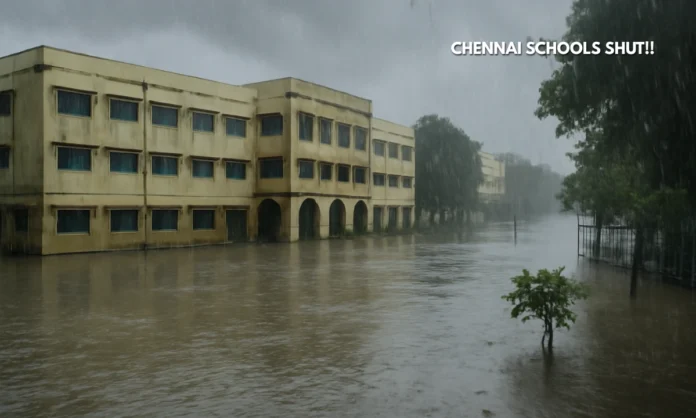
Key Highlights:
- Schools and colleges in Chennai, Tiruvallur, Kancheepuram, and Chengalpattu districts closed on December 3, 2025 due to Cyclone Ditwah remnants
- India Meteorological Department reported depression weakened into well-marked low-pressure area with Chennai recording 15 cm rainfall in 24 hours
- Greater Chennai Corporation deployed 22,000 personnel and 107 rescue boats across waterlogged areas with four rain-related deaths and 1,601 damaged huts statewide
Opening Overview
Educational institutions across Chennai and neighboring districts remained shut on December 3, 2025, following an official holiday declaration by local authorities as Cyclone Ditwah continued to impact the region. The closure decision came as persistent rainfall triggered by the remnants of Cyclone Ditwah continued to batter northern Tamil Nadu, causing widespread waterlogging and disrupting daily life across urban and coastal areas. District authorities announced the precautionary measure late on December 2 evening, prioritizing student safety amid forecasts of continued heavy downpour and deteriorating weather conditions across Chennai, Tiruvallur, Kancheepuram, and Chengalpattu districts.
The India Meteorological Department (IMD) confirmed in its official bulletin dated December 3, 2025 that the depression, which was the remnant of Cyclone Ditwah, moved slowly south-southwestwards at 3 kmph and weakened into a well-marked low-pressure area over north Tamil Nadu-Puducherry coasts at 0530 hours IST. The system remained positioned approximately 40 km east-northeast of Puducherry, 100 km south of Chennai, and 60 km northeast of Cuddalore, maintaining a minimum distance of about 25 km from the north Tamil Nadu-Puducherry coastline. Parts of northern Tamil Nadu recorded heavy rainfall as Cyclone Ditwah moved inland, while Chennai experienced moderate to heavy showers throughout the morning hours, accumulating 15 cm of precipitation in a 24-hour period.
Schools and colleges have been declared holiday for #Chennai for tmrw !!🌧️🌀
— TN Weatherman (Samarth) (@SAMARTHMBANSAL1) December 1, 2025
Intense bands North of #Chennai and might gradually move in towards parts of #Chennai causing more #heavyrains in the coming hr or so !!🌧️🌀#TNRains #APRains #ChennaiRains #CycloneDitwah pic.twitter.com/u56LLw3cZy
Impact Assessment and Administrative Response
The impact of Cyclone Ditwah affected thousands of students across four major districts, marking the third consecutive day of educational institution closures since the cyclone’s approach. District Collector Roshni Siddharth Jagade officially confirmed the closure decision for all schools and colleges in Chennai district, citing continuous overnight rain and severe waterlogging in low-lying areas that made travel unsafe for students and staff. The administrative decision extended beyond Chennai to encompass Tiruvallur, Chengalpattu, and Kancheepuram districts, where similar weather conditions and flooding threatened public safety.
Relief Operations and Damage Assessment:
- Greater Chennai Corporation deployed 22,000 personnel including officials, traffic police, and special units across affected zones
- 107 rescue boats positioned in flood-prone areas like Velachery, Thangachimadam, Perambur, and north-central zones
- 48 fallen trees cleared from roadways across various city locations in coordination with municipal departments
- Four rain-related deaths reported statewide with immediate compensation announced from State Disaster Response Fund
Revenue Minister K K S S R Ramachandran reported comprehensive damage figures from Cyclone Ditwah, including 1,601 huts and tenements damaged across Tamil Nadu, 582 heads of cattle killed, and crops destroyed across 2.11 lakh acres of farmland. The state government announced relief compensation of Rs 20,000 per hectare to farmers for crop losses caused by the persistent rainfall and flooding. Deputy Chief Minister Udhayanidhi Stalin conducted field inspections, visiting the Greater Chennai Corporation’s Integrated Command and Control Centre to review relief measures and supervise water drainage operations in severely affected neighborhoods.
| District | Status | Primary Concerns | Relief Measures |
|---|---|---|---|
| Chennai | Schools/Colleges Closed | Waterlogging in Perambur, T Nagar, Velachery, Ashok Nagar | 22,000 personnel, 107 boats deployed |
| Tiruvallur | Schools/Colleges Closed | Flooding in low-lying areas, road disruptions | Coordination with state relief agencies |
| Kancheepuram | Schools/Colleges Closed | Continuous rainfall, agricultural damage | Drainage operations ongoing |
| Chengalpattu | Schools/Colleges Closed | Heavy downpour, infrastructure stress | Emergency response teams active |
Meteorological Analysis and Weather Progression
Detailed meteorological assessments tracked Cyclone Ditwah evolution from a cyclonic storm to a depression and finally to a well-marked low-pressure area. According to the IMD’s official bulletin issued at 0230 hours IST on December 3, 2025, the depression remained centered at latitude 12.1°N and longitude 80.2°E, moving slowly southwestwards toward the north Tamil Nadu-Puducherry coasts with an expected further weakening within the next six hours. The system’s sluggish movement and proximity to land, remaining anchored approximately 25-50 km offshore, fueled persistent feeder bands that delivered continuous rainfall over Chennai and neighboring districts since Monday afternoon.
The IMD’s earlier press release dated November 29, 2025 had forecast isolated extremely heavy rainfall over coastal Tamil Nadu during November 29-30, with Cyclone Ditwah expected to pass as close as 25 km from the Chennai coast. The system maintained intensity longer than initially predicted, with gale wind speeds reaching 70-80 kmph gusting to 90 kmph along north Tamil Nadu and Puducherry coasts during the peak period. Significant rainfall measurements recorded between 0830 hours IST on November 28 to 0830 hours IST on November 29 included Kodiayakarai (25 cm), Vedaranyam (18 cm), Velankanni (13 cm), and Nagapattinam (12 cm), demonstrating the system’s intense precipitation potential.
Official IMD Warnings and Forecasts:
- Squally wind speeds of 35-45 kmph gusting to 55 kmph prevailing over southwest and adjoining westcentral Bay of Bengal
- Light to moderate rainfall at most places with heavy rainfall at isolated places over North Coastal Tamil Nadu on December 3
- Total suspension of fishing operations over southwest Bay of Bengal and along Tamil Nadu-Puducherry coasts until December 3 noon
- Sea conditions very rough to rough, gradually improving to moderate from December 3 morning
The depression’s Doppler Weather Radar monitoring from Chennai and Sriharikota stations showed Cyclone Ditwah persistent circular structure and continued moisture feed from the Bay of Bengal. The Regional Meteorological Centre issued orange alerts for Chennai and surrounding areas, while red alerts were initially declared for districts including Cuddalore, Nagapattinam, Mayiladuthurai, and Villuppuram during the storm’s peak intensity on November 30.
Urban Infrastructure Challenges and Public Safety Measures
Knee-deep water accumulated in critical areas including Perambur, Raja Annamalaipuram, Ashok Nagar, Velachery, Kathipara, Perungudi, Choolaimedu, T Nagar, and Saidapet as Cyclone Ditwah drenched the city, significantly slowing vehicular movement and disrupting public transportation networks. Mayor Priya Rajan confirmed that the city’s stormwater drainage system, designed to handle 12 cm of rainfall, was overwhelmed as precipitation totals exceeded 15 cm with forecasts suggesting potential accumulation beyond 20 cm. Authorities positioned 100 horsepower motors across strategic locations as contingency measures to pump out excess water from inundated streets and residential areas.
The Greater Chennai Corporation’s comprehensive response included deploying personnel for multiple critical tasks: removing clogs from drainage systems, clearing fallen tree branches from roadways, and bailing out water from submerged low-lying neighborhoods. Chennai Police Commissioner A Arun activated the Disaster Response mechanism, establishing a central control room at the Commissioner’s office alongside 12 district-level control rooms and 49 special assistance booths in vulnerable areas. Approximately 18,000 police personnel from traffic, law enforcement, and special units were deployed on an accelerated basis, working under senior official supervision and integrated coordination with all government agencies.
Officials issued specific safety advisories urging residents to remain indoors unless absolutely necessary, avoid non-essential travel through flooded streets, and adhere to all guidelines while the weakened Cyclone Ditwah system remained close to the Tamil Nadu coast. The IMD’s impact assessment warned of potential breaking of tree branches, uprooting of small trees, damage to kutcha roads and culverts, inundation and waterlogging in low-lying coastal areas, occasional visibility reduction due to heavy rainfall, traffic disruption, and localized landslides or mudslides. Airport disruptions saw 18 flights canceled due to poor visibility and adverse weather conditions from Cyclone Ditwah, further emphasizing the storm’s comprehensive impact on the metropolitan region’s connectivity.
Agricultural Impact and Economic Consequences
The broader agricultural sector across Tamil Nadu sustained significant damage from Cyclone Ditwah, with preliminary assessments indicating crop destruction across 2.11 lakh acres of farmland statewide. The persistent rainfall and waterlogging particularly affected rice paddies, groundnut fields, sugarcane plantations, cotton crops, black gram, maize, and various vegetable cultivations across coastal and interior districts. Chief Minister MK Stalin ordered immediate compensation from the State Disaster Response Fund for agricultural losses, with the government announcing relief packages of Rs 20,000 per hectare for affected farmers.
Villages like Gorakollai near Sirkazhi remained completely surrounded by water following Cyclone Ditwah, leaving families stranded for two days without adequate drainage infrastructure. Farmers across Vedaranyam and Thalaignayar regions demanded immediate compensation and crop insurance support as standing crops remained submerged under floodwater for extended periods, threatening total yield loss for the season. The IMD’s agromet advisories recommended draining excess rainwater from fields of rice, groundnut, sugarcane, cotton, vegetables, and plantations of coconut, banana, areca nut, mango, and rubber to prevent further crop lodging and root damage.
Livestock losses mounted to 582 heads of cattle across affected districts due to Cyclone Ditwah, with additional damage reported to horticulture and floriculture operations including banana, papaya, and drumstick tree plantations due to wind damage, inundation, and sea spray contamination. The storm surge during the cyclone’s peak, reaching heights of 0.5 to 1 meter above astronomical tide levels, inundated low-lying coastal areas of Tamil Nadu-Puducherry until November 30 morning, flooding salt pans and damaging escape routes in coastal villages. Fishing communities faced complete operational suspension, with authorities banning all fishing activities over the southwest Bay of Bengal, Gulf of Mannar, and along Tamil Nadu-Puducherry coasts until December 3 noon due to very rough sea conditions.
Recovery Outlook and Future Preparedness
Authorities projected gradual weather improvement with the IMD forecasting the well-marked low-pressure area from Cyclone Ditwah to continue moving southwestwards across north coastal regions of Tamil Nadu and Puducherry, further weakening into a low-pressure area within 24 hours of December 3. The meteorological department indicated that heavy to very heavy rainfall would shift westward to districts including Nilgiris, Erode, Coimbatore, Theni, Dindigul, Tiruppur, Tenkasi, Tirunelveli, Kanyakumari, Salem, and Namakkal as the system drifted inland. Subsequent decisions on December 4 school operations remained dependent on overnight rainfall assessment and drainage progress in waterlogged areas.
The experience with Cyclone Ditwah highlighted ongoing vulnerabilities in urban drainage infrastructure, with Mayor Priya Rajan acknowledging that current stormwater systems require upgrading to handle increasingly intense precipitation events associated with climate variability. The municipal corporation distributed approximately 2 lakh food packets to affected residents, with officials, MLAs, and councillors conducting ground-level assessments and identifying 160 low-lying areas requiring priority attention during future weather emergencies. Four localities requested temporary relocation assistance, prompting authorities to establish emergency shelters and coordinate with district administrations for medium-term housing solutions.
The comprehensive disaster response to Cyclone Ditwah demonstrated improved coordination between multiple agencies, including the Greater Chennai Corporation, Tamil Nadu Police, National Disaster Response Force (NDRF), State Disaster Response Force (SDRF), and municipal departments. Officials emphasized the importance of early warning systems, with the IMD’s advance forecasting enabling precautionary measures including school closures, fishing operation suspensions, and public safety advisories issued well before the storm’s peak impact. Deputy Chief Minister Udhayanidhi Stalin’s direct field visits and Chief Minister MK Stalin’s high-level review meetings reflected state leadership’s commitment to rapid damage assessment and timely relief distribution, setting precedents for future cyclone preparedness protocols.
Closing Assessment
The response to Cyclone Ditwah exemplified proactive disaster management as authorities prioritized student safety and public welfare amid challenging meteorological conditions affecting northern Tamil Nadu. The comprehensive response involving 22,000 personnel deployment, 107 rescue boats, extensive drainage operations, and immediate compensation announcements demonstrated coordinated government action during weather emergencies. The depression’s lingering presence and slow movement pattern created prolonged rainfall events, necessitating sustained relief efforts and infrastructure resilience assessments across metropolitan Chennai and surrounding districts.
The cyclonic system’s impact extended beyond immediate educational disruptions, affecting agricultural productivity, livestock welfare, fishing livelihoods, and urban infrastructure functionality across Tamil Nadu. The broader regional recovery requires sustained government support, infrastructure upgrades, and enhanced climate adaptation strategies to address increasingly frequent extreme weather phenomena. The experience reinforces the critical importance of meteorological monitoring systems, early warning mechanisms, and multi-agency coordination in protecting vulnerable populations and minimizing economic losses during natural disasters.