
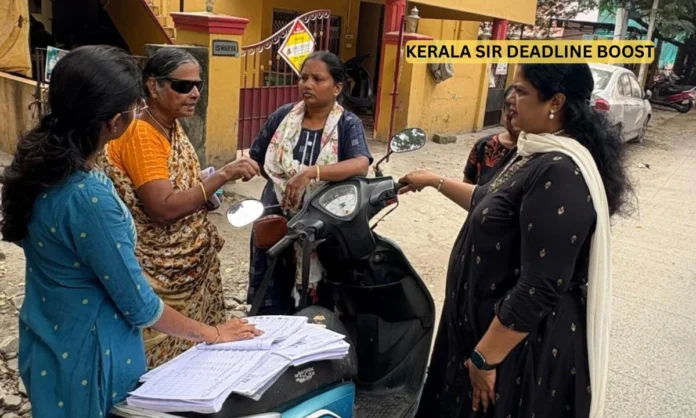
Key Highlights:
- Supreme Court deems Kerala’s request to extend SIR form deadline “just and fair,” directing Election Commission for further consideration.
- SIR Phase II in Kerala sees 98.96% form distribution (2.78 crore electors), 82.52% digitization as of early December.
- Local body elections on December 9-11 clash with SIR duties for 1.76 lakh poll staff and 25,468 SIR personnel.
Opening Overview
The Kerala SIR form deadline standoff has thrust electoral logistics into the national spotlight, as the Supreme Court stepped in to address a critical clash between voter roll revisions and local polls. Kerala urged an extension beyond December 11 for the Special Intensive Revision (SIR) forms, citing the burden on government staff handling both the SIR process and upcoming local body elections on December 9 and 11. Chief Justice Surya Kant called the plea “just and fair,” permitting the state to formally request more time from the Election Commission while ensuring no disruption to the overall timeline.
This development underscores the scale of SIR Phase II, launched nationwide by the Election Commission to purify electoral rolls ahead of 2026 polls. In Kerala alone, 2.78 crore electors received forms, with robust progress in distribution but challenges in final submissions amid poll preparations. The Kerala SIR form deadline debate highlights how administrative overlaps test India’s democratic machinery, balancing inclusion for new voters, migrants, and youth against operational realities. Official figures from the Chief Electoral Officer reveal 98.8% forms distributed and over 80% digitized, yet the state argues for flexibility to avoid disenfranchising poll-duty officials. As December 4 approaches, the focus on the Kerala SIR form deadline intensifies, with implications for voter turnout and roll accuracy across 1,199 local bodies.
Supreme Court Directive and Electoral Clash
- Bench led by CJI Surya Kant and Justice Joymalya Bagchi advises Election Commission to review Kerala’s extension proposal objectively.
- Original SIR form deadline of December 4 shifted to December 11; further week-long extension sought post-local polls.
The Supreme Court’s intervention in the Kerala SIR form deadline matter arose from a petition highlighting the impossible overlap between SIR enumeration and Kerala’s local body elections. The state argued that 1.76 lakh personnel deployed for polls, plus 25,468 on SIR duty, faced exclusion from voter rolls if the deadline held firm. CJI Kant remarked that the request allows missed voters and busy officials equal opportunity, directing the Election Commission to consider a one-week extension sympathetically within two days.
Senior Advocate Rakesh Dwivedi, for the Election Commission, noted the prior extension and high progress: 98.8% forms distributed, 80% digitized. Yet, the court prioritized practicality, observing that government machinery coped, but political and staffing pressures necessitated relief. This ruling aligns with SIR’s core aim under Election Commission mandates—to ensure accurate, duplicate-free rolls via house-to-house verification. Kerala’s Chief Electoral Officer data supports the urgency, showing steady but strained final-phase momentum. The Kerala SIR form deadline thus evolves from logistical hurdle to a benchmark for judicial-electoral coordination.
Table 1: SIR Staff Deployment in Kerala (Official ECI Data)
| Category | Personnel Deployed | Role Focus |
|---|---|---|
| Poll Staff | 1,76,000 | Local body elections (Dec 9-11) |
| SIR Booth Level Officers (BLOs) | 25,468 | Form distribution & verification |
| Booth Level Agents (BLAs) | 54,624 | Enumeration support |
SIR Phase II Scale and Kerala Progress
- Nationwide, 50.97 crore electors targeted; 99.78% forms distributed, 90.14% digitized by December 2.
- Kerala: 2,78,50,855 electors, 98.96% forms out, 82.52% (22.98 million) digitized as of Dec 1.
Kerala’s participation in SIR Phase II, from November 4 to December 11, reflects a massive door-to-door drive to update rolls for 2026 readiness. The Chief Electoral Officer reports over 2.63 crore forms initially distributed to 94.52% of electors, scaling to 98.96% coverage amid challenges. Digitization hit 82.52% with 22,98,1217 forms processed, per official bulletins, ensuring traceability for claims post-draft roll publication on February 14, 2026.
This phase emphasizes scrutiny: new entrants must link to prior rolls or submit documents from December 16 to February 7. Kerala’s BLOs and BLAs drove progress despite early lags at 49.55% coverage, now nearing national highs like Goa’s 100%. The Kerala SIR form deadline pressure stems from these tail-end collections, vital for migrants and youth inclusion. PIB data confirms Kerala’s BLO strength at 25,468, underpinning the 99.33% printing completion nationwide. Such metrics position the Kerala SIR form deadline as pivotal for defect-free rolls serving 2.84 crore local voters.
Table 2: Kerala SIR Progress vs National (ECI Bulletin, Dec 2025)
| Metric | Kerala Value | National (12 States/UTs) | Source |
|---|---|---|---|
| Electors Targeted | 2,78,50,855 | 50,97,00,000+ | ECI PIB |
| Forms Distributed (%) | 98.96% | 99.78% | ECI Daily Bulletin |
| Forms Digitized (%) | 82.52% | 90.14% | Chief EO Kerala |
| Forms Distributed Total | ~2.75 crore | 50.85 crore | ECI |
Local Body Elections: Schedule and Logistical Strain
- Polls in 1,199 bodies, 23,576 wards across two phases: Dec 9 (7 districts), Dec 11 (7 districts); counting Dec 13.
- Model Code of Conduct active since November 9 announcement by State Election Commissioner A. Shajahan.
Kerala’s 2025 local elections amplify the SIR form deadline dilemma, mobilizing vast resources during enumeration’s close. Phase 1 covers Thiruvananthapuram to Ernakulam; Phase 2, Thrissur to Kasaragod, affecting 2.84 crore voters minus Mattannur’s 36 wards. The State Election Commission fixed timelines post-delimitation, raising wards to 23,612 total.
Staff exemptions for SIR duties exist per affidavits, yet the Supreme Court noted real-world strains on officials’ personal form submissions. With nominations closed November 21 and withdrawals by November 24, focus shifts to polling logistics clashing with SIR camps. This overlap risks incomplete rolls for key personnel, prompting Kerala’s plea. Official portals like sec.kerala.gov.in track real-time updates, confirming no Mattannur polls till 2027. The Kerala SIR form deadline thus intersects with grassroots democracy, where 1,199 bodies decide local governance.
Digital Tools and Voter Safeguards in SIR
- SIR integrates BLO verification, online portals, SMS alerts for seamless claims/objections.
- Strict document linkage for deletions/duplicates; special camps address gaps.
The Kerala SIR form deadline benefits from advanced digital safeguards ensuring transparency amid scale. Booth Level Officers conduct verifications, uploading data to ECI portals for real-time tracking, with SMS for new voter notifications. Ceo.kerala.gov.in offers FAQs and filling guides, boosting accessibility despite poll distractions.
Grievance cells and camps target uncollected forms (11.12 lakh pending), prioritizing youth and migrants. Post-draft, one-month claims window (Dec 16-Jan 15) allows corrections, with extended proofs till February 7. These measures mitigate deadline risks, as seen in Kerala’s jump from 49.55% early coverage to near-99%. The framework, per ECI’s constitutional mandate, fortifies the Kerala SIR form deadline against exclusions.
Final Perspective
The Kerala SIR form deadline saga resolves as a triumph of pragmatic judicial oversight, securing extensions for genuine needs without compromising SIR’s integrity. With 98.96% forms distributed and 82.52% digitized, Kerala’s progress rivals national benchmarks, yet the Supreme Court’s nudge ensures poll staff join 2.78 crore voters seamlessly. This balance upholds electoral purity for 2026, where accurate rolls underpin fair local and national contests.
As local polls unfold December 9-13, the episode signals adaptive governance: flexibility strengthens democracy, not weakens it. Kerala’s story sets precedent, reminding that the Kerala SIR form deadline is more than dates—it’s the gateway to empowered participation for millions.