
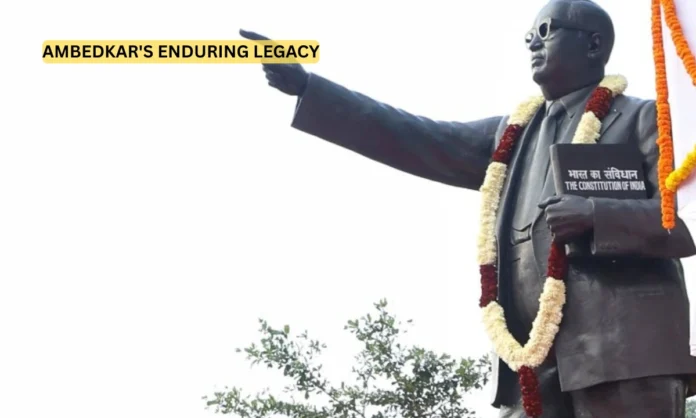
Key Highlights
- Mahaparinirvan Diwas is observed annually on December 6 to commemorate the death anniversary of Dr BR Ambedkar, who passed away in 1956
- Dr Ambedkar served as chairman of the Drafting Committee formed on August 29, 1947, presenting the first Constitution draft on February 21, 1948
- Thousands gathered at Chaitya Bhoomi in Mumbai’s Dadar on December 6, 2025, with leaders including PM Modi, President Murmu, and Maharashtra CM Fadnavis paying tributes
Opening Overview: A Day to Honor Constitutional Legacy
Mahaparinirvan Diwas 2025 marks the 69th death anniversary of Dr Bhimrao Ramji Ambedkar, observed across India on December 6 with profound reverence and national significance. The term “Mahaparinirvan” derives from Buddhist philosophy, meaning “great nirvana,” symbolizing the moment when an enlightened soul attains liberation. This observance holds special importance as Mahaparinirvan Diwas honors the architect of the Indian Constitution who dedicated his life to establishing social justice and equality. Dr Ambedkar passed away on December 6, 1956, in Delhi, just weeks after his historic conversion to Buddhism on October 14, 1956. His death anniversary has evolved into one of India’s most significant commemorations, with millions gathering at Chaitya Bhoomi in Mumbai’s Dadar area to pay homage.
This year’s Mahaparinirvan Diwas witnessed massive crowds at his memorial, where a helicopter showered flower petals over the sacred site, and copies of the Constitution were distributed to attendees. The observance of Mahaparinirvan Diwas reflects the enduring impact of Dr Ambedkar‘s vision for an egalitarian India, making this day a powerful reminder of his contributions to dismantling caste-based discrimination.
Today, on Mahaparinirvan Diwas, paid tributes to Dr. Babasaheb Ambedkar in Delhi.
— Narendra Modi (@narendramodi) December 6, 2025
We will keep working with full vigour to realise his dream for our nation. pic.twitter.com/nIejtgr0nJ
Constitutional Architect: Dr Ambedkar’s Role in Shaping Independent India
Formation and Leadership of the Drafting Committee
The Drafting Committee of the Indian Constitution was established on August 29, 1947, shortly after India gained independence, with Dr BR Ambedkar elected as its chairman. This seven-member committee, recommended by the Constituent Assembly’s Steering Committee chaired by Dr Rajendra Prasad, was tasked with preparing the draft Constitution for the newly independent nation. The significance of Mahaparinirvan Diwas extends to recognizing Dr Ambedkar’s pivotal role in this constitutional journey, as he presented the first draft on February 21, 1948, containing 315 Articles and 8 Schedules.
The draft underwent extensive public circulation and revision before Dr Ambedkar formally introduced the final version to the Constituent Assembly on November 4, 1948. The Constitution was adopted on November 26, 1949, and came into effect on January 26, 1950, establishing the democratic framework that governs India today.
Embedding Principles of Equality and Justice
Dr Ambedkar’s constitutional contributions, remembered every Mahaparinirvan Diwas, centered on establishing fundamental rights and prohibiting discrimination based on caste, religion, or gender. As chairman of the Drafting Committee, he ensured the Constitution enshrined affirmative action measures, including reservations for Scheduled Castes and Scheduled Tribes. Article 15(4) allows the State to make special provisions for the advancement of socially and educationally backward classes, while Article 16(4) enables reservation of appointments in government positions. These constitutional safeguards reflect Dr Ambedkar’s personal experiences with caste discrimination and his lifelong commitment to combating social injustice. His vision for Mahaparinirvan Diwas extends beyond remembrance, serving as a call to uphold the constitutional values of justice, liberty, equality, and fraternity.
The Constitution’s emphasis on affirmative action has provided a legal framework for addressing historical inequalities that persisted for centuries. Dr Ambedkar’s constitutional architecture guaranteed that marginalized communities would have protected rights and opportunities in independent India.
Social Reform Movements: Fighting Caste-Based Discrimination
The Mahad Satyagraha and Temple Entry Movement
Before his constitutional work, Dr Ambedkar led groundbreaking social movements that Mahaparinirvan Diwas commemorates as part of his broader legacy. The Mahad Satyagraha of 1927 challenged untouchability by asserting Dalits’ right to access public water sources, facing violent opposition from upper castes. Following this, Dr Ambedkar launched the Kalaram Temple Entry Movement on March 2, 1930, in Nashik, demanding entry rights for Dalits to Hindu temples. The temple, built by Brahminical Peshwas, had remained closed to lower castes for centuries, and despite letters to the temple authorities, Dalits were repeatedly denied entry. These movements employed non-violent resistance methods, though Dr Ambedkar’s approach differed from Gandhi’s philosophy.
While Gandhi believed in appealing to the conscience of upper-caste Hindus, Dr Ambedkar viewed temple entry as a fundamental human right requiring radical restructuring of the caste system. The significance of Mahaparinirvan Diwas includes recognizing these earlier struggles that laid the foundation for constitutional protections.
Conversion to Buddhism as Ultimate Protest
Dr Ambedkar’s embrace of Buddhism on October 14, 1956, at Deekshabhoomi in Nagpur represents a defining moment commemorated during Mahaparinirvan Diwas observances. Along with his wife Savita Ambedkar, he formally converted to Buddhism in a ceremony presided over by Mahasthavir Bhante Chandramani, with approximately 400,000 followers joining the conversion. This mass conversion, occurring just weeks before his death, was not merely a religious transition but a profound rejection of the caste hierarchy inherent in Hindu society. Dr Ambedkar formulated 22 vows for new converts, including pledges to believe in the equality of man, endeavor to establish equality, follow the noble eightfold path, and renounce Hinduism as harmful for humanity.
The conversion represented the culmination of his lifelong struggle against caste discrimination, inspiring millions to follow his path. Every Mahaparinirvan Diwas, his Buddhist followers remember this transformation as evidence of his commitment to achieving social justice through radical means.
Mahaparinirvan Diwas 2025: National Commemorations and Tributes
Gatherings at Chaitya Bhoomi Memorial
Mahaparinirvan Diwas 2025 witnessed thousands of followers converging at Chaitya Bhoomi, Dr Ambedkar’s cremation site in Mumbai’s Dadar area, to pay homage. After his death on December 6, 1956, in Delhi, his mortal remains were cremated at Dadar Chowpatty, now known as Chaitya Bhoomi. This site has evolved into one of India’s most visited death memorials, with the memorial structure inaugurated by his daughter-in-law Meera Ambedkar on December 5, 1971. The Government of Maharashtra has designated Chaitya Bhoomi as an A-class tourism and pilgrimage site, recognizing its significance for Mahaparinirvan Diwas commemorations. The Brihanmumbai Municipal Corporation established temporary infrastructure including sheds, mobile toilets, drinking water stations, and medical facilities to accommodate the massive crowds.
A helicopter showered flower petals over the memorial site, and copies of the Constitution were presented to attendees as symbolic tributes. Maharashtra Governor Acharya Devvrat, Chief Minister Devendra Fadnavis, and Shiv Sena (UBT) leader Uddhav Thackeray were among the political leaders who paid respects at Chaitya Bhoomi for Mahaparinirvan Diwas 2025.
Political Leadership and National Recognition
President Droupadi Murmu, Vice-President CP Radhakrishnan, and Prime Minister Narendra Modi offered tributes at the Prerana Sthal on Parliament premises for Mahaparinirvan Diwas 2025. Lok Sabha Speaker Om Birla and Leader of Opposition Rahul Gandhi joined them in offering floral tributes, demonstrating cross-party respect for Dr Ambedkar’s legacy. PM Modi recalled Dr Ambedkar’s “visionary leadership” in a post on social media, stating that his “unwavering commitment to justice, equality and constitutionalism continue to guide our national journey”. The Prime Minister emphasized that Dr Ambedkar’s ideals keep lighting the path toward building a Viksit Bharat (developed India), connecting Mahaparinirvan Diwas to contemporary national aspirations.
Dr Ambedkar’s recognition by the Indian state culminated in the posthumous conferment of the Bharat Ratna on April 15, 1990, during VP Singh’s government. His 84-year-old widow Dr Savita Ambedkar received the award from President R Venkataraman at a special investiture ceremony, though she expressed that the honor had been delayed. The observance of Mahaparinirvan Diwas has become a unifying occasion where leaders across the political spectrum acknowledge Dr Ambedkar’s transformative contributions to Indian democracy.
Historical Timeline: Key Milestones in Dr Ambedkar’s Life
| Date | Event | Significance |
|---|---|---|
| August 29, 1947 | Appointed Chairman of Drafting Committee | Led the creation of Indian Constitution |
| February 21, 1948 | First Constitution draft presented | Contained 315 Articles and 8 Schedules |
| November 26, 1949 | Constitution adopted | Established democratic framework for India |
| October 14, 1956 | Converted to Buddhism at Nagpur | Mass conversion of 400,000 followers |
| December 6, 1956 | Passed away in Delhi | Cremated at Dadar, now Chaitya Bhoomi |
| April 15, 1990 | Awarded Bharat Ratna posthumously | India’s highest civilian honor |
Closing Perspective: Enduring Legacy for Modern India
Mahaparinirvan Diwas 2025 serves as a powerful reminder that Dr Ambedkar’s vision for social justice and equality remains profoundly relevant to contemporary India. His constitutional architecture provided the legal framework for dismantling centuries of caste-based oppression, while his social movements demonstrated the power of organized resistance against discrimination. The observance of Mahaparinirvan Diwas transcends mere commemoration, functioning as an annual recommitment to the constitutional values Dr Ambedkar embedded in India’s founding document. The massive gatherings at Chaitya Bhoomi, attended by millions annually, demonstrate that his followers continue to draw inspiration from his teachings and sacrifice.
As India progresses toward becoming a developed nation, Mahaparinirvan Diwas challenges citizens and leaders alike to evaluate whether the ideals of justice, liberty, equality, and fraternity are being fully realized for all communities. The day honors not just Dr Ambedkar’s memory but the ongoing struggle to create the inclusive, egalitarian society he envisioned, making Mahaparinirvan Diwas a living testament to the unfinished work of social transformation in India.