
Key Highlights
- Joint opinion piece by UK, France, and Germany envoys criticizes Russia over Ukraine war escalation just before Putin India visit on December 4-5, 2025.
- India’s Ministry of External Affairs deems the timing “very unusual” and contrary to diplomatic norms on third-country relations.
- Putin India visit focuses on elevating bilateral trade to $100 billion by 2030 amid record $68.7 billion trade in FY25, driven by Russian oil imports.
Tense Prelude to Putin India Visit
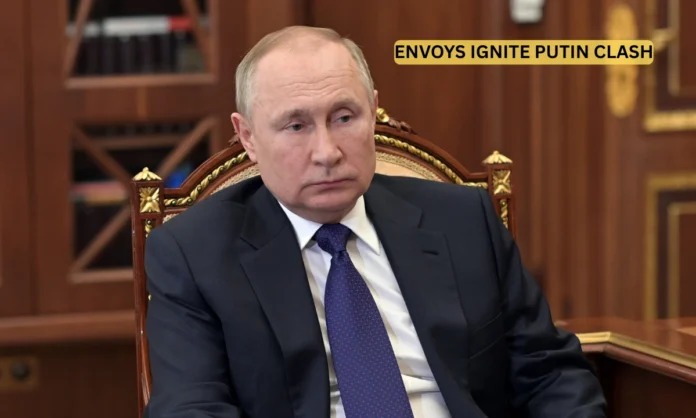
Western envoys’ sharp critique on Russia’s Ukraine stance has cast a shadow over the Putin India visit, scheduled for December 4-5, 2025. French Ambassador Thierry Mathou, German High Commissioner Philipp Ackermann, and UK High Commissioner Lindy Cameron published a joint piece in The Times of India, headlined “World Wants The Ukraine War To End, But Russia Doesn’t Seem Serious About Peace.” The article, released days before Russian President Vladimir Putin’s arrival, accuses Moscow of intensifying drone and missile strikes amid peace talks, labeling them systematic aggression rather than accidents.
This intervention arrives at a sensitive juncture, as Putin lands in New Delhi for the 23rd India-Russia Summit with Prime Minister Narendra Modi. India’s Ministry of External Affairs officials noted the piece’s timing as “very unusual,” stressing it deviates from acceptable practice of offering public advice on India’s ties with a third country like Russia. The Putin India visit underscores longstanding strategic bonds, with Moscow positioned as an all-weather ally supplying discounted crude oil despite Western sanctions post-2022 Ukraine conflict.
India maintains a balanced foreign policy, abstaining from UN votes condemning Russia while urging dialogue. Prime Minister Modi has reiterated, “this is not an era of war,” aligning with calls for ceasefire without joining sanctions. The envoys’ piece pledges continued NATO support for Kyiv, contrasting sharply with the Putin India visit’s agenda of deepening energy, defense, and trade cooperation. This episode highlights New Delhi’s diplomatic tightrope between Eastern partnerships and Western alliances.
Envoys’ Critique Targets Russia Ahead of Putin India Talks
- Envoys highlight 22 major air attacks since Ukraine peace talks began, over 1,200 drones and 60 missiles last week alone.
- They commit “ironclad support” to Ukraine’s defense, sovereignty amid Russia’s alleged refusal of ceasefire.
The joint op-ed by the three Western envoys pulls no punches on Russia’s conduct in Ukraine, timed provocatively before the Putin India visit. It details escalated attacks, including the war’s largest air barrages post-peace discussions, destroying civilian sites like hospitals and schools. “These are not actions of someone serious about peace,” the envoys assert, framing Russia’s strategy as ruthless territorial ambition extending beyond Ukraine via airspace incursions and disinformation.
Published in The Times of India, the piece invokes Prime Minister Modi’s peace advocacy while urging global pressure on Moscow. India’s response underscores protocol breaches, as public commentary on bilateral ties with Russia irks officials ahead of summit discussions on defense pacts and energy deals. The Putin India visit, detailed in Ministry of External Affairs advisories, includes Modi’s private dinner on December 4, ceremonial welcome by President Droupadi Murmu, summit at Hyderabad House, and state banquet.
Diplomatic analysts view this as breaching norms, potentially straining India-Europe relations. Yet, New Delhi prioritizes strategic autonomy, evident in sustained Russian oil purchases that cushioned global price shocks. The envoys’ move tests India’s multi-alignment, especially with Putin pushing “qualitatively new” tech ties in energy and space during the Putin India visit.
India-Russia Trade Boom Overshadows Diplomatic Static
- Bilateral trade hit $68.7 billion in FY25, up from $10.1 billion pre-pandemic, with imports at $63.84 billion led by crude oil.
- Exports grew to $4.88 billion; deficit widened to $58.96 billion, prompting $100 billion balanced target by 2030.
Economic momentum defines the Putin India visit backdrop, with trade surging amid Ukraine tensions. Commerce Ministry data reveals India’s imports from Russia leaped twelvefold from $5.48 billion in FY21 to $63.81 billion in FY25, fueled by $56.8 billion in petroleum crude. Exports rose 84% to $4.88 billion, covering engineering goods ($1.26 billion), electronics ($862 million), and pharmaceuticals ($577 million).
At the India-Russia Business Forum, Commerce Minister Piyush Goyal hailed Russia as “Sukh Dukh Ka Saathi,” targeting balanced growth via eased regulations in consumer goods, pharma, and telecom. Putin echoed elevating cooperation with India to new technological heights in energy, industry, and agriculture. November Russian oil imports hit 1.855 million bpd, highest since July, though December may dip to 0.6-1.0 million bpd due to US sanctions on Lukoil and Rosneft.
| Year | India Exports to Russia (USD Bn) | India Imports from Russia (USD Bn) | Trade Deficit (USD Bn) |
|---|---|---|---|
| FY21 | 2.68 | 8.28 | 5.6 |
| FY25 | 4.88 | 63.84 | 58.96 |
This table, derived from official trade figures, illustrates the imbalance the Putin India visit aims to address through export boosts.
Strategic Balancing Act During Putin India Engagement
- Putin India visit marks first since 2022 Ukraine war; agenda covers 25th anniversary of strategic partnership.
- India defends oil buys, with Jaishankar critiquing Europe’s worldview on global issues.
India’s deft navigation of great-power rivalries shines through the Putin India visit, blending Russian reliability with Western partnerships. External Affairs Minister S. Jaishankar has countered sanction pressures, arguing Europe’s problems differ from the world’s, justifying discounted Russian crude that stabilized India’s energy needs. The Ministry of External Affairs schedule confirms Putin’s arrival at AFS Palam on December 4, followed by Modi summit and Rajghat visit.
Russia identifies pharma, engineering, and chemicals for Indian expansion, aligning with Goyal’s call for diversified exports. Bilateral trade neared $70 billion, with India’s import share in Russia under 2%, ripe for growth. PIB notes GDP growth at 7.8% Q1 and 8.2% Q2 FY26, low inflation at 0.25% last month, bolstering resilience.
The envoys’ piece, while supportive of Ukraine, overlooks India’s neutral stance, abstaining from condemnations. Putin India visit reinforces defense supplies like S-400 systems and BrahMos missiles, vital amid regional threats. This equilibrium sustains New Delhi’s influence in multipolar dynamics.
Geopolitical Ripples from Envoys’ Move Pre-Putin India Summit
- Western envoys accuse Russia of global destabilization via cyberattacks, election meddling.
- India’s response prioritizes summit outcomes over public spats.
The envoys’ op-ed extends beyond Ukraine, alleging Russian malign activities like European airspace violations and institutional subversion, timed to influence the Putin India visit narrative. It contrasts NATO resolve with Moscow’s negotiation stalls, pledging stepped-up aid as Putin delays peace. India’s MEA views this as undiplomatic, prioritizing the summit focused on joint projects.
Official timelines detail the Putin India visit: Rashtrapati Bhavan honors, Hyderabad House talks yielding pacts in trade, space, and connectivity. PIB highlights untapped potentials in agri-tech and semiconductors, with 2.4 million annual STEM graduates aiding Russia’s talent gap.
India’s oil strategy, importing 35% of crude from Russia in November, mitigates sanction impacts via indirect routes. This pragmatic approach, rooted in energy security, defines New Delhi’s response to external pressures.
Closing Assessment: Putin India Visit Signals Resilience
The Putin India visit proceeds amid Western envoys’ Ukraine-focused critique, yet underscores enduring strategic ties resilient to diplomatic frictions. With trade at record highs and $100 billion goals, India prioritizes balanced growth over public admonitions. MEA’s stance on norms reinforces autonomy.
This episode reveals multipolarity’s challenges: NATO allies’ intervention tests India’s balancing, but economic imperatives prevail. Putin India visit outcomes in energy and defense will likely affirm Moscow’s priority, echoing Modi’s peace calls without concessions. Forward, diversified exports hold key to equity.