
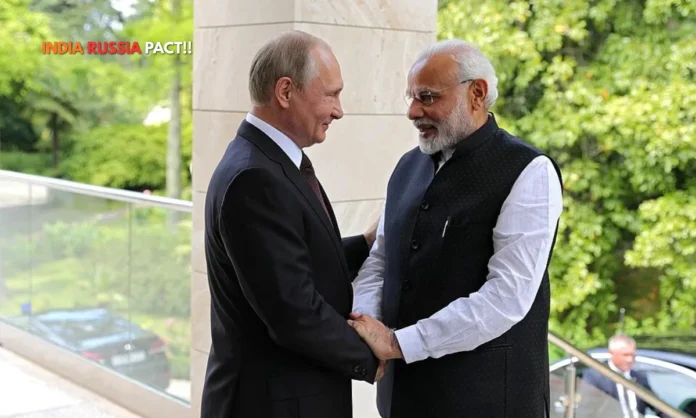
Key Highlights
- Russia’s State Duma ratified the Russia India RELOS defence pact on December 3, 2025, enabling reciprocal military logistics support between both nations
- The agreement permits up to five warships, ten aircraft, and 3,000 troops from either nation to be stationed simultaneously in partner territory for five years
- Bilateral trade between India and Russia reached a record $68.7 billion in FY 2024-25, with both countries targeting $100 billion by 2030
Opening Overview
Russia’s lower house of parliament, the State Duma, ratified the Russia India RELOS defence pact just hours before President Vladimir Putin’s state visit to New Delhi on December 4-5, 2025. The Reciprocal Exchange of Logistic Support (RELOS) agreement, originally signed on February 18, 2025 in Moscow, marks a transformative step in India-Russia military cooperation by formalizing logistics support mechanisms that have operated informally for decades.
State Duma Speaker Vyacheslav Volodin emphasized the strategic importance of the Russia India RELOS defence pact, stating that bilateral relations with India are “strategic and comprehensive, and we value them,” describing the ratification as “another step toward reciprocity and development of our relations.” The agreement was forwarded to the Duma by Russian Prime Minister Mikhail Mishustin for ratification, signaling Moscow’s commitment to deepening the Special and Privileged Strategic Partnership with New Delhi ahead of the 23rd India-Russia Annual Summit.
The Russia India RELOS defence pact establishes operational procedures for deploying military formations, naval vessels, and aircraft between both countries while organizing mutual logistical support during joint exercises, training missions, humanitarian operations, and disaster relief efforts. This framework represents a significant evolution from the traditional buyer-seller dynamic that has characterized India-Russia defence relations, moving toward integrated operational cooperation that extends both nations’ strategic reach across critical maritime and terrestrial domains.
🧵 RELOS is not just a logistics deal. It is a quiet geopolitical move.
— Inquisitive S (@InquisitiveS_) December 4, 2025
Here is what the India Russia pact really means in simple words 👇
Don’t Forget to Follow @InquisitiveS_ If you Like Reading Threads like these and SHARE IT MAX.
🔺What RELOS really does
India and Russia can… pic.twitter.com/oJsCO8lLhm
Strategic Scope and Operational Framework
- The Russia India RELOS defence pact allows simultaneous stationing of five warships, ten aircraft, and 3,000 military personnel from either country in partner territory
- The agreement extends India’s operational reach to Russian Arctic facilities while granting Russia access to the Indian Ocean Region
The Russia India RELOS defence pact provides comprehensive logistical support including refueling, replenishment of rations and spare parts, berthing facilities, and maintenance support for both peacetime and wartime missions. First Deputy Chairman of the Russian State Duma’s International Affairs Committee Vyacheslav Nikonov confirmed that the military pact permits up to five warships, ten aircraft, and 3,000 military personnel from either country to be stationed simultaneously in the partner nation’s territory for five years, with provisions for a further five-year extension upon mutual consent. This operational framework formalizes and standardizes existing ad-hoc logistics practices currently in place between the two militaries, enabling seamless use of existing logistics networks and improving response times during contingencies.
The strategic geography enabled by the Russia India RELOS defence pact is particularly significant, as India gains logistical access to Russian facilities in the Arctic region, including bases along the Northern Sea Route, while Russia benefits from entry points and support hubs throughout the Indian Ocean Region. This reciprocal arrangement amplifies both nations’ operational reach across two of the world’s most strategically important maritime zones. According to the Russian Cabinet of Ministers, the Russia India RELOS defence pact will facilitate mutual use of airspace and enable port calls by Russian and Indian warships, strengthening military cooperation between the two countries.
The established procedures under the Russia India RELOS defence pact will be implemented during joint military exercises such as INDRA (conducted annually between Indian and Russian armed forces), training operations, humanitarian aid missions, and disaster relief efforts following natural and man-made disasters. The agreement also covers other operational scenarios as mutually agreed upon by both governments, providing flexibility to adapt to evolving security requirements.
Putin’s India Visit and Bilateral Summit Agenda
- President Vladimir Putin will visit New Delhi from December 4-5, 2025 for the 23rd India-Russia Annual Summit
- Defence cooperation discussions will include potential deals for S-400 missile systems, Su-57 fifth-generation fighter jets, and the Russia India RELOS defence pact implementation
President Vladimir Putin’s state visit to India represents the highest level of diplomatic engagement between the two nations, marking the continuation of the Annual Summit mechanism that has served as the primary institutionalized dialogue format since the signing of the Declaration on the India-Russia Strategic Partnership in October 2000. The visit, scheduled for December 4-5, 2025, will feature formal talks between President Putin and Prime Minister Narendra Modi, during which both leaders will exchange views on regional and global issues of mutual interest and review progress in bilateral relations across multiple sectors.
The Russia India RELOS defence pact ratification serves as a significant pre-visit confidence-building measure, demonstrating Moscow’s commitment to expanding military-technical cooperation with New Delhi. Kremlin spokesperson Dmitry Peskov confirmed that discussions during Putin’s visit may include a possible additional S-400 air defense missile system and negotiations on the Su-57 fifth-generation fighter jet, which he described as the “best plane in the world.” These potential agreements would complement the Russia India RELOS defence pact by enhancing India’s defence capabilities while deepening technological cooperation between both nations.
Defence Minister Rajnath Singh and his Russian counterpart Andrei Belousov are scheduled to co-chair the 22nd India-Russia Inter-Governmental Commission on Military & Military Technical Cooperation (IRIGC-M&MTC) in New Delhi, providing a structured platform to operationalize the Russia India RELOS defence pact and review ongoing defence projects. The bilateral agenda extends beyond defence to encompass trade, economy, healthcare, academics, culture, and media, with several agreements expected to be signed during the visit. President Droupadi Murmu will receive President Putin and host a state banquet in his honor, underscoring the ceremonial significance of the visit.
Putin and Modi will jointly address the India-Russia Business Forum, highlighting investment opportunities, manufacturing partnerships, and technology collaboration as both countries work toward their ambitious target of $100 billion in annual bilateral trade by 2030. The Russia India RELOS defence pact forms part of this broader strategic framework that encompasses not only military cooperation but also economic integration, energy security, Arctic cooperation, technology transfers, and mobility agreements.
India-Russia Defence and Economic Partnership
| Indicator | FY 2024-25 Data | Source |
|---|---|---|
| Bilateral Trade Volume | $68.7 billion | Indian Ministry of Commerce |
| Indian Exports to Russia | $4.9 billion | Indian Embassy Moscow |
| Russian Exports to India | $63.8 billion | Indian Embassy Moscow |
| Target Bilateral Trade (2030) | $100 billion | IRIGC-TEC |
| Defence Cooperation Agreement Duration | 2021-2031 | Ministry of Defence |
The Russia India RELOS defence pact represents the latest evolution in a defence partnership that has transformed from a buyer-seller relationship into joint research, development, and co-production of advanced defense technologies and systems. Russia remains India’s second-largest arms supplier, with the military-technical cooperation agreement for 2021-2031, signed on December 6, 2021 in New Delhi, focusing on joint research, development, production, and after-sales support of weapons and military equipment. This framework agreement has enabled flagship collaborative projects including the BrahMos cruise missile system (jointly developed by India’s DRDO and Russia’s NPO Mashinostroyeniya), licensed production of Su-30MKI fighter aircraft and T-90 Bhishma main battle tanks by Hindustan Aeronautics Limited, and manufacturing of AK-203 assault rifles under the “Make in India” initiative.
The Russia India RELOS defence pact will enhance the operational efficiency of these existing defence platforms by providing standardized logistics support during joint exercises and training missions. India’s procurement of the $5 billion S-400 Triumf surface-to-air missile defense system represents one of the most significant recent defence deals, while the possibility of additional systems being discussed during Putin’s visit demonstrates continued momentum in high-technology military cooperation. The India-Russia Inter-Governmental Commission on Military & Military Technical Cooperation (IRIGC-M&MTC), co-chaired by both nations’ defence ministers, serves as the institutional mechanism for implementing the Russia India RELOS defence pact and coordinating broader military-technical collaboration.
Bilateral trade between India and Russia reached a record $68.7 billion in FY 2024-25, representing rapid growth from just $1.4 billion in 1995, according to official data from the Indian Ministry of Commerce and Industry and the Indian Embassy in Moscow. Indian exports to Russia totaled $4.9 billion, primarily consisting of pharmaceuticals, chemicals, iron and steel, and marine products, while imports from Russia reached $63.8 billion, dominated by crude oil and petroleum products, sunflower oil, fertilizers, coking coal, and precious stones and metals.
The 26th session of the India-Russia Intergovernmental Commission for Trade, Economic, Scientific & Cultural Cooperation (IRIGC-TEC), held on August 20, 2025 in Moscow and co-chaired by External Affairs Minister and Russian First Deputy Prime Minister Denis Manturov, emphasized achieving the revised bilateral trade target of $100 billion by 2030.
The Russia India RELOS defence pact complements this economic partnership by reducing operational costs for joint military exercises and long-distance deployments, making bilateral defence cooperation more efficient and cost-effective. Both countries are also working toward the ambitious target of $50 billion in mutual investments by 2025, with Indian companies investing in Russia’s oil, gas, and pharmaceutical sectors, while Russian firms invest in India’s energy, infrastructure, and manufacturing sectors.
Geopolitical Implications and Regional Dynamics
- The Russia India RELOS defence pact extends India’s operational reach from the Indian Ocean to the Arctic region
- The agreement positions both nations to respond more effectively to regional security challenges while maintaining strategic autonomy
The Russia India RELOS defence pact carries significant geopolitical implications as it enables both nations to project power across strategically vital regions while maintaining their respective commitments to multipolarity and strategic autonomy. For India, access to Russian Arctic facilities along the Northern Sea Route represents a major strategic gain, allowing the Indian Navy to extend its operational presence into the Far North, a region increasingly important for global trade routes and resource exploration. This northward reach complements India’s existing maritime focus on the Indian Ocean Region, where it seeks to maintain regional stability and secure vital sea lanes of communication.
Russia’s reciprocal access to the Indian Ocean Region through the Russia India RELOS defence pact provides Moscow with vital operational flexibility amid Western sanctions and geopolitical isolation following the Ukraine conflict. The agreement enables Russian naval vessels and military aircraft to utilize Indian facilities for refueling, maintenance, and operational support, effectively extending Russia’s strategic reach into the Indo-Pacific region where it has historically maintained limited presence. This arrangement aligns with Russia’s broader “pivot to the East” strategy and complements connectivity initiatives such as the International North-South Transport Corridor, the Chennai-Vladivostok Eastern Maritime Corridor, and the Northern Sea Route.
The Russia India RELOS defence pact reflects both nations’ commitment to maintaining independent foreign policy positions despite pressure from Western powers to align with bloc-based security architectures. The agreement was ratified even as Washington imposes tariffs on Indian goods and maintains pressure on New Delhi to reduce defence ties with Moscow, demonstrating India’s determination to preserve its longstanding strategic partnership with Russia. President Putin stated, “We will fulfill our obligations to foreign partners and expand cooperation with those countries that are interested in it,” emphasizing Russia’s commitment to strengthening ties with nations that maintain independent strategic positions.
The Russia India RELOS defence pact also strengthens both nations’ positions within multilateral frameworks including BRICS, the Shanghai Cooperation Organization (SCO), and the G20, where they cooperate closely on issues of global governance, economic coordination, and security cooperation. Russia has consistently expressed support for India’s candidature for a permanent seat on the UN Security Council, while both countries advocate for a multipolar world order that respects sovereignty and territorial integrity. The operational cooperation enabled by the Russia India RELOS defence pact reinforces this diplomatic alignment with practical military-to-military coordination that enhances both nations’ strategic flexibility.
Closing Assessment
The ratification of the Russia India RELOS defence pact by Russia’s State Duma represents a watershed moment in the 25-year evolution of the India-Russia Special and Privileged Strategic Partnership, moving beyond traditional arms sales toward integrated operational cooperation. The agreement formalizes decades of informal logistics cooperation into a structured framework that permits up to five warships, ten aircraft, and 3,000 troops from either nation to operate simultaneously in partner territory with full logistical support. This operational integration, combined with access to strategically vital regions from the Arctic to the Indian Ocean, positions both nations to respond more effectively to regional security challenges while maintaining strategic autonomy in an increasingly multipolar world.
President Putin’s state visit to New Delhi for the 23rd India-Russia Annual Summit provides the political framework to operationalize the Russia India RELOS defence pact alongside discussions on advanced defence systems including potential S-400 and Su-57 deals. The timing of the ratification demonstrates Moscow’s commitment to deepening military-technical cooperation with New Delhi even as both nations face external pressures to realign their strategic partnerships. With bilateral trade reaching a record $68.7 billion in FY 2024-25 and both countries targeting $100 billion by 2030, the Russia India RELOS defence pact forms part of a comprehensive strategic framework encompassing defence, energy, trade, technology, and cultural cooperation.
The Russia India RELOS defence pact signals that future Eurasian security architecture will increasingly be shaped by sovereign partnerships based on mutual interests rather than bloc-based alliances. As External Affairs Minister emphasized during the 26th IRIGC-TEC session, both countries are working to address trade barriers, promote connectivity, and strengthen payment mechanisms to achieve their ambitious economic and strategic goals. The operational cooperation enabled by the Russia India RELOS defence pact, combined with ongoing joint exercises including INDRA-2025 and participation in Russia’s Zapad exercises, demonstrates the depth and resilience of India-Russia military ties that have endured for over seven decades.