
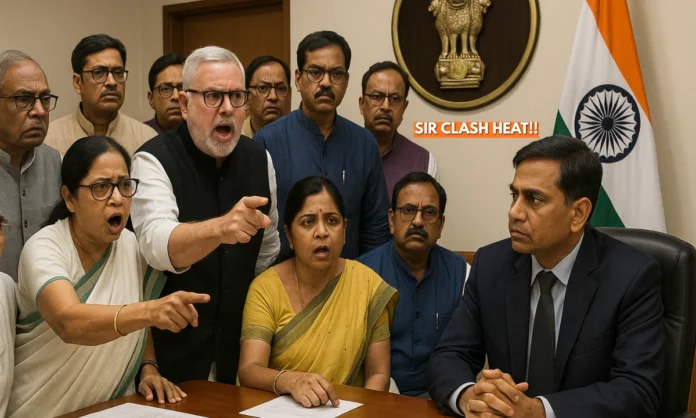
Key Highlights:
- TMC delegation presented list of 40 deaths allegedly linked to SIR process in West Bengal, accusing Election Commission of having “blood on their hands”
- Party questions why West Bengal faces extensive SIR while other border states like Tripura, Meghalaya, and Nagaland remain exempt from the process
- TMC challenges credibility of voter rolls now under scrutiny, asking why same lists were acceptable for 2024 Lok Sabha elections that formed current government
SIR in Bengal: Opening Overview
A ten-member delegation from the Trinamool Congress confronted Chief Election Commissioner Gyanesh Kumar on November 27, 2025, delivering sharp accusations against the Special Intensive Revision of electoral rolls in West Bengal. The SIR in Bengal has emerged as a flashpoint between the state’s ruling party and the Election Commission of India, with TMC leaders alleging that the process has become punitive, discriminatory, and fatal for ground-level officials tasked with its implementation.
TMC MP Derek O’Brien stated bluntly after the meeting that the Election Commission has “blood on their hands,” referencing approximately 40 deaths allegedly connected to the SIR process, including Booth Level Officers who died under what their families described as tremendous work pressure. The SIR in Bengal commenced on November 4, 2025, targeting the state’s 7.66 crore registered voters across 294 Assembly constituencies, with enumeration forms distributed to verify voter identities against a baseline 2002 electoral roll.
SIR के नाम पर देश भर में अफ़रा-तफ़री मचा रखी है – नतीजा? तीन हफ्तों में 16 BLO की जान चली गई। हार्ट अटैक, तनाव, आत्महत्या – SIR कोई सुधार नहीं, थोपा गया ज़ुल्म है।
— Rahul Gandhi (@RahulGandhi) November 23, 2025
ECI ने ऐसा सिस्टम बनाया है जिसमें नागरिकों को खुद को तलाशने के लिए 22 साल पुरानी मतदाता सूची के हज़ारों स्कैन पन्ने… pic.twitter.com/oHdabs0kHe
SIR in Bengal: Why West Bengal Faces Intensive Scrutiny While Border States Are Exempt
The TMC delegation raised fundamental questions about geographical selectivity in implementing the SIR process. TMC’s memorandum to the Chief Election Commissioner specifically challenged why West Bengal alone faces such extensive voter list revision while other states sharing borders with Bangladesh and Myanmar remain exempt from similar scrutiny. The party listed Tripura, Meghalaya, Mizoram, Arunachal Pradesh, Nagaland, and Manipur as border states conspicuously absent from the SIR process, suggesting the exercise targets Bengali identity rather than addressing infiltration concerns.
- The Election Commission is conducting SIR across 12 states and Union Territories, including SIR in Bengal, Uttar Pradesh, Chhattisgarh, Goa, Gujarat, Kerala, Madhya Pradesh, Rajasthan, Tamil Nadu, Andaman and Nicobar Islands, Lakshadweep, and Puducherry
- Research published in August 2025 estimated West Bengal’s electoral rolls contain 1.04 crore excess voters, representing 13.69 percent inflation based on demographic projections from Census 2001 and 2011 data
- West Bengal witnessed a 69 percent surge in voter count over the past 23 years, significantly outpacing demographic growth expectations and prompting Election Commission scrutiny
The SIR in Bengal has identified approximately 15.53 lakh dead voters during the ongoing revision exercise as of November 28, 2025, with 6.45 lakh enumeration forms digitized and 7.65 lakh forms distributed to voters for verification. The Election Commission extended the enumeration period to December 11, 2025, with draft electoral rolls now scheduled for publication on December 16, 2025, and final voter lists due February 7, 2026. Mapping exercises conducted by the Election Commission revealed that between 51.3 percent and 65.2 percent of voters in seven West Bengal districts have their names on both the 2025 electoral roll and the 2002 SIR baseline list.
Deaths of Booth Level Officers Spark Institutional Accountability Questions
The human cost of the SIR in Bengal has become central to TMC’s criticism of the Election Commission. The party presented documentation of approximately 40 deaths allegedly linked to the SIR process, with 17–18 being Booth Level Officers whose families cited intense work pressure and inadequate institutional support. TMC MP Mahua Moitra reported that Election Commission officials expressed surprise at the death reports during their meeting, stating the commission appeared unaware of these fatalities in West Bengal.
- At least four BLO deaths had been confirmed in West Bengal by November 27, 2025, with families alleging “tremendous pressure” from juggling SIR duties alongside regular teaching responsibilities
- The Election Commission deployed 5.32 lakh BLOs across 12 states and UTs for the SIR process, with each official responsible for approximately 956 electors within a one-month timeline
- Reports indicated BLOs received insufficient training, faced unrealistic deadlines, and experienced systemic pressure that TMC characterized as institutional neglect
The SIR in Bengal has generated intense political friction, with the Election Commission seeking security assurances from West Bengal’s Director General of Police for BLOs and associated personnel. The poll body also requested a report from Kolkata Police Commissioner regarding security at the Chief Electoral Officer’s office after BLOs staged protests. Meanwhile, the Election Commission denied TMC and DMK allegations about BLO deaths as “false and motivated” in a response filed ahead of Supreme Court hearings on the matter.
Electoral Roll Credibility and Political Implications of the SIR Process
TMC’s memorandum challenged the fundamental premise of the SIR in Bengal by questioning why electoral rolls deemed reliable for the 2024 Lok Sabha elections suddenly became “unreliable” within a year. The party pointed out that the same voter lists now under intensive revision were used to elect India’s current Lok Sabha, three major Assembly elections, and the national government. This contradiction forms a central pillar of TMC’s argument that the SIR in Bengal serves political rather than administrative purposes.
- The 2024 Lok Sabha elections in West Bengal used the electoral rolls now being revised, delivering 29 of 42 seats to TMC while the BJP-led NDA secured 240 seats nationally, requiring coalition support to form government
- West Bengal recorded 79.29 percent voter turnout in the 2024 Lok Sabha elections, among the highest in the country and indicating strong public engagement with the electoral process
- As of December 2, 2025, data for 2.45 crore voters (32.06 percent of West Bengal’s total electorate) had been successfully matched in the mapping exercise comparing current rolls with 2002 baseline data
The TMC accused the Election Commission of selective responsiveness, alleging swift action on BJP concerns while ignoring Opposition objections to the SIR in Bengal. The party cited BJP leaders’ public statements claiming one crore voters would be deleted from West Bengal’s rolls, arguing the Election Commission’s silence on such pronouncements reveals partisan bias. TMC General Secretary Abhishek Banerjee accused the poll body of “planting selective leaks” to falsely claim point-by-point rebuttals of issues raised by the TMC delegation. The Election Commission has maintained that the SIR process follows established procedures, with Chief Electoral Officer Manoj Kumar Agarwal instructing District Election Officers that “no eligible voter to be left out and no ineligible voter to be entered” in electoral rolls.
Political Battle Lines Drawn Over Voter List Verification
The SIR in Bengal has crystallized broader political tensions between the Trinamool Congress and the BJP, with each party accusing the other of manipulating the electoral roll revision process. BJP leaders, including Leader of Opposition Suvendu Adhikari, have accused TMC of pressuring BLOs not to delete names of dead voters from electoral rolls, posting purported WhatsApp screenshots and audio clips as evidence. Conversely, TMC has characterized the SIR in Bengal as “linguistic terrorism” targeting Bengali identity and questioned whether the process aims to “quietly push Bengalis out” of voter lists.
- The Election Commission criticized West Bengal’s government for delaying increased honorariums for BLOs engaged in the SIR process, adding another dimension to the institutional friction
- Chief Election Commissioner Gyanesh Kumar cited Bihar’s SIR completion as an example, where the final electoral roll published with 7.42 crore voters after removing approximately 47 lakh names and adding 21 lakh new voters
- Multiple pleas reached the Supreme Court seeking pause and extension of the SIR timeline amid reports of BLO deaths and work pressure across participating states
The SIR in Bengal requires voters to verify their inclusion against the 2002 electoral roll baseline, with the Election Commission notifying specific documents required for new voter ID applicants. Voters whose names do not appear in the 2002 electoral roll must provide additional documentation during the verification process, a requirement TMC has characterized as creating unnecessary barriers to voting rights. The revised SIR schedule extended the enumeration period by seven days across all 12 participating states, with the draft electoral roll publication moved from December 9 to December 16, 2025. This extension followed widespread complaints about insufficient time for BLOs to complete door-to-door verification, form distribution, collection, and digitization tasks within the original 30-day timeline.
Final Assessment
The SIR in Bengal has evolved from an administrative electoral roll revision into a political battleground raising fundamental questions about institutional neutrality, democratic inclusion, and the human cost of compressed timelines for massive bureaucratic exercises. TMC’s presentation of 40 deaths allegedly linked to the SIR process, coupled with families’ testimonies about work pressure on Booth Level Officers, has forced uncomfortable scrutiny on the Election Commission’s implementation methodology.
The geographical selectivity of the SIR process, concentrating intensive revision in West Bengal while exempting other border states, lends credence to TMC’s allegations that the exercise serves purposes beyond simple voter list accuracy. Whether the SIR in Bengal ultimately strengthens electoral integrity or undermines democratic participation will depend significantly on how the Election Commission addresses documented implementation failures, particularly the reported deaths of ground-level officials and the political manipulation allegations from both major parties.