
Key Highlights
- A Malaga-Madrid high-speed train derailed near Adamuz, colliding head-on with an oncoming Huelva-bound train, killing 39 and injuring over 70.
- Rescue operations continue amid twisted wreckage on newly renovated straight track, with 30 seriously hurt and services suspended across Andalusia.
- Prime Minister Pedro Sanchez calls it a “night of deep pain” as Spain mourns worst rail disaster since 2013 Santiago crash.
Spain Train Collision: Opening Overview
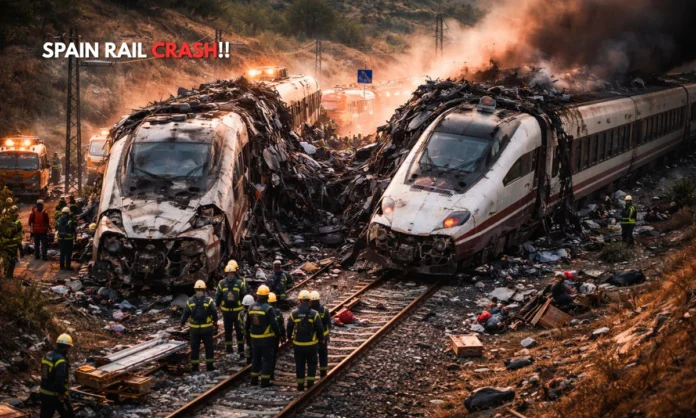
Spain reels from a catastrophic high-speed train collision in Andalusia that claimed 39 lives and injured more than 70 others. The Spain train collision near Adamuz unfolded Sunday evening when a Malaga-to-Madrid service derailed on a straight, recently renovated track section, veering into the path of an oncoming train. This head-on impact caused both trains to derail, trapping hundreds in mangled carriages and sparking a frantic multi-agency rescue effort that stretched into Monday.
Prime Minister Pedro Sanchez captured national grief, describing the event as a “night of deep pain” for Spain. Emergency coordinator Antonio Sanz warned the death toll could climb, with 73 injured including 30 in serious condition rushed to hospitals. The disaster strikes at the heart of Spain’s pride in its high-speed rail network, Europe’s largest at over 3,700 kilometers of track serving millions annually. Spain’s Transport Minister Oscar Puente called the incident “extremely strange” given the modern train and pristine infrastructure involved. As families gather at aid stations in Madrid, Seville, Cordoba, Malaga, and Huelva, questions mount over safety protocols on this vital corridor. This Spain train collision exposes vulnerabilities in even advanced systems, demanding swift investigation into derailment causes.
Tragedy in southern Spain🇪🇸: a high-speed train derailed, crossed tracks, and hit another train head-on.
— Sumit (@SumitHansd) January 19, 2026
More than 21 reportedly killed, and at least 100 injured, with 25 suffering critical injuries#Spain | #trainaccident pic.twitter.com/UHas6y2Luk
Spain Train Collision: Details and Sequence
- Malaga-Madrid Iryo train derailed ten minutes post-Cordoba, rear carriages crossing tracks to hit Renfe Huelva service.
- Both trains carried around 300 passengers each; twisted metal and embankment plunge complicated extractions.
- Occurred 6:40 p.m. on flat, renovated track with “practically new” rolling stock.
The Spain train collision began when the Iryo high-speed train, flight number unspecified but fresh from Malaga with a Cordoba stop, suddenly derailed near Adamuz, 40 kilometers northeast of Cordoba. Rear carriages jumped the rails first, sliding onto the opposing track just as a Renfe service from Madrid toward Huelva approached at high speed. The resulting smash sent front carriages of the second train tumbling four meters down an embankment, while twisted metal fused passengers with wreckage across both consists.
Francisco Carmona, Cordoba fire chief, detailed the grim scene to RTVE: rescuers cut through carriages where metal entangled victims, sometimes removing deceased to reach survivors. Passenger Montse on the Huelva train recalled a jolt, blackout, and chaos with luggage flying and children crying in the last carriage. Survivor Lucas Meriako from the derailed train likened it to a “horror movie,” citing a massive rear impact shattering glass and threatening collapse.
Adif, Spain’s rail infrastructure manager, confirmed the sequence via official X posts, suspending all high-speed services between Madrid and Andalusian hubs: Cordoba, Seville, Malaga, Huelva. This Spain train collision halted over 20 daily runs, stranding thousands. Preliminary notes highlight no immediate signal failure alerts, with the straight track segment fully renovated in May 2025 per ADIF maintenance logs. Around 600 passengers total faced evacuation, with military emergency units deploying 40 personnel and 15 vehicles to aid civil responders.
Spain Train Collision: Rescue Efforts and Victim Impact
- 73 confirmed injured, 30 critical; all evacuated to six regional hospitals by dawn Monday.
- Firefighters battled twisted carriages; passenger accounts describe bleeding attendants, flying debris.
- Victim assistance centers opened at major stations; King Felipe VI offers condolences.
Rescue operations at the Spain train collision site mobilized over 200 personnel from regional fire services, national police, and military units into Monday morning. Andalusia’s top emergencies official Antonio Sanz reported 39 fatalities per police tallies, with 73 injured including many trapped for hours in overturned coaches. Transport Minister Oscar Puente noted 30 serious cases airlifted or road-transported to facilities in Cordoba, Jaen, and Seville.
Fire chief Carmona’s teams used hydraulic cutters and cranes to disentangle victims, navigating a landscape of derailed wagons half-buried in embankment soil. One operation required extracting a deceased passenger to free a survivor, underscoring the painstaking work amid fading light and winter chill. Passenger testimonies paint visceral horror: Montse felt thrown in darkness, aiding a bleeding attendant while shielding children; Meriako endured glass shards and structural groans post-impact.
ADIF established family reunion points at five key stations, coordinating with Red Cross for psychological support. Spain’s royal family, King Felipe VI and Queen Letizia, expressed profound concern via palace statement, extending sympathies. International figures like French President Emmanuel Macron and EU Commission President Ursula von der Leyen echoed condolences. This Spain train collision’s human toll, with around 300 aboard the Iryo alone, amplifies scrutiny on evacuation drills and carriage integrity.
Spain Train Collision: Infrastructure and Safety Context
- Track renovated May 2025; derailment on straight section baffles experts given modern AVE-standard trains.
- Iryo train under 4 years old; Renfe service state-operated on shared high-speed corridor.
- Compares to 2013 Santiago derailment (80 dead), prompting ERTMS signaling rollout.
Spain’s high-speed rail, branded AVE, ranks among global elite, yet this Adamuz Spain train collision revives safety debates. The incident site, a straight 10-kilometer stretch renovated last May with €150 million in EU-backed upgrades, used continuously welded rails and advanced ballast for stability. Puente emphasized the Iryo train’s near-new status, compliant with EN 15227 crashworthiness norms enforced since 2014 post-Santiago reforms.
ADIF’s 2025 report logs zero derailments on this corridor since AVE inauguration in 1992, with network-wide incident rates at 0.12 per million train-km, below EU averages. Signaling relies on ERTMS Level 2, mandating automatic train protection (ATP) to prevent overspeeds or route violations. No preliminary faults in balises or points detected, per initial ADIF telemetry.
| Historical Spain Train Incidents Comparison | Date | Location | Deaths | Cause |
|---|---|---|---|---|
| Adamuz Collision (2026) | Jan 18 | Andalusia | 39 | Derailment unknown |
| Santiago de Compostela | Jul 2013 | Galicia | 80 | Overspeed curve |
| Angrois Derailment | 2013 | Galicia | 80 | Human error |
| Fregoso Level Crossing | 1944 | Valladolid | 88 | Collision |
This Spain train collision occurred sans curves or known defects, contrasting 2013’s speed violation. Private operator Iryo, launched 2021, maintains fleets to UIC standards, audited yearly by AESF (Spanish Railway Safety Agency). Investigations now probe wheel-rail interaction, potential track anomalies post-renovation, or cyber-signal interference, with full report due in 30 days.
Investigation Outlook and National Response
- ADIF leads probe with AESF, ETA (European Transport Agency); black boxes recovered intact.
- Services suspended through Tuesday; €5 million aid package announced for victims.
- Sanchez convenes crisis cabinet; parallels to 2013 spark calls for full network review.
National response to the Spain train collision mobilized swiftly, with Prime Minister Sanchez convening an emergency cabinet Monday. He vowed “all resources” for answers, activating ADIF’s accident protocol alongside AESF oversight. Black boxes from both trains, containing voyage data recorders, were secured overnight, promising data on speed, braking, and signals at derailment instant.
AESF’s 2025 safety bulletin notes Spain’s high-speed fleet logged 98.7% on-time reliability, with zero fatal collisions since 1944 until Adamuz. EU Regulation 2016/796 mandates independent probes, integrating ETCS event logs. Initial focus: why rear Iryo carriages detached on straight track, possibly rail fracture or suspension flaw. Renfe’s Huelva train bore impact brunt, its front derailing fully.
Public outrage brews over privatized operations like Iryo sharing ADIF tracks, echoing 2021 liberalization debates. Regional president Juanma Moreno declared three mourning days, allocating €5 million for families. This Spain train collision prompts parliamentary inquiries into maintenance contracts, with opposition demanding ERTMS Level 3 upgrades nationwide.
Closing Assessment
The Adamuz Spain train collision stands as a stark reminder of rail travel’s inherent risks, even on Europe’s gold-standard high-speed network. With 39 confirmed dead and dozens fighting for life, Andalusia grapples with profound loss while investigators dissect causes on impeccably maintained infrastructure. Prime Minister Sanchez’s pledge ensures transparency, but public faith hinges on uncovering derailment roots, be they mechanical, procedural, or undetected flaws.
This tragedy, deadliest since 2013’s 80 fatalities, underscores ongoing tensions between expansion and safety in Spain’s 3,700-km AVE web. As services resume piecemeal, enhanced protocols like real-time AI monitoring could fortify resilience. Families deserve not just condolences, but systemic evolution preventing recurrence. Spain’s rail legacy demands no less: turning grief into guardianship for future passengers.