
Key Highlights
- Sunita Williams retired from NASA on December 27, 2025, after 27 years, qualifying for Federal Employees Retirement System (FERS) pension based on high-3 salary average and service length.
- Estimated annual FERS pension around $43,200, plus Social Security, Thrift Savings Plan access, and lifelong health/life insurance benefits.
- NASA astronauts under FERS receive 1% of high-3 salary per year of service, with her GS-15 grade supporting substantial post-retirement income.
Sunita Williams Pension: Opening Overview
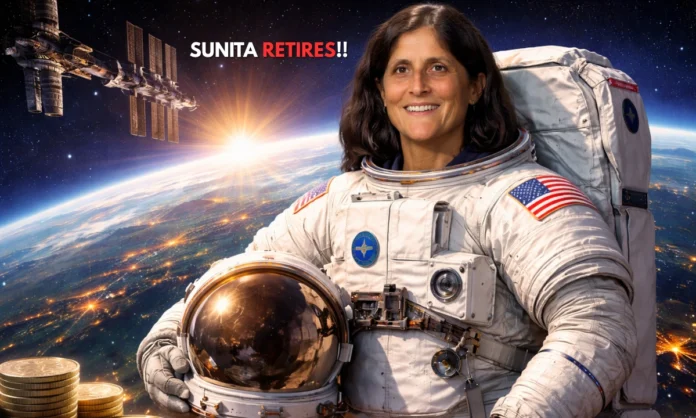
Sunita Williams pension details spark widespread curiosity following her NASA retirement on December 27, 2025. As a veteran astronaut with 27 years of service, Sunita Williams pension eligibility under the Federal Employees Retirement System (FERS) promises financial security after logging 608 days in space. This milestone closes a chapter defined by three International Space Station missions and record-setting nine spacewalks totaling 62 hours and 6 minutes.
The broader context of Sunita Williams pension reflects how U.S. federal employees, including elite NASA personnel, transition to post-career life. FERS, established in 1987, blends annuity, Social Security, and personal savings to replace about 30-40% of pre-retirement income for long-serving staff. For high-achievers like Williams, who held GS-15 pay grade with salaries near Rs 1.20-1.30 crore annually (about $143,000-$155,000), the formula yields meaningful support. Official NASA channels confirm retirement processing through the National Shared Services Center (NSSC), with annuities accruing post-January 2026 for recent retirees. This system ensures trailblazers sustain contributions to science and inspiration beyond active duty, amid ongoing Artemis program demands. Williams’ path, blending Navy captain credits with NASA tenure, exemplifies FERS adaptability for military-to-civilian careers.
The sky was never the limit for her! 🌌 🌟
— Sonal Goel IAS 🇮🇳 (@sonalgoelias) January 21, 2026
Astronaut Ms. Sunita Williams retires after 600+ days in space and 27 groundbreaking years at NASA. 🚀
From breaking barriers in space to inspiring millions on Earth, she has shown that courage, perseverance, and vision can take… pic.twitter.com/wGM5L55XSj
FERS Pension Formula for Astronauts
- Core calculation: 1% of high-3 average salary multiplied by creditable service years, rising to 1.1% if retiring at age 62+ with 20+ years.
- Sunita Williams’ 27 years positions her for unreduced annuity, estimated at $43,200 yearly based on GS-15 scale.
- Official NASA documents outline processing timelines, with first payments mid-March 2026 for December retirees.
Sunita Williams pension hinges on FERS mechanics tailored for federal civilians like NASA astronauts. The high-3 average captures the best three consecutive years’ basic pay, excluding bonuses or overtime. For a GS-15 Step 10 employee, 2025 base pay reached $191,900 before locality adjustments, per Office of Personnel Management schedules. Multiplied by 1% per year, her 27 years yield 27% replacement rate, aligning with the $43,200 estimate when factoring Ohio locality (16.17%) and potential step reductions.
Astronauts benefit from “creditable service” including prior military time, as Williams accrued from U.S. Navy captaincy. FERS rules credit such periods fully if deposited, boosting her total without penalty. Post-62 retirement enhances the multiplier to 1.1%, though her age at exit (around 60) secures standard terms. NSSC handles computations, accruing annuities from the second month post-retirement, with adjustments for survivor options or supplements until age 62.
| FERS Annuity Multipliers | Service/Years | Formula Rate |
|---|---|---|
| Standard (under 62 or <20 years) | Any | 1% x high-3 x years |
| Enhanced (62+ and 20+ years) | 20+ | 1.1% x high-3 x years |
| Special (e.g., law enforcement, not astronauts) | 20+ | 1.7% first 20 years |
This table clarifies why Sunita Williams pension remains robust, independent of mission hazards pay.
Additional Retirement Benefits Package
- Thrift Savings Plan (TSP) offers 401(k)-like growth, with NASA matching up to 5% of salary during service.
- Social Security provides separate monthly checks, approximated by Special Retirement Supplement pre-62.
- Lifelong FEHB health insurance and FEGLI life coverage continue at retiree rates.
Beyond core annuity, Sunita Williams pension ecosystem includes TSP withdrawals, potentially millions from decades of contributions. Federal employees auto-enroll in TSP, with low-fee index funds yielding 7-10% average returns historically. Williams, as high earner, likely maximized matches, accessing funds penalty-free post-59.5 or via annuitization.
Social Security integrates via FERS’ Special Retirement Supplement (SRS), mimicking benefits earned under FERS years until 62. Formula: (Social Security at 62 x FERS service years / 40), payable if retiring at minimum retirement age with 30 years. For Williams, SRS bridges to full SSA payments, estimated $2,000+ monthly at her earnings history. Health perks shine: FEHB premiums pre-tax, covering 70%+ plans, with dental/vision options. FEGLI life insurance converts to private policy, ensuring family protection.
| Benefit Type | Annual Value Estimate (GS-15) | Source Admin |
|---|---|---|
| TSP Access | $1M+ principal possible | tsp.gov |
| Social Security | $24,000+ post-62 | ssa.gov |
| FEHB Premium Subsidy | $5,000+ savings | opm.gov |
| SRS (pre-62) | Varies by high-3 | OPM FERS handbook |
These layers make Sunita Williams pension holistic, sustaining her post-NASA pursuits.
NASA Astronaut Service Records Impact
- 608 days in space, second-highest for NASA; nine spacewalks, female record-holder.
- GS-15 classification standard for senior astronauts, with 2025 pay scales verified via OPM.
- Retirement effective December 27, 2025, processed via NSSC for timely benefits.
Sunita Williams pension calculation credits full 27 years, including Navy-to-NASA transition. Her records amplify legacy: three ISS flights (Expeditions 32/33, 52/53, Boeing Starliner) demanded GS-15 stature, topping $170,000 base. OPM’s 2025 GS pay table confirms Step 1 at $144,000+, scaling to $191,900 Step 10 nationwide, plus 15-30% locality. FERS excludes flight pay but includes longevity increases.
NASA’s retirement portal details NSSC role: applications reviewed through February 2026, first checks mid-March. Astronauts retain TRICARE eligibility via military credits, layering DoD health atop FEHB. This setup underscores federal commitment to space pioneers, with Williams’ tenure exemplifying value.
Post-Retirement Life and Financial Security
- Potential speaking, advisory roles leverage expertise, supplementing pension.
- No public disclosure of exact high-3, but GS-15 benchmarks enable Rs 36 lakh ($43,200) FERS estimate.
- Global inspiration continues, with benefits ensuring stability.
Sunita Williams pension affords flexibility for philanthropy, writing, or private sector gigs. Comparable retirees like Peggy Whitson parlay experience into consulting, doubling income. FERS’ inflation-adjusted annuity (COLA post-2026) preserves purchasing power, with TSP for growth.
Official projections align: 0.01 x high-3 x 27 for her profile. Indian diaspora watches closely, converting $43,200 to Rs 36 lakh at 83 INR/USD, robust amid Bengal’s Koch Bihār context.
Closing Assessment
Sunita Williams pension under FERS cements a secure horizon after 27 extraordinary years. Blending $43,200 annuity, TSP, Social Security, and insurance, her package exemplifies federal rewards for space service. As NASA eyes Mars, retirees like her inspire next generations.
This financial architecture ensures trailblazers thrive. Williams’ journey prompts reflection: how pensions honor risks taken 250 miles above Earth. Her story reaffirms FERS as pillar of American innovation support.