
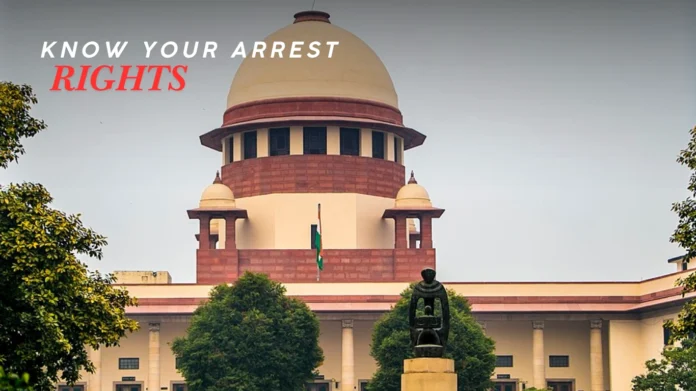
Key Highlights:
- Supreme Court declares written arrest grounds mandatory for all offences under every statute, including BNS 2023, with two-hour pre-remand deadline
- Non-compliance with Article 22(1) constitutional mandate renders arrest and subsequent remand illegal, entitling immediate release
- Landmark ruling in Mihir Rajesh Shah BMW hit-and-run case establishes universal framework protecting 513 annual arrests under special laws alone
Opening Overview
The Supreme Court has delivered a transformative judgment mandating written communication of arrest grounds for every detained individual across India, regardless of offence severity or statutory provisions. A bench comprising Chief Justice B R Gavai and Justice Augustine George Masih ruled on November 6, 2025, that failure to provide written arrest grounds in a language understood by the arrestee violates fundamental constitutional protections under Article 22(1) and renders both arrest and remand proceedings illegal. This 52-page verdict emerged from the high-profile Mihir Rajesh Shah case involving Mumbai’s July 2024 BMW hit-and-run incident, where the accused challenged arrest legality citing absence of written grounds.
The Supreme Court’s directive establishes that constitutional safeguards protecting personal liberty are not procedural formalities but mandatory requirements applicable universally, with arresting authorities now bound to furnish grounds in writing within reasonable time frames and definitively two hours before magistrate production.
Justice Augustine George Masih, authoring the judgment, emphasized that Article 22(1)’s constitutional mandate serves as fundamental protection against arbitrary state action, requiring arrest grounds communication “in each and every case without exception”. The Supreme Court has ordered its registry to transmit judgment copies to all high court registrars general and state chief secretaries, ensuring nationwide implementation of these reinforced arrest protocol standards. According to Enforcement Directorate statistics, 513 persons were arrested under special laws by January 2023, highlighting the significant impact this ruling will have on arrest procedures across multiple statutory frameworks.
Constitutional Framework and Legal Imperatives
- Article 22(1) establishes non-negotiable right to arrest grounds information with mandatory written communication requirement
- Two-hour pre-remand deadline introduced as absolute threshold for exigency situations where immediate written communication proves impossible
- Universal applicability extends beyond special laws to include Indian Penal Code and Bharatiya Nyaya Sanhita 2023 offences
The Supreme Court’s ruling fundamentally redefines arrest procedures by declaring the constitutional mandate under Article 22(1) applies universally to “all offences under all statutes, including offences under IPC 1860 (now BNS 2023)”. This constitutional provision, protecting individuals from arbitrary detention, requires arresting authorities to inform detained persons of arrest grounds “as soon as may be” while ensuring comprehension through language accessibility. The judgment clarifies that arrest grounds must be communicated in writing “in the language he/she understands,” establishing linguistic accessibility as integral to constitutional compliance.
Justice Masih’s verdict introduces a critical temporal framework addressing practical enforcement challenges while maintaining constitutional rigor. Where arresting officers cannot immediately provide written grounds due to operational exigencies, oral communication remains permissible initially, but written documentation becomes mandatory “within a reasonable time and in any case at least two hours prior to production of the arrestee for remand proceedings before the magistrate”. This two-hour pre-remand deadline represents a substantial tightening of arrest procedures, creating an absolute threshold beyond which non-compliance renders arrest and subsequent remand illegal.
The Supreme Court reinforced that Article 22(1)’s objective extends beyond mere notification to ensuring arrested individuals comprehend allegations against them, achievable only through written communication in understood languages. The judgment cited the landmark Pankaj Bansal v. Union of India (2024) case, which underscored that Article 22(1) mandates informing arrested persons of detention grounds at the earliest opportunity. Article 22(2) complements these protections by requiring arrestee production before the nearest magistrate within 24 hours excluding journey time, preventing prolonged custody without judicial oversight. Together, these constitutional provisions establish comprehensive safeguards ensuring arrest procedures remain subject to constitutional limitations and judicial scrutiny.
Landmark judgement by Supreme Court!
— Raman Singh Dhaka (@RamanDhaka) November 7, 2025
Now grounds of arrest of any person would be required to be given in writing by the authorities who arrest the person upholding the rights in Article 21 i.e. right to life and personal liberty-in Indian constitution
Hats off Supreme Court! pic.twitter.com/kNltdfCh81
Mihir Rajesh Shah Case and Judicial Reasoning
- 24-year-old accused challenged arrest legality in July 2024 BMW hit-and-run case that killed 45-year-old Kaveri Nakhwa
- Bombay High Court acknowledged procedural lapse but upheld arrest citing offence gravity, prompting Supreme Court intervention
- CCTV footage corroborated Shah was driving BMW at incident time, with victim dragged 1.5-2 kilometers after impact
The Supreme Court’s landmark ruling emerged from appeals filed by Mihir Rajesh Shah, accused in Mumbai’s devastating BMW hit-and-run incident that occurred on July 7, 2024, at approximately 5:25 AM in Worli area. The Supreme Court case involved Shah, son of former Shiv Sena leader Rajesh Shah, allegedly driving his high-end BMW in an inebriated condition when he struck a scooter carrying Pradeep Nakhwa and his wife Kaveri, who were traveling to sell fish. The impact threw both victims onto the car’s bonnet, with Kaveri becoming trapped between the bumper and front wheel as Shah continued driving, dragging her for approximately 1.5 to 2 kilometers.
Kaveri Nakhwa, 45, died from her injuries while Pradeep sustained serious harm in the incident that shocked Mumbai. Shah fled the scene and evaded capture for two days before his arrest on July 9, 2024, with his driver Rajrishi Bidawat arrested on the incident day itself. Both accused remained in judicial custody as the case proceeded through multiple judicial forums. The Bombay High Court on November 25, 2024, dismissed petitions filed by Shah and Bidawat challenging arrest legality, with the court recording that both petitioners were “conscious of their serious act of hitting the moped” while operating the BMW “in a rash and negligent manner, with Mihir having consumed alcohol”.
The Supreme Court granted leave on April 22, 2025, formulating two critical questions for judicial determination. First, whether furnishing written arrest grounds proves necessary in every case including IPC/BNS offences, and second, whether arrests become vitiated when exigencies prevent immediate grounds communication.
The Mumbai Sessions Court had earlier rejected Shah’s bail plea on August 22, noting the accused “had behaved in a merciless manner, and it meant to say that anything can be done on the basis of financial and muscular power”. CCTV footage corroborated that Shah was driving the BMW at the incident time, establishing his direct culpability in the fatal hit-and-run. The Supreme Court’s ruling addressed Shah’s central contention that his arrest violated constitutional protections by failing to provide written grounds, ultimately establishing universal standards that transcend individual case circumstances.
Implementation Directives and Enforcement Mechanisms
- Registry ordered to transmit judgment copies to all high court registrars general and state chief secretaries for nationwide implementation
- Non-compliance consequences include arrest and remand illegality with mandatory arrestee release
- Ruling impacts arrest procedures across criminal justice system handling thousands of annual detentions
The Supreme Court issued comprehensive implementation directives ensuring nationwide adoption of reinforced arrest protocol standards. The judgment explicitly directs the Court’s registry to send copies to registrars general of all high courts and chief secretaries of every state and Union territory, establishing formal channels for cascading constitutional compliance requirements through judicial and administrative hierarchies. This systematic dissemination approach recognizes that transforming arrest procedures requires coordinated action across India’s federal structure, engaging both judicial officers supervising remand proceedings and executive authorities conducting arrests.
Justice Masih’s verdict establishes unequivocal enforcement consequences for non-compliance, stating that failure to adhere to the two-hour pre-remand timeline for written grounds communication would render “the arrest and subsequent remand illegal, and the person would be at liberty to be set free”. This clear remedial pathway empowers magistrates conducting remand proceedings to scrutinize arrest documentation rigorously, effectively creating judicial gatekeeping that prevents constitutional violations from proceeding into extended detention. The ruling transforms what was previously treated as procedural irregularity into grounds for immediate release, substantially elevating the stakes for law enforcement agencies conducting arrests.
The judgment’s impact extends across India’s criminal justice system, which according to National Crime Records Bureau data compiles crime statistics through its “Crime in India” publication series, with the latest published report covering 2022. The Supreme Court’s directive applies universally to arrests under special statutes and ordinary criminal laws alike, affecting procedures in cases ranging from economic offences to violent crimes. Enforcement Directorate records indicate 513 persons were arrested under Prevention of Money Laundering Act by January 2023, representing just one category of special law arrests now subject to enhanced constitutional protections.
The ruling’s comprehensive scope ensures that arrest grounds in writing become standard practice regardless of investigating agency, offence category, or statutory framework, fundamentally reshaping police-citizen interactions during detention processes.
Broader Implications for Rights Protection
- Ruling strengthens constitutional protections balancing individual liberty against state security through procedural safeguards
- Judgment prevents arbitrary detention by establishing judicial oversight requirements before extended custody
- Language accessibility provisions ensure marginalized communities comprehend arrest circumstances fully
The Supreme Court’s verdict represents a fundamental rebalancing of state power and individual liberty by transforming arrest procedures from discretionary practices into constitutionally mandated protocols. The Supreme Court judgment acknowledges that procedural safeguards serve as bulwarks protecting citizens from state arbitrariness, comparable to protections prohibiting women’s custody after sunset or requiring female police officer presence during arrests. These procedural requirements, far from being mere formalities, constitute essential checks preventing miscarriage of justice by constraining police powers through constitutional limitations.
Article 22’s comprehensive framework reflects the Constitution’s commitment to protecting personal freedom while accommodating legitimate security concerns through carefully calibrated exceptions. The provision distinguishes between ordinary criminal arrests governed by strict procedural protections and preventive detention situations where public interest may justify extended custody with alternative safeguards including Advisory Board review. The Supreme Court’s emphasis on written communication in understood languages proves particularly significant for India’s linguistically diverse population, ensuring constitutional protections extend meaningfully to marginalized communities who might otherwise face comprehension barriers during arrest situations.
The ruling’s insistence on pre-remand written grounds delivery prevents prolonged custody without judicial oversight by forcing magistrates to evaluate arrest legality at the earliest possible juncture. This temporal requirement ensures that judicial scrutiny occurs before detention hardens into extended incarceration, providing arrestees with immediate recourse against unlawful detention. The Supreme Court judgment thus operationalizes Article 21’s fundamental right to life and personal liberty by establishing concrete mechanisms preventing arbitrary state action. By declaring non-compliance grounds for immediate release, the Supreme Court creates powerful incentives for law enforcement agencies to prioritize constitutional compliance, effectively embedding rights protection into routine arrest procedures rather than treating it as aspirational principle subject to operational convenience.
Final Perspective
The Supreme Court’s November 6, 2025 judgment in Mihir Rajesh Shah v. State of Maharashtra establishes a watershed moment for constitutional protections against arbitrary arrest across India. By declaring written arrest grounds mandatory for all offences under every statute and introducing the two-hour pre-remand deadline, the verdict transforms Article 22(1) from aspirational constitutional text into enforceable procedural requirement with concrete consequences for non-compliance. The ruling’s universal applicability, extending from special laws to ordinary criminal statutes including the Bharatiya Nyaya Sanhita 2023, ensures comprehensive coverage protecting all arrested individuals regardless of offence severity or investigating agency.
Justice Masih’s 52-page judgment reinforces that constitutional mandates protecting personal liberty are not subordinate to operational convenience but represent fundamental safeguards requiring strict adherence. The directive for nationwide dissemination through high courts and state governments demonstrates judicial commitment to systemic implementation rather than case-specific relief. The verdict’s emphasis on language accessibility ensures arrest grounds in writing become meaningful protections rather than symbolic gestures, particularly benefiting India’s marginalized communities facing comprehension barriers. As law enforcement agencies adapt to these reinforced constitutional standards, the judgment promises to reshape police-citizen interactions during arrests, embedding rights protection into routine procedures while maintaining necessary flexibility for genuine operational exigencies through the carefully calibrated two-hour pre-remand threshold.