
Key Highlights
- A construction crane collapsed onto a passenger train from Bangkok to Ubon Ratchathani in Sikhio district, killing 22 and injuring over 30 on January 14, 2026.
- The incident occurred during high-speed rail construction, derailing carriages and sparking a brief fire now extinguished.
- Rescue teams extracted trapped passengers from twisted wreckage as authorities launched investigations into safety lapses.
Incident Overview
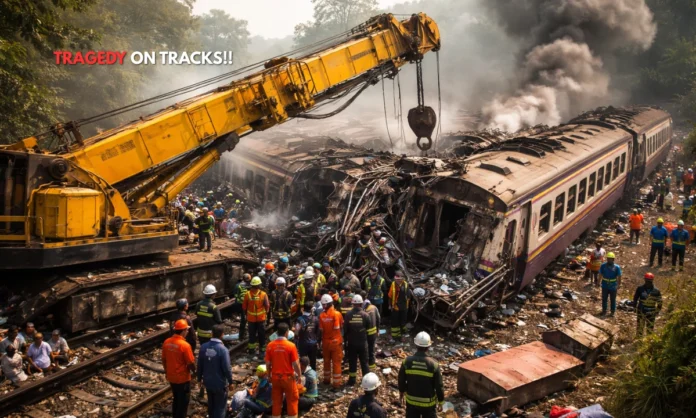
A devastating train derailment struck Thailand’s northeast on January 14, 2026, when a construction crane collapsed onto a passenger train, claiming at least 22 lives and injuring more than 30 others. The Thailand train derailment unfolded around 9:05 a.m. in Sikhio district, Nakhon Ratchasima province, 230 km northeast of Bangkok. Local police chief Thatchapon Chinnawong confirmed the toll, noting the train was en route to Ubon Ratchathani with approximately 195 passengers aboard.
Emergency responders rushed to the scene, cutting through mangled metal to free those trapped inside derailed coaches. Videos showed firefighters battling flames that briefly engulfed the wreckage before extinguishing them. Thailand’s Transport Minister Phiphat Ratchakitprakarn highlighted the rapid deployment of medical teams and disaster units. This Thailand train derailment exposed vulnerabilities in coordinating rail traffic with nearby infrastructure projects.
The broader context reveals Thailand’s push for modernization through ambitious rail networks, yet recurring accidents underscore persistent risks. Authorities prioritized victim identification and aid for the critically injured, several of whom required urgent surgery. Public shock rippled across social media as families awaited news. This tragedy amplifies calls for stringent oversight in construction zones adjacent to active tracks. With rescue efforts ongoing, the full scope of the Thailand train derailment remains fluid, but initial reports paint a grim picture of chaos and heroism amid twisted steel.
At least 22 dead and 55 injured in #Thailand after a construction crane collapsed on the train No.21 from Bangkok to Ubon Ratchathani, with 190 passengers on board.
— Timjbo 🇦🇺 (@TimjboAU) January 14, 2026
The crane lifting a bridge segment for a high-speed rail project fell across the tracks at 9:05 a.m., derailing two… pic.twitter.com/s30uforCwn
Crash Sequence and Immediate Response
- Crane failure during high-speed rail work directly impacted three carriages at 9:05 a.m.
- Fire erupted post-derailment, controlled within minutes by on-site teams.
The Thailand train derailment began when a crane, positioned for elevated track construction, toppled onto the passing train in Sikhio. The impact sheared through carriages, hurling debris and passengers alike. Witnesses described a deafening crash followed by screams as the train screeched to a halt, its momentum pulling the crane’s cable and worsening the collapse. This sequence in the Thailand train derailment left many pinned under wreckage, complicating early extractions.
Rescue operations mobilized swiftly, with over a dozen teams from Nakhon Ratchasima converging by 9:30 a.m. Firefighters doused the blaze using foam suppressants, preventing further casualties. Medical personnel triaged survivors on-site, airlifting severe cases to regional hospitals. The Thai government’s public relations department posted updates on X, confirming multiple units’ involvement and urging public calm. By midday, most accessible victims received care, though deeper searches continued.
This phase of the Thailand train derailment highlighted inter-agency coordination strengths, yet challenges persisted in accessing rear coaches. Passenger accounts, relayed through rescuers, spoke of shattered windows and overturned seats. Officials cordoned off a 2-km radius, halting rail services on the Bangkok-Ubon line. The crane’s operator survived with minor injuries, providing crucial early testimony. Such rapid response mitigated potential escalation, but the human cost of the Thailand train derailment demanded deeper scrutiny into mechanical safeguards.
Official data from the State Railway of Thailand indicates daily passenger volumes exceed 100,000 on this corridor, amplifying the stakes. Preliminary engineering assessments pointed to possible overload or structural fatigue in the crane, pending forensic review.
| Casualty Breakdown | Confirmed Figures |
|---|---|
| Fatalities | 22 |
| Injuries (minor) | 25+ |
| Critical cases | 8 |
| Passengers aboard | 195 |
Infrastructure Project Background
- High-speed rail initiative valued at $5.4 billion links Bangkok to northeast provinces.
- Crane involved in bridge elevation for dual-track upgrades prone to overload risks.
The Thailand train derailment ties directly to Thailand’s high-speed rail expansion, a cornerstone of national connectivity goals. Launched in 2017, the project aims to cut Bangkok-Ubon travel from 10 hours to under three via 873 km of electrified tracks. Funding blends state budgets and Chinese loans, targeting completion by 2028. The Sikhio site focused on viaduct erection, where the crane hoisted 50-ton girders skyward.
This backdrop contextualizes the Thailand train derailment as a collision between progress and peril. Ministry of Transport records show 15 similar projects nationwide, employing over 20,000 workers. Safety protocols mandate 50-meter buffers from live tracks, yet proximity here proved fatal. Engineering logs, per government filings, logged routine inspections, but lapses in wind monitoring or load calibration surface as suspects.
The rail network carries 60 million passengers yearly, per State Railway statistics, fueling economic corridors. Recent upgrades boosted capacity by 30%, yet incidents like this Thailand train derailment erode public confidence. Comparative data reveals Thailand’s rail fatality rate at 0.12 per million passenger-km, below Southeast Asian averages but above Japan’s 0.05.
| Rail Project Milestones | Key Data |
|---|---|
| Total Length | 873 km |
| Investment | $5.4B |
| Expected Speed | 250 km/h |
| Annual Passengers | 60M |
Contractors face audits, with the Transport Ministry vowing transparency. This Thailand train derailment spotlights the tension between accelerated timelines and rigorous checks in mega-infrastructure.
Safety and Historical Context
- Thailand reports 45 rail incidents yearly, often tied to third-party interference.
- Post-accident probe ordered, focusing on crane certification and operator training.
Prior to the Thailand train derailment, Thailand’s railways grappled with vulnerabilities from aging infrastructure and urban encroachment. Department of Highways data lists 120 construction-related disruptions since 2020, including three crane mishaps. The 2019 Pakchong collision killed five due to signal failure, prompting buffer zone laws now under review post this Thailand train derailment.
National rail safety frameworks, outlined in the 2023 Land Transport Act, require certified equipment and 24-hour monitoring. Yet compliance audits reveal 18% of sites flouting standards. The Sikhio crane, a crawler model rated for 100 tons, likely exceeded limits amid beam lifts. Operator fatigue, common in 12-hour shifts, emerges as a factor.
Thailand’s accident profile shows construction faults in 40% of derailments, per Ministry compilations. International benchmarks, like EU’s 0.08 fatality rate, urge tech upgrades such as AI sensors. Families of the Thailand train derailment victims demand accountability, fueling protests.
| Historical Rail Incidents | Fatalities | Cause |
|---|---|---|
| 2023 Yasothon derailment | 8 | Track fault |
| 2021 Bangkok shunt | 4 | Human error |
| 2019 Pakchong crash | 5 | Signals |
Investigation and Victim Support
- Multi-agency probe targets crane maintenance records and project oversight.
- Compensation pledged at 2M baht per fatality via state fund.
Authorities launched a joint investigation into the Thailand train derailment hours after impact, led by the Transport Ministry and police forensics. Teams secured the black box from the locomotive and crane hydraulics for analysis. Preliminary findings suggest cable snap from overload, but metallurgy tests continue. The panel, including SRT engineers, aims for a 30-day report.
Victim support ramps up with 195 profiled via manifests. Hospitals treated 35, discharging 12 lightly hurt. Identification via DNA accelerates for the 22 deceased, many northeast locals. Prime Minister’s office allocated 500M baht emergency aid, covering funerals and rehab.
This Thailand train derailment response includes mental health units for survivors. International observers from ASEAN rail forums assist, sharing protocols. Legal experts anticipate charges under negligence clauses, with fines up to 1M baht per violation.
Strain on regional facilities shows: Nakhon Ratchasima General admits 20, overwhelming ICUs. Community drives collected blood and supplies. The Thailand train derailment underscores aid system resilience amid surging needs.
Closing Assessment
The Thailand train derailment in Sikhio marks a stark reminder of infrastructure ambitions’ human toll, with 22 lives lost and dozens scarred forever. As probes unfold, accountability must prevail to avert repeats on this vital corridor. Thailand’s rail renaissance promises growth, yet demands ironclad safety.
Editorial eyes turn to systemic fixes: mandatory tech buffers, rigorous audits, worker protections. Families grieve, but their voices propel change. Will this Thailand train derailment catalyze a safer network, or fade as another statistic? Nation watches, urging swift justice and reform.