
Key highlights:
- Chandrababu Naidu intensifies his attack on YSRCP, alleging the previous regime trivialised theft of Lord Venkateswara’s money and shielded those involved in the Parakamani case at Tirumala.
- YSRCP counters that its government installed robotic systems that exposed the theft, pushed the case through Lok Adalat, and secured large asset donations to Tirumala Tirupati Devasthanams, accusing Naidu of political spin.
- The battle over the so‑called Tirumala temple scam is unfolding within a strict legal framework that governs TTD’s funds, properties and administration under the Andhra Pradesh Endowments Act.
Opening overview: how the Tirumala temple scam turned into a political flashpoint
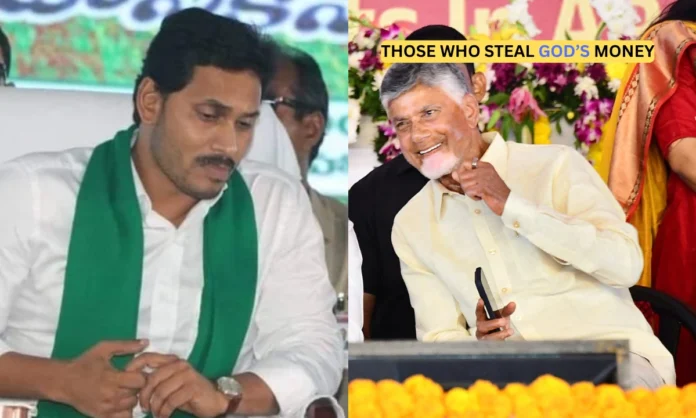
The current Tirumala temple scam row has become one of the sharpest political confrontations in Andhra Pradesh, pitting Chief Minister N Chandrababu Naidu against Opposition Leader YS Jagan Mohan Reddy over the sanctity and security of offerings at India’s most famous hill shrine. At the heart of the dispute is the Parakamani theft case at Tirumala Tirupati Devasthanams, where donations placed at the feet of Lord Venkateswara are counted and stored. Naidu now claims that “those who steal God’s money and those who defend them are in the opposition,” framing the Tirumala temple scam as a moral crisis that exposes how the previous regime allegedly handled temple wealth.
The controversy traces back to 2023, when a staff member linked to Tirumala’s Parakamani arrangements, Ravi Kumar, was caught trying to remove foreign currency from the counting area, triggering a criminal case and eventually a negotiated resolution through Lok Adalat. Since then, political narratives around the incident, earlier allegations of ghee adulteration in Tirupati laddus and questions over temple property management have fused into a larger storyline that opponents and supporters are calling the Tirumala temple scam. As the ruling Telugu Desam Party and the YSR Congress Party trade accusations, the debate has moved beyond a single theft to wider questions of temple governance, accountability and the line between faith and politics at Tirumala.
Naidu’s charge: “Those who steal God’s money” and the battle over Dharma
- Naidu positions the Tirumala temple scam as proof that the previous YSRCP government normalised temple wrongdoing instead of enforcing strict accountability.
- He links the Parakamani theft to earlier disputes over prasadam and ghee quality, using them to argue that temple sanctity was repeatedly compromised.
Chandrababu Naidu has used his recent public remarks to turn the Tirumala temple scam into a central plank of his attack on YS Jagan Mohan Reddy’s tenure. He says he was “shocked” that the theft of Lord Venkateswara’s money was described as a “small crime,” adding that any regime that protects people caught looting money kept at the feet of the deity has no respect for Dharma. Naidu insists that under his government any official found stealing from temple funds would be suspended and prosecuted, not defended, and he has urged voters to see the Tirumala temple scam as a reflection of the values that guided the previous administration.
Leaders allied with Naidu have gone further, with BJP’s representative on the TTD board, Banu Prakash Reddy, alleging that the Parakamani incident was not an isolated act but part of a much larger pattern that could involve a diversion of temple money running into tens or even hundreds of crores, claims that are now part of a broader probe. These assertions, though still under investigation, have been used to argue that the Tirumala temple scam reveals a systemic failure to secure offerings, rather than a one‑off lapse.
Naidu has also referred back to earlier controversies about alleged adulteration in the ghee used for Tirupati laddus and complaints of substandard prasadam quality during YSRCP rule, contending that when seen together with the Parakamani theft, they show a pattern of disregard for temple standards and devotee trust. Through this framing, the Chief Minister portrays the Tirumala temple scam as a stark contrast between two political cultures: one that treats every rupee offered to the deity as sacred and another that, in his telling, trivialised or rationalised serious breaches until they became public.
By repeating phrases like “those who steal God’s money” on public platforms, Naidu is seeking to lock the issue in popular memory as a moral test for political leadership in Andhra Pradesh, well beyond the technicalities of the Parakamani theft case itself.
YSRCP’s counter: robotic detection, Lok Adalat and allegations of political spin
- YSRCP argues that what is being called the Tirumala temple scam was actually exposed by systems it installed, and that the case was processed through proper legal channels.
- The party highlights the accused’s confession video and property donation to TTD as evidence that the episode was resolved institutionally, not covered up.
YSR Congress has responded by accusing Naidu of twisting facts and weaponising faith. According to the party, the Parakamani incident that now stands at the centre of the Tirumala temple scam was detected because Jagan Mohan Reddy’s government introduced robotic counting systems and enhanced surveillance in the donation halls, which picked up irregularities when Ravi Kumar attempted to remove foreign currency. They say the TTD administration under their watch filed a case, moved through formal procedures and did not treat the matter as trivial, rejecting Naidu’s claim that the theft was brushed off as a “small crime.”
YSRCP also points to Ravi Kumar’s later video statement, in which he admitted wrongdoing at Parakamani and said he had decided to donate most of his assets to Tirumala Tirupati Devasthanams as repentance, a move that was channelled through Lok Adalat proceedings. Party leaders argue that this outcome, in which TTD gained properties worth crores, shows that the system responded with both legal consequences and recovery for the temple, and that calling it a Tirumala temple scam ignores these facts.
In his video, Ravi Kumar also alleged that he had been subjected to blackmail and defamatory claims after the episode, prompting him to file cases against those he accuses of harassment, which YSRCP cites as proof that the story has been manipulated for political narratives. Beyond the Parakamani case, YSRCP has flipped the charge back at Naidu by accusing him of misusing or mishandling temple‑related assets, including the historic Sadavarthi lands linked to TTD, and of raising exaggerated fears about adulteration in Tirumala laddus without evidence.
The party insists that if there is to be a serious conversation about the Tirumala temple scam, it must include scrutiny of decisions taken by the TDP in previous terms, not just events that occurred under Jagan’s tenure. For YSRCP, the current rhetoric around “those who steal God’s money” is less about protection of temple funds and more about an attempt to mobilise religious sentiment ahead of future political battles in Andhra Pradesh.
The legal backbone: how law protects TTD funds, assets and administration
- Tirumala Tirupati Devasthanams operates under a dedicated chapter of the Andhra Pradesh Charitable and Hindu Religious Institutions and Endowments Act, 1987, which defines its board, powers and financial controls.
- The Act specifies how donations, hundi offerings and temple income are consolidated, stored and used, and it tightly regulates any transaction involving temple properties.
Behind the political noise over the Tirumala temple scam is a detailed legal architecture that governs how TTD is run. The Andhra Pradesh Charitable and Hindu Religious Institutions and Endowments Act, 1987, applies to temples across the state and includes a special chapter that groups all institutions under Tirumala Tirupati Devasthanams into a single administrative unit. Under this framework, the state government appoints a TTD board, currently designed for up to 29 members, all professing the Hindu faith, with ex‑officio positions for senior officials such as the Endowments Commissioner and the Executive Officer of TTD.
The Executive Officer is designated by law as the chief administrative authority for TTD, charged with the custody of records and properties and responsible for organising the collection and accounting of offerings, which directly covers Parakamani and hundi operations that are now central to the Tirumala temple scam debate. The Act creates a consolidated TTD fund that pools donations, kanukas, hundi collections, sale of prasadams, seva tickets, rents from cottages and rest houses, lease income and other earnings.
These funds must be deposited in scheduled banks or government treasuries or invested in specified secure instruments, and can only be used for defined purposes such as temple maintenance, pilgrim services, religious propagation and educational or charitable institutions managed by TTD. Property safeguards in the law are equally strict. Sections relating to immovable properties make it clear that any sale, gift, exchange or mortgage of temple land or buildings without prior sanction from the competent authority is void or null and void, depending on when it occurs, and the Act provides procedures for removing encroachments and adjudicating disputes through Endowment Tribunals.
Provisions for annual budgets, audits, inspection of institutions and government review of board decisions are intended to ensure that large religious bodies like TTD manage funds and assets transparently. These legal protections form the baseline against which the Tirumala temple scam allegations are measured: critics argue that any failure to fully investigate theft or misuse violates the spirit of the Act, while defenders point to compliance with its mechanisms, such as institutional probes and Lok Adalat settlements, to claim that the framework is functioning as designed.
Key legal and financial features of TTD governance
| Area | Legal provision or practice |
|---|---|
| Governing law | Andhra Pradesh Charitable and Hindu Religious Institutions and Endowments Act, 1987. |
| Administrative structure | Government‑appointed TTD board with Hindu members and ex‑officio officials, plus an Executive Officer as chief administrator. |
| Consolidated fund | Donations, kanukas, hundi offerings, prasadams and ticket sales, rents, leases and other income pooled into a single TTD fund. |
| Use of funds | Restricted to temple maintenance, pilgrim services, religious and educational activities and institutional obligations. |
| Property safeguards | Prior sanction needed for any transfer of immovable property, with unauthorised transactions treated as void. |
| Oversight mechanisms | Mandatory budgets, audits, inspections and provision for tribunals and government review. |
Temple controversies, official norms and the larger trust challenge
- The Tirumala temple scam narrative is reinforced by earlier disputes over prasadam quality and ghee purity, which strike at the core of devotee trust.
- TTD’s internal rules and special civic powers on Tirumala hill are designed to enforce high standards of hygiene, conduct and financial discipline.
The Parakamani theft case did not emerge in a vacuum. For several years, Tirumala has seen periodic controversies that opponents now package together under the Tirumala temple scam label. During the YSRCP tenure, allegations surfaced that ghee used in the famous Tirupati laddus was of substandard quality or adulterated, and that prasadam standards in general had declined, though TTD maintained that it followed prescribed procurement and preparation norms. These disputes, even when not fully substantiated, eroded confidence among some devotees and gave political parties material to question whether temple management remained aligned with its own strict codes.
TTD’s internal service rules and the special civic status of Tirumala under the Endowments framework aim to prevent exactly such crises. The notified hill area is governed with specific restrictions, including controls on meat and alcohol, regulation of trades and vendors and enhanced powers for the Executive Officer and designated officers to enforce public health and order, reflecting expectations that the temple environment must stay uniquely protected. Detailed guidelines cover staff conduct, dress codes, hygiene protocols, handling of prasadams and the movement of valuables within TTD premises.
When these rules appear to be breached, or when allegations arise about theft of offerings, adulterated ghee or misuse of temple properties, they are instantly framed as elements of a wider Tirumala temple scam because they suggest a breakdown of systems explicitly created to uphold sanctity. For a religious institution that manages large budgets, multiple educational and charitable arms and a constant influx of pilgrims from India and abroad, even a single high‑profile breach can have outsized impact on public perception.
The ongoing exchanges between TDP and YSRCP over who protected “those who steal God’s money,” who installed robotic counters, who pushed for Lok Adalat settlement and who mishandled land or prasadam complaints are therefore all, at their core, about restoring or undermining trust. Whether or not new findings emerge from current investigations, the phrase Tirumala temple scam has become shorthand for a wider worry: that legal safeguards, internal rules and political oversight may not always be enough to guarantee that every offering made to Lord Venkateswara is safe from error, negligence or exploitation.
Final perspective: beyond slogans, a test of systems at Tirumala
The Tirumala temple scam battle has moved far beyond its starting point as a case of theft in a counting hall. Chandrababu Naidu’s rhetoric about “those who steal God’s money” is designed to underline a simple message: that treating theft in the Parakamani as minor, or allowing those involved to be protected, is incompatible with the responsibilities of public office in a state where Tirumala holds immense spiritual and emotional weight.
YSRCP’s counter‑argument, that its own government’s robotic systems exposed the theft, that the accused confessed and surrendered properties through Lok Adalat, and that the episode is being selectively narrated as a Tirumala temple scam for political gain, is intended to rebut the charge that it ever trivialised wrongdoing inside the shrine. Beyond these competing claims stands a robust legal and institutional framework that already treats TTD as an exceptional entity, with a dedicated chapter in the Andhra Pradesh Endowments Act, consolidated funds, tightly regulated property rules and special civic powers on the Tirumala hill.
The real challenge exposed by the Tirumala temple scam debate is not whether rules exist, but whether they are consistently applied, transparently enforced and insulated from partisan pressures. For devotees, the critical question is likely to be which leadership can demonstrate concrete steps to strengthen internal vigilance, improve technology‑driven monitoring, ensure independent probes of irregularities and publish clear findings, rather than rely solely on emotive slogans or retrospective blame. As investigations and political arguments continue, Tirumala now stands as a test case for how India’s largest temple institutions can protect faith, money and public confidence in an era of high‑stakes politics.