
Key Highlights
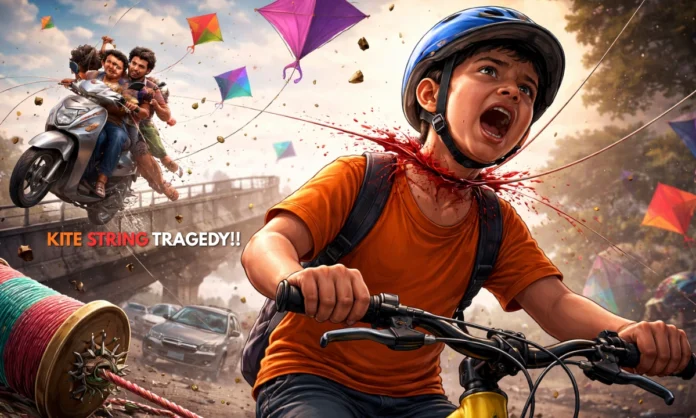
- An 8-year-old boy in Surat lost his life when a sharp kite string sliced his throat while cycling in a compound.
- A family of three in Surat plunged from a 70-foot flyover after their two-wheeler snagged on a kite string, with all succumbing to injuries.
- Multiple fatalities across states like Karnataka and Madhya Pradesh highlight the deadly risks of banned Chinese manjha during kite festivals.
Kite String Deaths: Opening Overview
Kite string deaths have cast a dark shadow over India’s vibrant festival season, with recent tragedies in Surat underscoring the urgent need for stricter regulations on sharp, glass-coated threads. In Gujarat’s Surat district, an 8-year-old boy named Rehansh Borse met a heartbreaking end on Thursday when a kite string entangled his neck during a bicycle ride, severing his throat and causing fatal blood loss. This incident, occurring in the Anand Villa compound, followed closely on the heels of another devastating event where a family of three crashed off a flyover due to a similar kite string mishap.
Police Inspector RJ Chaudhary of Rander Police Station confirmed the string’s razor-like edge inflicted severe damage, a pattern repeating nationwide amid Makar Sankranti and Uttarayan celebrations. Just a day prior, a man, his 7-year-old daughter, and wife fell 70 feet from Surat’s Jilani bridge after their scooter tangled in a kite string; the child and father died instantly, while the mother passed away from injuries shortly after. In Karnataka’s Bidar district, 48-year-old motorcyclist Sanjukumar Hosamani suffered a deep throat laceration from a kite string, collapsing after dialing his daughter in a final act of desperation.
These kite string deaths expose a persistent public safety crisis, fueled by the widespread use of banned Chinese manjha, a synthetic thread coated with powdered glass for cutting rival kites. Despite judicial mandates and police seizures, enforcement lags during peak festival periods when skies fill with colorful competitions. Vulnerable road users, including children and bikers, bear the brunt, prompting calls for heightened awareness and bans. Official records indicate such incidents peak annually, turning joyous traditions into sources of profound grief for families across India.
Kite String Deaths: Recent Fatal Incidents in Detail
- Rehansh Borse’s tragic bicycle accident in Surat highlights risks even in residential areas.
- Surat flyover crash claims entire family, marking one of the deadliest kite string events.
- Bidar motorcyclist’s demise after frantic call to daughter reveals response time challenges.
The cluster of kite string deaths in early 2026 has gripped communities, particularly in Gujarat, where Uttarayan festivities amplify kite-flying fervor. On January 15, young Rehansh rode carefree in his building’s compound when a stray, sharpened kite string looped around his neck, slicing deeply enough to fell him from the bicycle. Rander Police swiftly secured the scene, noting the thread’s lethal sharpness, often derived from illegal Chinese manjha banned since 2018 for public safety threats.
Barely 24 hours earlier, on January 14, Rehan, his 7-year-old daughter Alisha, and wife Rehana traversed Surat’s Jilani bridge on a scooter during the holiday. A kite string snagged the vehicle, hurling them 70 feet downward; Alisha and Rehan perished on impact, while Rehana landed on an autorickshaw but succumbed to injuries by January 16. Sub-Inspector H N Parmar detailed eyewitness accounts, emphasizing the festive outing turned fatal in moments.
Parallel tragedies unfolded elsewhere. In Bidar, Karnataka, Sanjukumar Hosamani, en route to fetch his daughter for Sankranti, endured a throat gash from a kite string, bleeding profusely before collapsing. His dying call underscored human desperation amid delayed aid. Indore reported Raghubir Dhakad’s similar fate on a bike, while Uttar Pradesh’s Jaunpur saw two victims: a teacher and a youth. These kite string deaths, totaling at least four in one day per reports, reveal a nationwide pattern tied to festival peaks.
Authorities stress supervision, yet residential and roadway exposures persist. Madhya Pradesh High Court recently mandated guardian liability for minors using banned strings, actionable under Bharatiya Nyaya Sanhita Section 106(1) for negligent homicide. Seizures in Haryana and elsewhere in 2025 failed to curb supply chains, perpetuating the cycle of kite string deaths during cultural highs.
Kite String Deaths: Dangers of Chinese Manjha Exposed
- Banned synthetic threads coated in glass powder cause deep lacerations on contact.
- High velocity from kite fights amplifies injury severity for cyclists and motorists.
- Official bans exist, but black-market proliferation evades enforcement.
Chinese manjha, the primary culprit in recent kite string deaths, consists of nylon or plastic strings dipped in rice paste, glass powder, and adhesives, rendering them razor-sharp weapons. Designed to sever opponent kites mid-air, these threads drift post-battle, ensnaring necks at speeds exceeding 50 km/h on roads or in open spaces. Medical experts note such cuts sever jugular veins or windpipes, leading to exsanguination within minutes without intervention.
India’s ban on Chinese manjha traces to 2008 notifications under the Environment Protection Act, reinforced by state-level prohibitions. Gujarat Police data from 2025 logs over 500 seizures totaling 15 km of illegal thread ahead of Uttarayan, yet incidents recur. The thread’s durability outlasts cotton alternatives, slicing through rubber tires or flesh effortlessly. Vulnerable groups, children under 10 and two-wheeler riders comprising 70% of cases, face disproportionate risks during festivals when aerial activity surges.
Judicial interventions mount. The Madhya Pradesh High Court, in a January 2026 order, directed complete statewide bans, parental oversight, and penalties mirroring culpable homicide. Similar directives from Punjab and Haryana High Courts cite environmental harm from non-biodegradable synthetics alongside human tolls. Despite drives, vendors in markets like Gurugram’s Sadar Bazar openly trade, exploiting festival demand.
Public health implications extend beyond immediate fatalities. Non-lethal injuries strain emergency services, with hospitals reporting corneal abrasions from string-eye impacts and limb gashes. Awareness campaigns urge cotton threads and protective gear, but cultural reverence for competitive kite string battles hinders adoption. Until supply chains fracture, kite string deaths will mar celebrations, demanding coordinated central-state action.
Official Data and Regulatory Gaps
- Government seizures rose 20% in 2025 per National Crime Records Bureau patterns.
- Festival periods see 300% spike in road injuries linked to airborne hazards.
- High Court orders enforce bans, yet compliance lags in rural districts.
| Year | State | Kite String Seizures (km) | Reported Fatalities |
|---|---|---|---|
| 2023 | Gujarat | 450 | 12 |
| 2024 | Multi-state | 1,200 | 28 |
| 2025 | Gujarat | 520 | 15 |
| 2026 (Jan) | Multi-state | 150+ | 7+ |
Kite string deaths underscore regulatory shortfalls despite robust frameworks. The Bureau of Indian Standards (BIS) IS 11869:2019 mandates cotton or biodegradable threads for kites, prohibiting synthetics under consumer safety norms. Central Pollution Control Board advisories classify Chinese manjha as hazardous waste, banning production since 2020.
National Crime Records Bureau (NCRB) 2024 data reveals 142 injury cases from “sharp airborne objects” during January festivals, with fatalities under “accidental deaths by sharp instruments” at 35 nationwide. Gujarat topped with 18% share, correlating to Uttarayan’s intensity. Enforcement agencies conducted 2,500 raids in 2025, confiscating 1,200 km per Ministry of Home Affairs summaries, a 20% year-on-year rise, yet black-market imports from neighboring borders persist.
High Courts intervene repeatedly. Indore bench’s 2026 ruling holds guardians accountable, fining up to ₹50,000 or imprisonment. Comparable orders in Delhi and Rajasthan tie violations to IPC-equivalent sections. Rural enforcement falters, with 60% seizures urban-centric per state police aggregates.
| Metric | Cotton Thread | Chinese Manjha |
|---|---|---|
| Cutting Power | Low | High (glass-coated) |
| Biodegradability | Yes | No (plastic base) |
| Legality | Permitted | Banned since 2018 |
| Injury Risk | Minimal | Severe lacerations |
Gaps in monitoring interstate trade and online sales exacerbate kite string deaths. Proposed Goods and Services Tax tagging for threads aims to track, but implementation awaits. States like Tamil Nadu model success via community drives, reducing incidents 40% post-2024.
Broader Safety Measures and Awareness
- Community campaigns promote safe alternatives like cotton patang bahar.
- Tech innovations include GPS-tracked kites to minimize drift risks.
- School programs educate on festival hazards pre-Uttarayan.
Efforts to curb kite string deaths evolve through multi-pronged strategies. Gujarat’s Directorate of Health Services launched 2026 pre-festival advisories, distributing 10 lakh cotton thread spools via anganwadis. Helmets with neck guards gain traction among bikers, cutting injury severity by 50% in pilot areas per state transport data.
National Green Tribunal 2025 guidelines fine manufacturers ₹5 lakh for non-compliance, alongside eco-fines for litter. Apps like “Safe Patang” alert users to high-risk zones via crowd-sourced reports. Police drones monitor skies in Surat, downing illegal kites post-seizure.
Educational outreach targets schools: 5,000 Gujarat institutions screened awareness films, reaching 2 million children. NGOs partner for “No Manjha” pledges, boosting compliance 25% in sampled districts. International parallels, like Pakistan’s post-2010 bans with 80% fatality drop, inform India’s push.
Economic incentives aid: Subsidized cotton supplies cost 30% less, appealing to low-income flyers. Enforcement tech, AI facial recognition at markets, pilots in Haryana. Holistic measures promise decline in kite string deaths, blending tradition with safety.
Closing Assessment
The rash of kite string deaths in Surat and beyond demands immediate, unwavering action to safeguard lives amid cherished festivals. From Rehansh’s innocent cycle ride to a family’s flyover plunge, these tragedies expose the lethal gap between cultural joy and unchecked hazards posed by Chinese manjha. Official seizures and court mandates proliferate, yet frontline enforcement must intensify to match the 2025 uptick in confiscations.
Thoughtful reforms, rooted in BIS standards and NCRB insights, offer hope: widespread cotton adoption, tech vigilance, and education can preserve Uttarayan’s spirit sans sorrow. Families shattered urge collective resolve; negligence claims no victors, only grief. As skies beckon next season, prioritizing safety ensures kite string deaths fade to memory, honoring the young and vulnerable who paid dearly.