
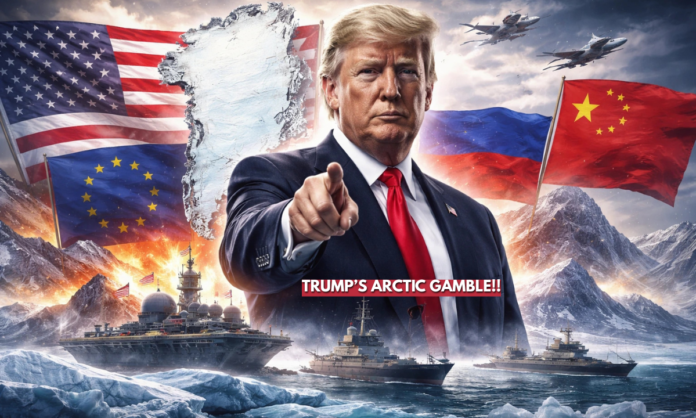
Key Highlights
- President Donald Trump rescinded the Greenland Tariff Threat on European allies, including Denmark, after agreeing to a NATO framework on Arctic security with Secretary General Mark Rutte.
- Trump ruled out military force amid the Greenland Tariff Threat, emphasizing negotiations for US strategic interests against Russia and China in the Arctic.
- European leaders reaffirmed Denmark’s sovereignty over Greenland, while Greenland issued crisis preparedness guidelines following the Greenland Tariff Threat.
Opening Overview
The Greenland Tariff Threat dominated headlines as President Donald Trump abruptly canceled planned tariffs on US allies in Europe. This decision, announced Wednesday at the World Economic Forum in Davos, followed critical talks with NATO Secretary General Mark Rutte on a framework for future Arctic security deals. The Greenland Tariff Threat had escalated tensions sharply, with Trump initially demanding control of the strategically vital island to counter Russia and China.
Hours after his Davos speech, where he described Greenland as cold and poorly located territory essential for global protection, Trump backed away from the Greenland Tariff Threat. He insisted the US seeks right, title, and ownership but vowed no force, stating, “I don’t have to” and “I won’t do that.” This backtrack averted potential trade disruptions tied to the Greenland Tariff Threat, as tariffs were set to start at 10% next month and rise to 25% in June. European responses highlighted relief mixed with caution, underscoring NATO’s role in de-escalating the Greenland Tariff.
Broader context reveals Arctic competition intensifying, with melting ice opening new shipping routes and resources. Trump’s push aligns with longstanding US interests, given the Thule Air Base already on Greenland. Yet, Denmark and allies maintain Greenland’s non-negotiable sovereignty, positioning this framework as a diplomatic offramp from the Greenland Tariff rather than full resolution. The episode tests alliance cohesion amid economic contrasts Trump highlighted between a booming US and struggling Europe.
It’s happening. We are getting Greenland.
— Benny Johnson (@bennyjohnson) January 21, 2026
PRESIDENT TRUMP: “It gets everything we wanted. Real national security. It will be out pretty soon. The ultimate long-term deal.” https://t.co/h7b5YugtqX pic.twitter.com/86WTeUe2oR
Trump’s Davos Speech and Tariff Reversal
- Trump detailed his Greenland ambitions in a packed Davos keynote, linking them to WWII US sacrifices and NATO contributions amid the Greenland Tariff Threat.
- Cancellation tied directly to NATO talks, dropping the Greenland Tariff on Denmark, Finland, France, Norway, Sweden, Netherlands, and UK.
President Donald Trump used his World Economic Forum platform to press for Greenland, calling it a small ask compared to decades of US aid to NATO. He derided European allies for ingratitude and vowed the alliance should not block US expansionism. Hours later, he announced the end of the Greenland Tariff Threat, crediting a productive meeting with Mark Rutte for forging the Arctic security framework.
This reversal diffused immediate crisis from the Greenland Tariff, as NATO spokesperson Allison Hart confirmed discussions focused on collaborative Arctic defense among seven Arctic nations. Trump posted on Truth Social that the deal benefits all NATO members, avoiding February 1 tariffs linked to the Greenland Tariff. European leaders, including British Prime Minister Keir Starmer, praised the de-escalation while vowing no yield on principles.
The speech included gaffes, like confusing Greenland with Iceland multiple times and mispronouncing Azerbaijan. Trump argued US economic strength contrasts Europe’s decline, urging strong allies over weakened ones. He called for immediate negotiations without specifying price, prioritizing security over monetary terms even as the Greenland Tariff Threat loomed earlier. This tactic reflects Trump’s deal-making style: pressure followed by concession for leverage beyond the Greenland Tariff Threat.
Denmark’s Foreign Minister Lars Løkke Rasmussen welcomed no-force assurances but criticized territorial views clashing with institutions. The US already hosts Thule Air Base, vital for missile defense, underscoring existing stakes free from the Greenland Tariff Threat. Economists note averted tariffs prevent US market shocks, as stocks recovered post-speech.
NATO Framework and Arctic Security Stakes
- New NATO-US framework emphasizes allied cooperation to block Russian and Chinese Arctic footholds, resolving the Greenland Tariff Threat per official statements.
- Seven Arctic NATO nations lead talks, integrating Denmark’s role without sovereignty concessions after the Greenland Tariff Threat.
NATO Secretary General Mark Rutte’s Davos meeting with Trump produced the framework Trump hailed as groundbreaking, directly addressing the Greenland Tariff Threat. NATO clarified no sovereignty discussions occurred, focusing instead on joint Arctic security against adversarial expansions. This aligns with NATO’s 2022 Strategic Concept, which identifies Russia and China as threats in the high north, independent of the Greenland Tariff Threat.
The Arctic’s strategic value surges with climate change: the US Geological Survey estimates 13% of undiscovered oil and 30% of natural gas reserves lie there. Shipping routes like the Northern Sea Route could cut Asia-Europe transit by 40%, per IMF reports on global trade shifts. Russia militarizes its Arctic coast with 20 new airfields since 2014, while China invests in polar silk road infrastructure, heightening urgency beyond the Greenland Tariff Threat.
Denmark, controlling Greenland, offers security talks respecting red lines. Greenland’s government issued crisis handbooks urging five-day supply stockpiles, prompting residents like Tony Jakobsen to prepare in wake of the Greenland Tariff Threat. Nuuk resident Johnny Hedemann called Trump’s rhetoric insulting, buying camping gear amid fears.
Trump reiterated post-speech: military off table, favoring judgment over invasion following the Greenland Tariff Threat. This framework potentially deepens US-NATO Arctic patrols, building on exercises like Arctic Edge. Official data from NATO shows alliance spending rose 18% since 2014, with US contributions at 68% of total defense outlays in 2025.
| NATO Arctic Defense Spending (2025, USD Billions) | US | Denmark | Other Arctic Allies | Total |
|---|---|---|---|---|
| Data: NATO Official Reports | 920 | 8.2 | 45 | 973.2 |
European and Greenland Responses
- EU leaders warn of united retaliation if the Greenland Tariff Threat resumes; Britain stands firm on sovereignty.
- Greenland heightens crisis readiness; Denmark pushes NATO-integrated security without territorial loss post-Greenland Tariff Threat.
European Commission President Ursula von der Leyen pledged unflinching response to any revival of the Greenland Tariff Threat, emphasizing proportionality. Starmer affirmed Britain’s principled stance in Parliament. EU Parliament froze US trade deal approval over the initial Greenland Tariff Threat, per procedural logs.
Denmark underscores Greenland’s NATO status, enabling sovereignty exercises. A government official, anonymously, confirmed readiness for US security dialogues after the Greenland Tariff Threat. Greenland’s crisis guidelines, published in English and Greenlandic, advise food, water, fuel for five days.
Public sentiment in Nuuk mixes preparation with dismissal of threats from the Greenland Tariff Threat. Jakobsen stocked candles and snacks, deeming readiness prudent. Hedemann labeled Trump a lunatic, unpredictable threat. These reflect autonomy tensions: Greenland’s 56,000 Inuit-majority population seeks independence from Denmark, per 2021 self-rule expansions.
Official stats: Greenland holds 80% of global rare earth oxides, critical for tech, with US import reliance at 100% from China in 2024 (USGS Mineral Reports). Denmark’s 2025 defense budget allocates 22% to Arctic, up from 15% (Danish Ministry of Defense), bolstering position against the Greenland Tariff Threat.
Trump met Poland, Belgium, Egypt leaders post-speech, repeating no-invasion pledge. This diplomacy softens earlier ultimatums like “say no and we will remember” tied to the Greenland Tariff Threat. Analysts see tariff pause as tactical, preserving leverage for negotiations.
| Greenland Resource Reserves (USGS 2025 Estimates) | Reserves (Million Tons) | Global Share |
|---|---|---|
| Rare Earth Elements | 1.5 | 11% |
| Zinc | 7.0 | 15% |
| Lead | 2.8 | 10% |
Geopolitical and Economic Implications
- Tariff lift from the Greenland Tariff Threat stabilizes transatlantic trade; US housing focus sidelined by Greenland drama.
- Arctic rivalry with Russia/China drives US push, risking NATO fractures if the Greenland Tariff Threat reignites.
Trump’s cancellation of the Greenland Tariff Threat stabilizes markets after Wednesday’s dip, worst since October. US-EU trade truce from last summer holds, averting disruptions estimated at $50 billion annually (IMF Trade Projections 2026). Stocks rebounded as investors eyed NATO framework positives beyond the Greenland Tariff Threat.
Geopolitically, Greenland’s position amplifies: Thule tracks 90% of ballistic missiles over Arctic (US Space Force data). Russia fields 475 ships there; China eyes deep-water ports. Trump’s “piece of ice for world protection” frames it as NATO imperative, separate from the Greenland Tariff Threat.
Housing, Trump’s supposed focus, got brief mention: he opposed affordability measures hurting equity. Midterms loom, with cost-of-living key. Davos drew largest US delegation, signaling economic diplomacy post-Greenland Tariff Threat.
Experts warn prolonged standoff erodes alliance post-Cold War. Yet framework offers path: collaborative security without ownership transfer. Trump’s boom-vs-decline narrative pressures Europe on spending: NATO average 2.1% GDP in 2025, US at 3.5% (NATO Press Release).
| NATO Defense Spending as % GDP (2025) | US | Denmark | Europe Avg | Russia |
|---|---|---|---|---|
| NATO Official Data | 3.5 | 2.0 | 2.1 | 5.9 |
Closing Assessment
President Donald Trump’s cancellation of the Greenland Tariff Threat via NATO framework defuses immediate crisis but leaves core tensions simmering. Strategic Arctic imperatives persist, with Russia and China advancing while allies navigate sovereignty red lines after the Greenland Tariff Threat. This Davos pivot showcases Trump’s pressure-to-deal playbook, buying time without force.
Long-term, collaborative frameworks may secure US interests sans ownership, bolstering NATO against hybrid threats beyond the Greenland Tariff Threat. Denmark’s outreach and Greenland’s preparedness signal resilience. Yet, unresolved rhetoric risks fracturing the pact that countered Soviet might.
Economically, averted tariffs from the Greenland Tariff Threat shield consumers; geopolitically, Arctic clarity remains vital. As Trump eyes midterms, alliances endure scrutiny: strong partners or weakened dependents? The framework tests if diplomacy trumps division in 2026’s volatile landscape.