
Key Highlights:
- Senate voted 60-40 on November 10, 2025 to advance compromise legislation ending the 40-day US government shutdown, the longest in American history
- Eight moderate Democrats broke party lines to support funding bill without guaranteed ACA health care subsidy extensions affecting 24 million Americans
- The US government shutdown disrupted SNAP benefits for 42 million people, furloughed 670,000+ federal workers, and caused over 2,000 daily flight cancellations
Opening Overview
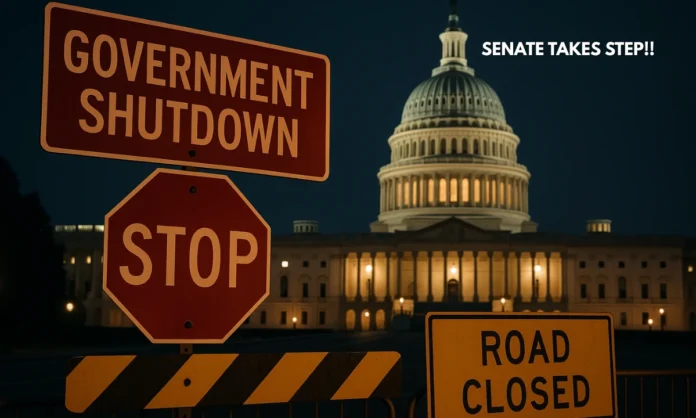
The US government shutdown entered a decisive turning point on November 10, 2025 when the Senate voted 60-40 to advance compromise legislation aimed at ending the nation’s longest-ever funding impasse. After 40 grueling days, the procedural vote marked the first substantial progress toward reopening federal operations that have left hundreds of thousands of workers unpaid, disrupted critical food assistance programs, and created nationwide aviation chaos. The US government shutdown began on October 1, 2025 when Congress failed to pass appropriations legislation for the 2026 fiscal year, triggering a standoff that has tested the limits of partisan brinkmanship.
Eight moderate Democrats defied their party leadership to join Republicans in advancing the funding package, breaking a six-week stalemate that had seen 14 previous attempts fail. The compromise does not guarantee an extension of Affordable Care Act tax credits expiring January 1, 2026, which currently benefit 24 million Americans, according to Kaiser Family Foundation data. Instead, Senate Majority Leader John Thune promised a mid-December vote on the health care subsidies, a concession that sparked fierce criticism from progressive Democrats who accused their moderate colleagues of capitulation. The US government shutdown has compounded financial pressures on a federal budget already strained by a $1.8 trillion deficit and $38.09 trillion national debt, according to Congressional Budget Office figures and Senate Joint Economic Committee data.
The agreement includes provisions to reverse mass federal worker firings initiated during the US government shutdown, reimburse states that maintained federal programs with their own funds, and ensure furloughed employees receive back pay. Transportation Secretary Sean Duffy warned that air travel ahead of Thanksgiving would be “reduced to a trickle” if the US government shutdown continued, as flight cancellations exceeded 2,000 per day for the first time since the crisis began. With the Senate taking this first procedural step, final passage could occur within days, though House approval and President Donald Trump’s signature remain uncertain.
BREAKING: Senate votes 60-40 to end the longest U.S. government shutdown in history, with 8 Democrats joining Republicans. Funding secured through January 2026, backpay promised for furloughed workers. Trump's push for waste-cutting and healthcare reform credited. https://t.co/uTdcErIvvV pic.twitter.com/yTaU6qC2TO
— 𝐃𝐔𝐓𝐂𝐇 (@pr0ud_americans) November 10, 2025
Moderate Democrats Break Ranks in Historic Vote
Three former governors led the breakthrough that ended the US government shutdown stalemate: New Hampshire Senators Jeanne Shaheen and Maggie Hassan, along with Independent Senator Angus King of Maine. These moderate lawmakers agreed to vote for the funding package without ironclad guarantees on health care subsidies, calculating that reopening the government took precedence over prolonging the US government shutdown standoff. Their decision triggered a cascade effect, bringing Democratic Senators Tim Kaine of Virginia, Dick Durbin of Illinois, John Fetterman of Pennsylvania, Catherine Cortez Masto of Nevada, and Jacky Rosen of Nevada along in the 60-40 vote.
- Senate Democratic Leader Chuck Schumer voted against the compromise, along with all but eight Democratic colleagues, declaring he could not “in good faith” support the deal
- Independent Senator Bernie Sanders called abandoning the fight for health care subsidies a “horrific mistake” during the US government shutdown negotiations
- Senator Chris Murphy argued that recent Democratic election victories proved Americans wanted the party to “hold firm” against Republican demands
The fracture within Democratic ranks exposed deep ideological divisions over negotiating strategy during the US government shutdown crisis. Senator Catherine Cortez Masto defended her vote, stating, “We must extend the ACA enhanced premium tax credits, but that can’t come at the expense of the millions of Americans across our country impacted by a shutdown”. Virginia Senator Tim Kaine, representing tens of thousands of federal workers in his home state, faced particular pressure to end the US government shutdown as constituents went without paychecks for over a month. The vote temporarily delayed on the Senate floor when three conservative Republicans, Senators Mike Lee of Utah, Rick Scott of Florida, and Ron Johnson of Wisconsin, withheld their votes and huddled with Majority Leader Thune before eventually supporting the measure after speaking with President Trump.
Texas Senator John Cornyn had to fly back from his home state to deliver the crucial 60th vote needed to advance the US government shutdown compromise. House Democrats swiftly criticized the Senate agreement, with Congressional Progressive Caucus Chairman Greg Casar calling a deal without reduced health care costs a “betrayal” of millions of Americans. Representative Angie Craig of Minnesota posted skeptically on social media, “If people believe this is a ‘deal,’ I have a bridge to sell you,” reflecting progressive frustration with the US government shutdown resolution. Despite the internal Democratic discord, the procedural vote represented the most significant progress toward ending the US government shutdown since it began 40 days earlier.
Massive Disruptions Across Federal Services
The US government shutdown inflicted unprecedented damage across multiple sectors of American life, with 670,000 federal employees furloughed according to Bipartisan Policy Center workforce estimates. The Congressional Budget Office calculated that compensation for furloughed workers totaled approximately $400 million per day during the US government shutdown. In mid-October, the Trump administration sent “reduction in force” layoff notices to over 4,000 federal employees across seven agencies, including the Departments of Commerce, Education, Energy, Health and Human Services, Housing and Urban Development, Treasury, and the Environmental Protection Agency.
- SNAP benefits lapsed for 42 million low-income Americans for the first time in the program’s 60-year history during the US government shutdown
- The Supreme Court allowed the Trump administration to withhold approximately $4 billion from the Supplemental Nutrition Assistance Program amid legal challenges
- Flight cancellations exceeded 2,000 daily at peak disruption, with over 5,500 flights canceled since the FAA ordered reductions
- Only four air traffic controllers reported for work at Atlanta’s Hartsfield-Jackson International Airport, the world’s busiest, on one Saturday during the US government shutdown
The aviation crisis deepened as the Federal Aviation Administration ordered airlines to increase cancellations at 40 of the nation’s busiest airports to 6% by mid-November and ultimately ramp up to 10% by week’s end. Over 1,600 flights were canceled within, into, or out of the United States on one Monday alone, with more than 2,700 additional flights delayed. Transportation officials reported that 81 air traffic controllers nationwide didn’t work on one critical Saturday, with 18 of 22 controllers at Atlanta’s airport absent. The US government shutdown forced airlines and the FAA into emergency talks about when flight cuts would stop, with Transportation Secretary Duffy warning the situation would “get much worse” without resolution.
Food insecurity escalated dramatically as SNAP recipients turned to already strained food pantries and made sacrifices like forgoing medications to stretch tight budgets during the US government shutdown. In Washington, D.C., home to tens of thousands of federal workers, the Capital Area Food Bank reported providing 8 million more meals ahead of the holidays than budgeted, a nearly 20% increase. States that spent their own funds to maintain federal programs during the US government shutdown will receive reimbursement under the Senate compromise agreement. The deal also includes language to reverse Trump administration firings and protect against future reductions in force through January 30, 2026.
Health Care Subsidies Remain Uncertain
The fate of Affordable Care Act enhanced premium tax credits emerged as the central flashpoint prolonging the US government shutdown negotiations. These subsidies, which benefit 24 million Americans, are scheduled to expire on January 1, 2026, threatening to more than double premium costs for recipients. Kaiser Family Foundation analysis estimates that subsidized enrollees would see their monthly premium payments increase by approximately 114% on average if the enhanced credits expire, with currently subsidized individuals paying an additional $1,016 annually. The enhanced tax credits, introduced in 2021 and extended through 2025 by the Inflation Reduction Act, both increased financial assistance for already-eligible enrollees and made middle-income individuals with incomes above 400% of federal poverty guidelines newly eligible.
Senate Republicans committed to a December vote on extending the tax credits as part of the US government shutdown compromise, but that promise offers no guarantee of passage. House Speaker Mike Johnson refused to commit to bringing any subsidies extension to a vote in his chamber, casting doubt on whether the December Senate vote represents meaningful progress. President Trump spent the weekend before the US government shutdown vote posting on social media that the ACA is “broken” and that federal dollars should be directed away from “BIG, BAD” and “money sucking” insurance companies. Despite Republican antipathy toward the Affordable Care Act, voters overwhelmingly support extending the enhanced credits, according to Kaiser Family Foundation polling showing 78% of adults favor Congressional action.
- Without extension, the Congressional Budget Office estimates approximately 4 million people will lose insurance coverage entirely
- Twenty-two million out of 24 million marketplace enrollees currently receive tax credits, with 90% of ACA recipients benefiting from enhanced subsidies
- The loss of credits will be felt most acutely in Republican districts, raising concerns for conservatives heading into midterm election years
The US government shutdown compromise splits Democrats between moderates who prioritized reopening the government and progressives who view the health care concession as unacceptable capitulation. Some Republicans have indicated openness to extending the COVID-19-era tax credits as premiums could skyrocket for millions, but they also want new limits on eligibility and argue subsidies should be routed through individuals rather than directly to insurers. Other Republicans have used the US government shutdown debate to renew yearslong criticism of the Affordable Care Act, calling for it to be scrapped or completely overhauled. Kaiser Family Foundation data shows about six in ten adults have heard “a little” or “nothing at all” about the expiring subsidies, revealing widespread lack of information about coverage costs for over 24 million Americans.
Fiscal and Political Implications
The US government shutdown unfolded against a backdrop of mounting fiscal pressures, with national debt reaching $38.09 trillion as of November 6, 2025, according to Senate Joint Economic Committee data. The debt increased $2.18 trillion year over year, climbing at an average rate of $5.97 billion per day, $248.91 million per hour, or $69,714 per second. The Congressional Budget Office reported a $1.8 trillion federal deficit for fiscal year 2025, driven significantly by record $1 trillion interest costs on servicing the national debt. Gross national debt per household now stands at $288,101, while debt as a percentage of GDP reached approximately 123% in 2025.
The compromise funding package extends government operations through January 30, 2026, leaving the federal government on a path to continue adding about $1.8 trillion annually to its debt burden. Interest payments to service the national debt now consume approximately 17% of the federal budget in fiscal year 2025, with the Congressional Budget Office projecting net interest as a share of outlays will reach 13.85% in FY2026, 14.11% in FY2027, and 14.52% in FY2028. The rapid debt accumulation during the US government shutdown period raised alarms among fiscal watchdogs, with the Committee for a Responsible Federal Budget criticizing the shutdown as “pointless and wasteful”.
| Fiscal Indicator | FY2025 Amount | Source |
|---|---|---|
| Federal Deficit | $1.8 trillion | Congressional Budget Office |
| National Debt | $38.09 trillion | Senate Joint Economic Committee |
| Debt Interest Costs | $1.0 trillion | Congressional Budget Office |
| Federal Spending | $7.0 trillion | Congressional Budget Office |
| Federal Revenue | $5.2 trillion | Congressional Budget Office |
Political ramifications from the US government shutdown reverberated through both parties, with Democrats capitalizing on election victories in New Jersey, Virginia, and New York City to argue Republicans should negotiate on health care. President Trump brought Senate Republicans to the White House on November 5, the day the US government shutdown became the longest in history, to discuss strategy after Republican losses in key elections across the country. Trump appeared to soften his stance as the crisis deepened, telling reporters on November 10 that “it looks like we’re getting close to the shutdown ending” after initially supporting a hardline approach. The agreement includes provisions ensuring federal workers receive back pay once the US government shutdown ends, addressing concerns about hundreds of thousands of employees who have worked without compensation or been furloughed.
The US government shutdown exposed vulnerabilities in essential government functions, from air traffic control to food assistance programs, while highlighting partisan divisions over health care policy. Senate Majority Leader Thune quickly endorsed the compromise deal and called an immediate vote, declaring “The time to act is now” as disruptions mounted nationwide. Final passage of the funding legislation could take several days if Democrats object and delay the procedural process, though the November 10 vote represented the critical first step toward resolution. The House of Representatives must also approve the Senate package before it reaches President Trump’s desk, with Speaker Johnson instructing House members to return to Washington immediately in anticipation of a rapid vote.
Closing Assessment
The 60-40 Senate vote on November 10, 2025 to advance compromise legislation represents a watershed moment in ending the US government shutdown that paralyzed federal operations for over 40 days. Eight moderate Democrats made the politically perilous decision to break with their party leadership and support funding without guaranteed health care subsidy extensions, calculating that the immediate humanitarian costs of prolonging the US government shutdown outweighed the strategic value of continued resistance. Their gamble delivered the procedural victory needed to move toward final passage, but it also exposed deep rifts within Democratic ranks that may persist beyond this immediate crisis.
The US government shutdown inflicted measurable damage across multiple dimensions of American life, from 670,000 furloughed federal workers to 42 million people facing disrupted SNAP benefits and over 2,000 daily flight cancellations. These consequences unfolded against the sobering backdrop of $38.09 trillion national debt and a $1.8 trillion annual federal deficit, according to official government data. The compromise funding package addresses immediate operational needs through January 30, 2026, but it leaves unresolved the larger questions about health care subsidies affecting 24 million Americans and the structural fiscal challenges threatening long-term budget sustainability.
Whether the promised December vote on Affordable Care Act tax credits will yield meaningful results remains highly uncertain, with House Republican leaders noncommittal and President Trump hostile to expanded coverage under the law. The political calculus that drove moderate Democrats to end the US government shutdown may prove prescient if disruptions had continued to escalate, or it may be remembered as a missed opportunity to secure health care protections at a moment of maximum leverage. As the legislation moves to the House of Representatives for consideration, the nation watches to see whether this first step toward ending the US government shutdown will translate into final resolution or merely postpone the inevitable reckoning over competing visions of federal spending priorities.