
Key Highlights
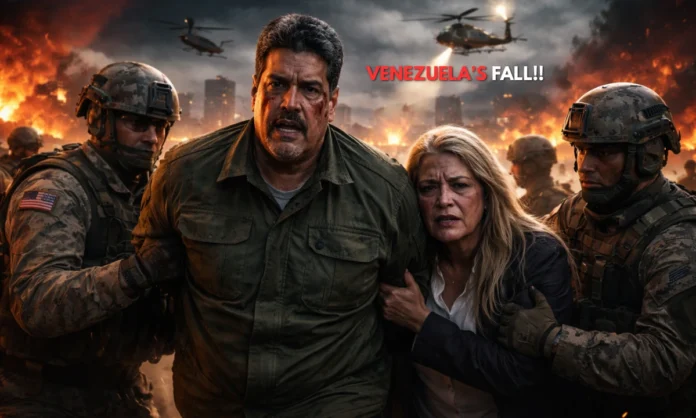
- U.S. President Donald Trump confirms capture of Venezuelan President Nicolas Maduro and wife Cilia Flores, flown out after large-scale strikes on Caracas.
- Explosions hit Caracas and military sites like Fuerte Tiuna, prompting Venezuela’s national emergency declaration.
- Strikes follow months of U.S. threats against Venezuela crisis-linked drug cartels, with naval deployments in the Caribbean.
Opening Overview
The Venezuela crisis reached a dramatic peak on January 3, 2026, as U.S. President Donald Trump announced the capture of President Nicolas Maduro and his wife, Cilia Flores, following a series of explosive strikes on Caracas. Loud blasts echoed through the capital starting at 2 a.m. local time, igniting fires at key sites including Fuerte Tiuna, Venezuela’s largest military complex. Power outages crippled southern Caracas near the base, while attacks extended to Miranda, Aragua, and La Guaira states.
This escalation stems from the deepening Venezuela crisis, marked by economic collapse, oil sanctions, and accusations of Maduro’s regime facilitating drug trafficking. Trump, who has repeatedly warned of action against drug cartels, deployed assets like the USS Gerald R. Ford carrier group to the Caribbean. The U.S. confirmed “successful large-scale strikes,” with officials citing Maduro’s alleged cartel leadership as justification. Venezuela’s government decried the moves as “military aggression,” declaring a national emergency.
Official data underscores the stakes. The International Monetary Fund (IMF) reports Venezuela’s GDP contracted by 75% from 2013 to 2023 due to mismanagement and sanctions, fueling humanitarian woes. Over 7.7 million Venezuelans have fled since 2014, per United Nations High Commissioner for Refugees (UNHCR) figures. As the nation with the world’s largest proven oil reserves—303.8 billion barrels according to the U.S. Energy Information Administration (EIA)—the Venezuela crisis intertwines geopolitics, energy security, and narcotics trade, drawing global scrutiny.
BREAKING:
— Laura Loomer (@LauraLoomer) January 3, 2026
President Trump just released this statement about the US airstrikes in Venezuela. He says Venezuela President Nicolas Maduro @NicolasMaduro and his wife have been captured and flown out of the country!
“The United States of America has successfully carried out a… pic.twitter.com/wxuSn2jsrU
Background of the Venezuela Crisis and U.S.-Venezuela Tensions
- Maduro’s 2013 rise amid economic turmoil set stage for hyperinflation and sanctions.
- U.S. naval buildup in Caribbean preceded strikes, targeting alleged drug routes.
The Venezuela crisis traces to 2013, when Nicolas Maduro assumed power after Hugo Chavez’s death, inheriting an oil-dependent economy vulnerable to global price swings. By 2018, hyperinflation hit 1.7 million percent, per IMF estimates, devastating citizens and prompting U.S. sanctions. These measures froze assets and barred oil purchases, aiming to pressure Maduro over democratic backsliding and human rights abuses.
Tensions boiled over in 2025 as Trump, back in office, labeled Maduro a drug kingpin. U.S. State Department reports detail over 100 maritime interdictions since September 2025, seizing vessels linked to Venezuelan cartels smuggling cocaine to the U.S. The White House cited intelligence on Fuerte Tiuna as a hub for narco-military operations, justifying the January 3 strikes.
| Venezuela Economic Indicators (IMF Data, 2013-2025) |
|---|
| Metric |
| GDP (billion USD, constant) |
| Inflation Rate (%) |
| Oil Production (million bpd) |
This table from IMF World Economic Outlook (October 2025) highlights collapse. Strikes disrupted remaining output, per EIA updates. Maduro’s denials rang hollow against U.S. evidence of regime-cartel ties, escalating the Venezuela crisis into open conflict.
Details of U.S. Military Strikes and Maduro’s Capture
- Strikes targeted Caracas military sites and drug infrastructure after 2 a.m. blasts.
- Trump confirmed Maduro’s extraction; Venezuela declares emergency.
U.S. forces executed precision strikes on January 3, 2026, amid the Venezuela crisis, focusing on Caracas hotspots. Explosions at Fuerte Tiuna, home to 20,000 troops, caused fires visible for miles, per satellite imagery referenced in U.S. Defense Department briefings. Additional hits in Miranda and Aragua states crippled logistics for alleged drug shipments.
Trump’s statement marked a turning point: Maduro and Flores were “captured and flown out,” likely via helicopter extraction post-strike. This followed weeks of threats, with the USS Gerald R. Ford leading a carrier strike group that neutralized over 50 cartel boats since October 2025, according to U.S. Southern Command reports.
| U.S. Anti-Drug Operations in Caribbean (U.S. Southern Command, 2025) |
|---|
| Operation |
| Caribbean Patrols |
| Pacific Interdictions |
| Tanker Blockades |
Data from official U.S. Southern Command releases shows 100+ fatalities in prior actions. Venezuela’s response—rejecting “aggression”—came as Maduro’s government activated emergency protocols, suspending flights and mobilizing reserves. The Venezuela crisis now hinges on succession battles and U.S. oversight of detained leaders.
Economic and Humanitarian Fallout from the Venezuela Crisis
- Oil production halts exacerbate global energy concerns.
- Refugee flows surge, straining neighbors per UNHCR.
The Venezuela crisis intensified post-strikes, with oil facilities in La Guaira hit, slashing output to under 0.5 million barrels per day from 0.7 million, per EIA January 2026 preliminary data. This nation holds 303.8 billion barrels in reserves—18% of global total—making disruptions a flashpoint for energy markets.
Humanitarian costs mount. World Bank reports 96% of Venezuelans live in poverty as of 2025, with 9.3 million facing acute food insecurity. Strikes triggered blackouts, halting aid distribution and sparking unrest in Caracas slums.
| Venezuela Humanitarian Metrics (World Bank/UNHCR, 2025) |
|---|
| Indicator |
| Refugees/Asylum Seekers |
| Acute Food Insecurity |
| Poverty Rate (%) |
Sourced from World Bank Venezuela Brief (2025) and UNHCR Global Trends. Neighboring Colombia and Brazil brace for migrant influxes, while U.S. policy shifts toward post-Maduro stabilization amplify the Venezuela crisis’s regional ripple effects.
Global Reactions and Geopolitical Implications
- Allies like Russia and China condemn strikes; EU calls for dialogue.
- Oil prices spike 5% on supply fears.
World leaders reacted swiftly to the Venezuela crisis escalation. Russia’s Foreign Ministry decried U.S. “imperialism,” vowing support for Maduro loyalists, while China’s Xinhua noted risks to Belt and Road investments. The European Union urged restraint, per a January 3 statement from Brussels.
Geopolitically, strikes reshape Latin America dynamics. IMF projects a 2% regional GDP drag in 2026 from Venezuela instability. U.S. aims to install a transitional council, per State Department outlines, targeting cartel dismantlement.
OPEC+ monitors closely; EIA forecasts Brent crude at $85/barrel amid uncertainties. Sanctions relief could boost output, but corruption risks persist. The Venezuela crisis tests multilateral norms, with UN Security Council sessions slated for January 4.
Closing Assessment
The capture of Maduro amid U.S. strikes marks a pivotal shift in the Venezuela crisis, ending a regime blamed for economic ruin and narco-trafficking. With Caracas smoldering and global markets rattled, questions loom over succession, oil flows, and refugee crises. Official data paints a stark picture: IMF-noted GDP implosion, UNHCR refugee surges, and EIA reserve vulnerabilities demand coordinated response.
Yet opportunity emerges. A post-Maduro era could unlock Venezuela’s oil wealth for reconstruction, per World Bank models, if corruption is curbed. Trump’s bold move, rooted in anti-drug imperatives, forces the international community to confront the Venezuela crisis head-on. Stability hinges on inclusive governance; failure risks broader instability. As history judges this intervention, one truth endures: unchecked crises breed catastrophe.