
Key Highlights
- Uttar Pradesh Chief Minister Yogi Adityanath urges citizens to verify identity before hiring anyone, linking it to state security and welfare protection.
- UP government orders detention centres in all 18 divisions and directs urban local bodies to identify suspected Rohingya and Bangladeshi illegal immigrants.
- Supreme Court questions the legal status of Rohingyas and asks whether “intruders” deserve a “red carpet welcome” while Indian citizens face poverty.
Opening Overview
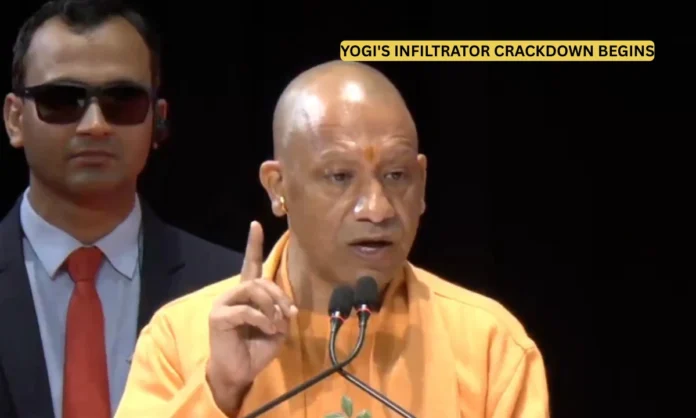
Uttar Pradesh Chief Minister Yogi Adityanath has issued a sharp public appeal asking residents and employers to verify identity before hiring domestic workers, labourers and support staff, framing the move as a shared duty to protect state security and social balance. The appeal comes amid an intensified crackdown on suspected Rohingya and Bangladeshi illegal immigrants, with the chief minister asserting that state resources and welfare benefits belong to Indian citizens and cannot be diverted to those staying unlawfully.
Adityanath’s message was amplified through a post on X in which he referred to the Supreme Court’s observation that a “red carpet” cannot be laid out for infiltrators, arguing that this clearly signals zero tolerance for illegal entry and settlement. The call to verify identity before hiring dovetails with a broader documentation and enforcement push, in which urban local bodies, police and district administrations have been tasked with tracing undocumented foreign nationals across the state.
मेरे सम्मानित प्रदेश वासियों,
— Yogi Adityanath (@myogiadityanath) December 8, 2025
उत्तर प्रदेश की सुरक्षा, सामाजिक संतुलन और सुदृढ़ कानून-व्यवस्था हमारी सर्वोच्च प्राथमिकता है। प्रदेश में अवैध रूप से रह रहे रोहिंग्या एवं बांग्लादेशी घुसपैठियों के विरुद्ध सख्त और निर्णायक कार्रवाई प्रारम्भ की गई है।
मैं प्रदेश की जागरूक जनता से… pic.twitter.com/2u0CP0AapW
The political and legal backdrop is equally significant: the Supreme Court is currently examining petitions related to Rohingyas in India, including questions around their status as refugees or illegal entrants and the extent of protections they can claim under Indian law. Against this backdrop, Uttar Pradesh’s insistence that citizens verify identity before hiring workers, tenants and ancillary staff signals a model that other states may look to as the national debate over illegal immigration, security and welfare intensifies.
Verification Drive Across Urban Local Bodies
- UP directs major urban local bodies to identify suspected illegal immigrants and map their residences and workplaces.
- Citizens and contractors are urged to verify identity before hiring staff, with a focus on municipal and informal labour sectors.
The state government has launched what officials describe as a structured, multi-tier drive across urban Uttar Pradesh, beginning with directions to key municipal bodies to prepare lists of suspected foreign nationals. Commissioners, police chiefs and civic officials have been instructed to coordinate door-to-door checks, document scrutiny and field intelligence inputs to identify clusters where Rohingya and Bangladeshi nationals may be residing without valid papers.
Within this framework, instructions to verify identity before hiring have been pushed down to contractors, resident welfare associations and individual households, especially in sectors where casual labour and outsourced staff are common, such as sanitation, security, housekeeping and construction. Authorities have asked municipal departments to review contracts and ensure that vendors supply workers only after furnishing verifiable identity and address proof, with special attention to those employed in critical civic services.
The state argues that one key aim of the directive to verify identity before hiring is to prevent illegal immigrants from quietly integrating into local labour markets and then accessing welfare schemes designed for economically weaker Indian citizens. Officials contend that without systematic checks, illegal entrants can exploit gaps in documentation, acquire forged papers and eventually tap benefits under housing, food security or employment schemes, diluting the impact on genuine beneficiaries.
Detention Centres and Legal Architecture
- UP orders detention centres in all 18 administrative divisions to hold suspected illegal immigrants during verification and deportation processes.
- These facilities sit within the legal framework of the Foreigners Act, which governs detention and removal of unauthorized foreign nationals.
To support the intensified enforcement push, Uttar Pradesh has moved to set up detention centres at the divisional level, effectively creating dedicated facilities where suspected illegal immigrants can be housed while their status is verified. A blueprint submitted to the state government outlines centres with tiered security, biometric systems and controlled access, designed to hold significant numbers of detainees until documentation checks and consular processes are completed.
The legal basis for these detention facilities lies primarily in the Foreigners Act, which empowers authorities to detain and remove foreigners who overstay visas, enter without authorization or attract adverse security reports. While the Act grants the Union government broad authority to deport such individuals, it leaves the design and management of detention centres largely to executive rules and state-level arrangements, creating space for states like Uttar Pradesh to evolve their own operational models.
Within this architecture, the repeated emphasis that employers must verify identity before hiring serves a preventive function: by keeping undocumented individuals out of formal and semi-formal jobs, the state aims to reduce the number of people who eventually land in detention and deportation pipelines. Officials note that once a person without valid documents is detained, the process of confirming nationality, coordinating with foreign governments and arranging deportation can be lengthy and resource-intensive, making early verification at the point of hiring more efficient from both security and administrative standpoints.
Supreme Court Debate on Rohingyas and Illegal Entrants
- Supreme Court questions whether Rohingyas in India are to be treated as refugees or illegal entrants, and what rights each status entails.
- The Court’s “red carpet welcome” remark has been politically highlighted to justify calls to verify identity before hiring and tighten enforcement.
At the national level, the Supreme Court has become the central arena for debates over the status of Rohingyas in India, hearing petitions that challenge detentions and deportations, as well as pleas seeking protection and recognition. During a recent hearing, a bench led by the Chief Justice asked whether people who enter the country without authorization could be described as refugees or should instead be treated as illegal entrants under existing law, a distinction with far-reaching implications for their rights and protections.
The Court also raised a pointed question: whether “intruders” should be given a “red carpet welcome” when large sections of India’s own population continue to struggle with poverty and limited access to basic services. This remark has been prominently cited by political leaders in Uttar Pradesh to support the argument that citizens must verify identity before hiring workers or renting out property, and that public resources must be prioritized for lawful residents and citizens.
India does not have a dedicated refugee law and is not a signatory to the 1951 Refugee Convention or its 1967 Protocol, which means that Rohingyas are treated under general immigration and security laws rather than a specialized refugee framework. Parliamentary responses from the Ministry of Home Affairs have stated that over 40,000 Rohingyas are estimated to be present in India, many of them without valid documents, and that their presence has security implications in certain sensitive regions. These national security concerns feed directly into state-level measures like Uttar Pradesh’s campaign to verify identity before hiring and its push for divisional detention facilities.
Rohingya Numbers, Welfare Concerns and State Strategy
- Official estimates indicate more than 40,000 Rohingyas in India, with roughly half registered with UNHCR and the rest undocumented.
- UP links the call to verify identity before hiring with efforts to protect welfare schemes and employment opportunities for Indian citizens.
According to data placed before Parliament by the Ministry of Home Affairs, India hosts an estimated Rohingya population exceeding 40,000, distributed across states including Jammu and Kashmir, Telangana, Delhi and Uttar Pradesh. International and rights organizations report that around half of this population is registered with the UN High Commissioner for Refugees, while the rest lack formal status or documentation, which increases their vulnerability to detention and deportation. UNHCR figures suggest that several hundred Rohingyas remain in immigration detention at any given time as authorities pursue removal proceedings or Verify Identity Before Hiring and nationality.
Uttar Pradesh’s leadership has explicitly tied the instruction to verify identity before hiring to the question of welfare targeting, arguing that benefits designed for deprived Indian citizens in schemes such as subsidized food, housing and livelihood support must not be diverted to illegal immigrants. The state’s stance is that every undocumented worker who secures a job or housing slot without proper verification potentially displaces a citizen or lawful resident who could have used that opportunity, particularly in low-income urban settlements where competition for scarce resources is intense.
At the same time, critics and rights groups caution that an aggressive emphasis on identity checks and detention risks pushing vulnerable communities further into precarity, especially in the absence of a clear refugee framework or independent oversight of detention facilities. Supporters of the policy counter that, in a federal system where immigration is controlled by the Union government, states are still obligated to maintain internal security and ensure that public funds reach those legally entitled to them, making it reasonable to ask citizens, employers and landlords to verify identity before hiring or renting to anyone whose status is unclear.
Key Official Metrics Related to the Crackdown
| Indicator | Data | Source |
|---|---|---|
| Estimated Rohingya population in India | 40,000+ individuals | Ministry of Home Affairs reply to Parliament |
| Approximate Rohingyas registered with UNHCR | Around 20,000 | UNHCR and rights reports |
| Rohingyas in immigration detention (recent estimate) | 600+ individuals | Refugee and detention monitoring reports |
| UP administrative structure | 18 divisions, 75 districts | UP government and administrative records |
| Urban local bodies directed for identification exercise | Major municipal corporations and other bodies | UP government orders reported in official communications |
Closing Assessment on Verify Identity Before Hiring
Uttar Pradesh’s campaign built around the call to verify identity before hiring marks an assertive state-level response to longstanding concerns over illegal immigration, welfare leakage and internal security. By combining citizen-facing advisories, a structured mapping exercise through urban local bodies, and plans for divisional detention centres, the state is attempting to create a full-spectrum system that discourages undocumented residency, closes off informal employment avenues and channels suspected illegal immigrants into formal verification and deportation pipelines.
The evolving Supreme Court proceedings on Rohingyas, together with national data placed by the Ministry of Home Affairs and international agencies, ensure that this issue will remain legally and politically contested. For now, Uttar Pradesh is positioning its directive to verify identity before hiring as a model of “collective responsibility,” arguing that security is the foundation of prosperity and that citizens, employers and state agencies must jointly safeguard the integrity of welfare systems and demographic balance. How this model is implemented in practice, and how the courts ultimately define the rights and limits applicable to Rohingyas and other undocumented migrants, will shape not just UP’s approach, but potentially the wider national framework on irregular migration.