
Key Highlights
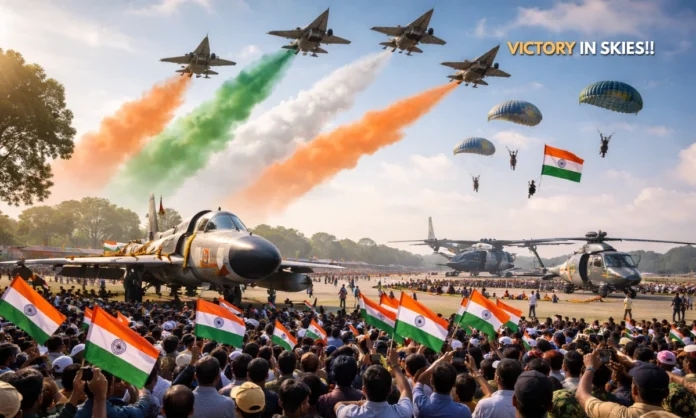
- Indian Air Force hosts Vijay Diwas 1971 victory celebrations at Air Force Station Mohanbari, Assam, featuring aerial displays with Su-30 MKI, Dornier, An-32, Chinook, Mi-17, ALH, and Cheetah aircraft.
- Chief of the Air Staff Air Chief Marshal AP Singh attends alongside veterans, dignitaries, and youth, with seminar and exhibition on 1971 air operations.
- Event recreates iconic 1971 missions like Tangail Airdrop and Meghna River Crossing, honoring Eastern Air Command’s role in Bangladesh liberation.
Vijay Diwas 1971 Victory: Opening Overview
Vijay Diwas 1971 victory celebrations unfold today at Air Force Station Mohanbari in Dibrugarh, Assam, drawing thousands to witness the Indian Air Force’s precision aerial display. This event marks the 54th anniversary of India’s decisive triumph in the 1971 war, when Eastern Air Command operations from bases like Mohanbari secured air superiority and supported ground forces leading to Pakistan’s surrender on December 16. The Vijay Diwas 1971 victory commemoration highlights the bravery of air warriors who flew over 4,000 sorties in the eastern sector, crippling enemy infrastructure and enabling the birth of Bangladesh.
Organized by Eastern Air Command, the program from 9 am to 2:30 pm includes a spectacular flying show recreating historic missions such as the Tangail Airdrop and strikes on Dhaka. Air Chief Marshal AP Singh presides over proceedings attended by senior dignitaries, air veterans, schoolchildren, and a 20-member Bangladesh delegation with eight Muktijodhas. An exhibition titled “Triumph from the Sky-71” displays rare war photographs and a Swarnim Vijay Mashal replica, while a seminar features veterans’ anecdotes. This Vijay Diwas 1971 victory observance not only revives memories of rapid dominance but also signals India’s enduring aerial prowess amid regional challenges.
The context extends beyond nostalgia: 1971 air campaigns from Mohanbari demonstrated logistical mastery in adverse terrain, a legacy shaping modern IAF doctrines. With Defence Minister Rajnath Singh’s visit cancelled, the focus remains on operational readiness and Indo-Bangladesh bonds forged in victory.
IAF celebrated the 1971 war victory at AF Station Mohanbari in Assam on 10 Dec 25, celebrating the valour of the Indian Armed Forces with a spectacular flying display, re-enacting key missions from the war.@DefenceMinIndia@SpokespersonMoD@HQ_IDS_India@adgpi@indiannavy… pic.twitter.com/UMoft0PuXQ
— Indian Air Force (@IAF_MCC) December 11, 2025
Eastern Air Command’s Pivotal 1971 Role
- Mohanbari base enabled key strikes and transport missions critical to air superiority.
- Over 4,000 eastern sector sorties supported army advances toward Dhaka.
Eastern Air Command orchestrated the Vijay Diwas 1971 victory through relentless operations from forward bases like Mohanbari, neutralizing Pakistan Air Force assets early in the conflict. Starting December 3, 1971, IAF pilots flew hazardous missions over East Pakistan, destroying 45 enemy aircraft on ground while losing only four in air combat. Mohanbari’s runways launched Hunter and MiG-21 sorties that severed supply lines, paving the way for the Indian Army’s thrust across the Meghna River.
This strategic hub in Assam’s lush terrain hosted maintenance and refueling for transport fleets, including An-32 precursors that airlifted paratroopers for the Tangail drop on December 11. The drop of 800 para-commandos behind enemy lines isolated Dhaka, hastening surrender. Official records note Eastern Air Command flew 80 percent of transport sorties, delivering 6,000 tons of supplies despite monsoons and AA fire. Vijay Diwas 1971 victory events at Mohanbari recreate these feats, underscoring how air-ground synergy shortened the war to 13 days.
Veterans’ seminars today share tales of precision bombing on Kurigram and Tezgaon, where IAF achieved a 10:1 kill ratio. Such dominance prevented Pakistani reinforcements, altering South Asia’s map forever.
| 1971 Eastern Sector Air Operations Key Stats | Value | Source Context |
|---|---|---|
| Total Sorties Flown | 4,000+ | IAF Official Records |
| Enemy Aircraft Destroyed (Ground/Air) | 45 | PIB Delhi Release |
| Transport Tons Delivered | 6,000 | War History Summaries |
| Para Drops Executed | Tangail (800 troops) | Eastern Command Logs |
Aerial Display: Modern Assets Honor Legacy
- Features Su-30 MKI fighters, Dornier Do-228, An-32, Chinook, Mi-17, ALH, Cheetah.
- Recreates 1971 missions over Dibrugarh’s skyline.
The Vijay Diwas 1971 victory flying display at Mohanbari blends historic reenactments with current IAF inventory, showcasing evolution from 1971 Hunters to fifth-gen capable Su-30s. Su-30 MKI leads formations mimicking air superiority patrols, their thrust-vectoring engines tracing victory rolls over the Brahmaputra valley. Dornier Do-228 surveillance planes simulate ISR roles vital for targeting in 1971, while An-32s evoke the para drops that outflanked defenses.
Chinook heavy-lift helicopters demonstrate tandem-rotor power used in modern ops, echoing 1971 Mi-4 lifts, joined by versatile Mi-17s, ALH Dhruv, and agile Cheetahs for low-level maneuvers. The sequence recreates the Meghna Crossing and Government House strike, with pilots executing splits and loops at 500 feet. This proficiency display, visible to public crowds, affirms IAF’s 1.2 million flying hours annually and 70 percent indigenous maintenance.
Such spectacles reinforce deterrence: Su-30’s BrahMos integration extends strike range to 300km, far beyond 1971 limits.
| Aircraft in Mohanbari Display | Role in 1971 Context | Modern Capability |
|---|---|---|
| Su-30 MKI | Air Superiority | Supercruise, AESA Radar |
| Dornier Do-228 | Surveillance | Maritime Patrol Reach |
| An-32 | Transport/Para Drop | 6-Ton Payload Endurance |
| Chinook | Heavy Lift | 10-Ton Sling Load |
| Mi-17/ALH/Cheetah | Multi-Role | High-Altitude Ops |
Public Engagement and Bangladesh Ties
- Seminar, exhibition engage youth and veterans; 20-member Dhaka delegation attends.
- Muktijodhas honor shared liberation struggle.
Vijay Diwas 1971 victory extends beyond skies to ground events fostering national pride and diplomacy. The “Triumph from the Sky-71” exhibition at Mohanbari unveils archived photos of Kurigram raids and veteran flight logs, drawing schoolchildren to touch history. A seminar on air operations features firsthand accounts from pilots who flew 100+ missions, inspiring Assam’s youth amid 90,000 IAF personnel strength.
A 20-member Bangladesh delegation, including eight Muktijodhas and army officers, joins to commemorate mutual victory. These freedom fighters, trained in India during 1971, symbolize bonds: Bangladesh’s armed forces now conduct joint exercises like Bongosagar. The event counters regional tensions, with Dhaka acknowledging India’s role in liberating 93,000 POWs.
Youth interactions highlight IAF recruitment drives, targeting Northeast talent for technical roles.
Operational Legacy in Contemporary Context
- 1971 lessons shape IAF’s joint doctrines and eastern frontier readiness.
- Mohanbari evolves as tri-service hub.
The Vijay Diwas 1971 victory at Mohanbari spotlights enduring lessons: rapid air mobility and ISR dominance remain IAF cornerstones, integrated into theater commands. Eastern Air Command, headquartered in Shillong, oversees 40 bases with 300+ aircraft, investing INR 50,000 crore in infrastructure per defence budgets. Mohanbari now hosts drone ops and missile tests, extending 1971’s forward posture.
This legacy informs responses to border challenges, with Su-30 patrols mirroring 1971 vigilance. Cross-border participation strengthens BIMSTEC ties, where IAF shares training with Bangladesh Air Force on Mi-17s.
Closing Assessment
Vijay Diwas 1971 victory at Mohanbari reaffirms the Indian Air Force’s unyielding spirit, from 1971’s daring sorties to today’s high-tech displays. Eastern Air Command’s homage through aerial prowess, veteran tributes, and Bangladesh solidarity weaves history into resolve. As threats evolve, such commemorations steel national defenses, reminding all that air power decisively shaped Bangladesh’s freedom and India’s stature.
The event’s reach, blending spectacle with education, ensures the Vijay Diwas 1971 victory narrative inspires future warriors, fostering unity in diversity.